
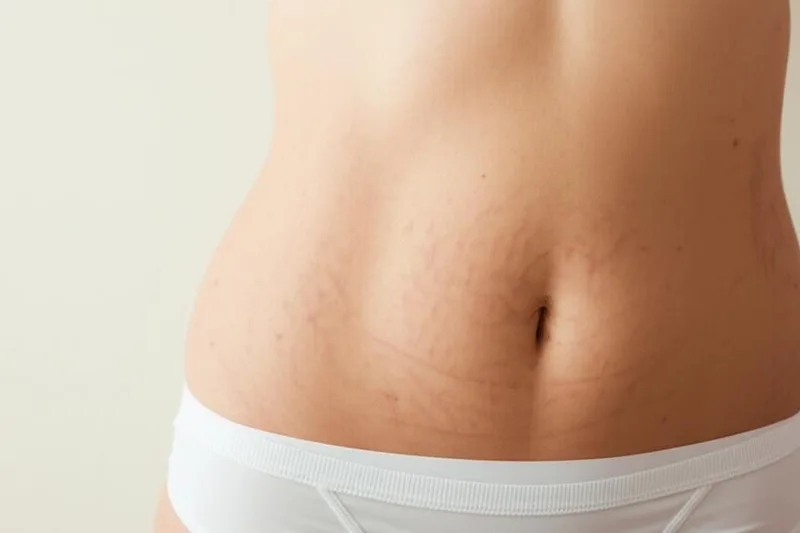
Have you ever noticed that your skin has lines on it? Maybe on your stomach, thighs, or breasts. Stretch marks are a problem that many people have. Don't worry, they're normal. Let's find out more about them today.
What are Stretch Marks?
Simply put, stretch marks are small, slightly sunken, scar-like lines that form when our skin is stretched or suddenly contracted. In medical terms, these are also called `Striae`. When they first appear, they can be red, pink, purple, or even black. Over time, they turn white or silver.
These stretch marks are commonly seen on:
- In your stomach area
- Thighs
- In the hip area
- In the breasts
- On the upper part of the arms
- Lower back
- In the buttocks area
Who is more likely to develop stretch marks?
Actually, anyone can get stretch marks. But some people are more likely to get them. Let's see who they are:
- If you are pregnant: Stretch marks can develop, especially during pregnancy, as the skin stretches as the belly grows. Some studies suggest that black, Hispanic, East Asian, or South Asian women are at higher risk.
- If you suddenly gain or lose weight: If there is a sudden big change in body weight, that is, if you gain weight quickly or lose weight quickly, the skin may not be able to adjust to the change and stretch marks may appear.
- If you exercise and get bigger breasts quickly: Some people go to the gym, lift weights, and build their bodies quickly, and their breasts grow quickly. Even then, the skin can stretch and these lines can form.
- Adolescence: We all know that during adolescence, we experience rapid growth spurts and changes in our bodies. Stretch marks can also occur with this rapid growth.
- Genetics: If your mother, father, or a close family member has stretch marks, you are more likely to get them too. This means there is a genetic influence .
- Certain medical conditions: People with certain medical conditions, such as Cushing's syndrome or Marfan syndrome, may also develop stretch marks.
- People who use certain medications for a long time: For example, this condition can also occur in people who take corticosteroid medications like Prednisone for a long time.
What effects can stretch marks have on the body?
The best news is that stretch marks can be treated with yourThere is no harm to physical health. These do not cause pain.
However, sometimes these can have a small psychological impact . You may feel anxious about your appearance and worried about how others see you. For some people, this can lead to stress , anxiety , or even depression . So if you are feeling this way, it is best to talk to someone you trust or a doctor instead of keeping it to yourself.
What are the symptoms of stretch marks?
The main characteristics of stretch marks are:
- Lines that appear to be sunken under the skin.
- These stripes change color. They may initially be red, pink, blue, black, purple, or brown.
- Over time, the skin gradually takes on a shiny appearance, appearing streaked with silver or white.
- Sometimes there may be itching in that area.
- You may feel a skin irritation from time to time.
Why do stretch marks form?
The main reason for this is that our skin is suddenly stretched or compressed. When this happens, the two most important fibers in our skin, elastin and collagen, can break.
Think of it this way: Elastin is like a rubber band. It gives our skin its elasticity. Collagen is a protein that gives our skin its strength, structure, and firmness. So when the skin is stretched, these Elastin fibers break. Then, when the skin tries to recover, these stretch marks form at those broken points.
Most importantly: Stretch marks are not contagious. You won't get them from someone just because they touched you.
How to recognize stretch marks?
Stretch marks are very easy to recognize. You can check for them yourself. You don't necessarily need to go to a doctor for this.
However, if you go to see a doctor, he or she will examine you physically and ask about your past medical conditions and medications. Sometimes, if they suspect that your stretch marks are due to another condition, such as Cushing's syndrome, they may do further testing to find out.
What are the treatments for stretch marks?
This is the problem that many people have. To be honest, treating stretch marks is a bit challenging. Treatments can reduce their appearance, but it is difficult to completely eliminate them 100%.
For best results, it's best to start treating stretch marks when they're new, meaning they're still red or purple. Older, white, and deep stretch marks can be even more difficult to treat.
Here are some of the current treatments:
1. Laser treatment (Laser skin resurfacing)
This is like surgery. The doctor directs a short, focused, pulsed laser beam to the area where your stretch marks are. The laser beam gently removes the top layers of skin. This allows new collagen fibers to grow, smoothing the skin.
- Results: You may notice a difference immediately after treatment. The skin condition may improve further over the course of a year. This improvement may last for several years.
- Side effects: Small white bumps (milia) may appear on the skin, swelling, and areas of the skin may become darker (hyperpigmentation) or lighter (hypopigmentation).
2. Dermabrasion
This is also like surgery. The doctor uses a special instrument to scrape away the top layer of skin that has stretch marks. This process improves the appearance of the skin's surface and creates new, smoother skin.
- Healing time: It can take at least two weeks for the skin to heal.
- Results: It may take several weeks or months to see full results.
- Side effects: Milia, hyperpigmentation, hypopigmentation, swelling, and possibly enlarged pores.
3. Microneedling
In this treatment, the doctor uses a very fine needle to make tiny punctures in your skin. These tiny punctures stimulate the production of new collagen and elastin fibers in the skin, which makes the skin stronger.
- Number of Treatments: Typically, between 3 and 6 treatments may be required to see results.
- Results: Some people may see full results within 4 to 6 months, but it may take longer.
- Side effects: Skin irritation, discoloration, swelling, and peeling may occur.
4. Creams containing retinol
`Retinol` is a derivative of `Vitamin A.` Retinol is often found in creams (OTC - that is, you can buy it from a pharmacy without a prescription) that control aging, reduce wrinkles, improve skin texture, and help retain moisture.
- Results:To see significant results from these creams, you need to use them continuously for at least 6 months.
- Side effects: Dry skin, skin irritation, discoloration, and light sensitivity may occur. Retinoids are not suitable for pregnant or breastfeeding women.
Are there any home remedies for stretch marks?
Yes, some research has found that some home remedies can help reduce the appearance of stretch marks or prevent them from forming. Some of them include:
- Aloe vera gel: Aloe vera is a very popular product in our country.
- Hyaluronic acid: This helps retain moisture in the skin.
- Centella asiatica herb extract: Centella asiatica is also a herb that is beneficial for the skin.
To get the best results from these, apply a small amount of these products to the areas where you have stretch marks every day and massage them in. It may take a few weeks to see results.
Important: If you are pregnant, it is always best to consult your doctor before using any product like this.
Does cocoa butter remove stretch marks?
Many people believe that oils like cocoa butter, coconut oil, olive oil, and almond oil are good for stretch marks and can help get rid of them. However, scientific studies have shown that these oils are not very effective in treating or preventing stretch marks.
Do stretch marks go away on their own?
Yes, stretch marks can fade on their own over time, or their visibility can become significantly reduced. Therefore, if you are not too concerned about them, there is no need to necessarily treat them.
Stretch marks typically take between 6 and 12 months to fade. With treatment, they may fade a little faster.
How to reduce the risk of stretch marks?
To be honest, there is no way to guarantee that stretch marks will be 100% prevented. Because we cannot control things like genetics. However, following some things can help reduce this risk to a certain extent.
1. Hydration
- Drink plenty of water: Water is very important for our skin. When we drink plenty of water, our skin stays smooth and hydrated. This reduces the chances of stretch marks.
- Be careful with caffeine:If you drink a lot of caffeinated beverages like coffee, tea, and soda, make it a habit to drink an equal amount or even more water at the same time. Caffeine can dehydrate the body, which is not good for the skin.
2. Diet
It is also very important to eat foods that are good for skin health.
- Foods rich in zinc: Things like nuts and fish.
- Foods rich in vitamins A, C, and D: Carrots, citrus fruits (like oranges and tangerines), milk.
- Protein-rich foods: lentils, beans, broccoli, lean beef, chicken.
3. Exercise
Regular exercise improves blood circulation in the body. It also helps the body produce collagen. This good blood circulation and collagen help the skin stay strong and elastic.
What to expect if you have stretch marks?
Stretch marks can be a bit tricky to treat. However, as mentioned earlier, they do not pose any harm to your physical health. Even if left untreated, their appearance will diminish significantly over time.
When should you see a doctor?
Stretch marks usually do not require a visit to a doctor. However,
- If these stretch marks have spread over a very large area of your skin,
- Or if you are interested in knowing about the treatments available for these,
- Sometimes, if you have a bad skin reaction to a cream or medication you're using,
It is best to see a doctor and get advice.
What questions can you ask your doctor?
If you go to see a doctor, you might ask questions like these:
- Why do I have these stretch marks?
- Could there be another reason for this?
- What treatment options do I have?
- What are the full side effects of each treatment?
- Do I need to make any changes to my diet?
- If treated, how long will it take to see results?
Finally, you have to say...
Stretch marks are actually a very common condition. Anyone can get them. You may not like the way they look on your body, and that's normal. But instead of worrying too much about it, you can talk to a doctor and decide what the best way to reduce the appearance of your stretch marks is. Together, you and your doctor can choose the treatment that's right for you. Remember, you're not alone!
` Stretch marks, skin lines, skin tightening, pregnancy, weight gain, collagen, elastin




💬 Comments (0)
No comments have been posted yet. Add your comment here for the first time.
Add your comment