

Have you ever heard the word 'extravasation'? Maybe you've heard it from your doctor, or maybe you've heard it while researching cancer treatments . Although it's actually a bit of a medical term, it has two meanings. One is that it's a natural process that happens inside our bodies. The other is that it's a minor complication that can sometimes occur when we give medicine, especially during cancer treatment (chemotherapy). We'll talk about both of these today, very simply, so that you can understand.
What is the process called 'extravasation'?
Simply put, 'extravasation' is the process of cells in our body moving out of the blood vessels (where blood flows) and into the surrounding tissues. It is made up of two Latin words. 'extra' means "outside" and 'vas' means "vessel." So it means something like "coming out of a vessel."
Think of it this way. When you get a small wound, or when a germ enters your body, the first thing that comes to the rescue are your white blood cells. They're like the police in your body. These white blood cells travel through your blood vessels, jump out of those vessels, and go to the wound or the germ. We call this process of jumping out 'extravasation.' This is an important part of your body's defense system .
Also, sadly, this same process of 'extravasation' is used by cancer cells to spread throughout the body, that is, to move from one place to another (which we also call `metastasis`).
How do cancer cells do this?
Cancer cells first break away from the original tumor they formed from. These cells then travel through the smallest blood vessels in our body, called capillaries , into the bloodstream. As they travel, these cancer cells attach to a thin layer of tissue called the endothelium , which lines the blood vessels.
At first, these cancer cells travel along the endothelium. After a while, they become firmly attached to the endothelium. (This is helped by some of our white blood cells, a type of cell called platelets . Medical researchers are studying this process a lot, because they think that if we can stop it, we can slow the spread of cancer.) Eventually, these cancer cells break through the walls of the blood vessels and travel out into the tissues. After that, the cancer cells can either become dormant, die, or start forming new tumors in a new location.
You may be thinking, "Would I feel it if I had an 'extravasation' like this in my body?" When white blood cells are fighting an infection, you might feel something like swelling and redness. But with 'extravasation', which occurs when cancer spreads , you may not see such major symptoms at first . Although medical tests do not show this 'extravasation' directly, things like the number of white blood cells in the blood and cancer markers can be checked with blood tests.
The medical condition called 'extravasation'
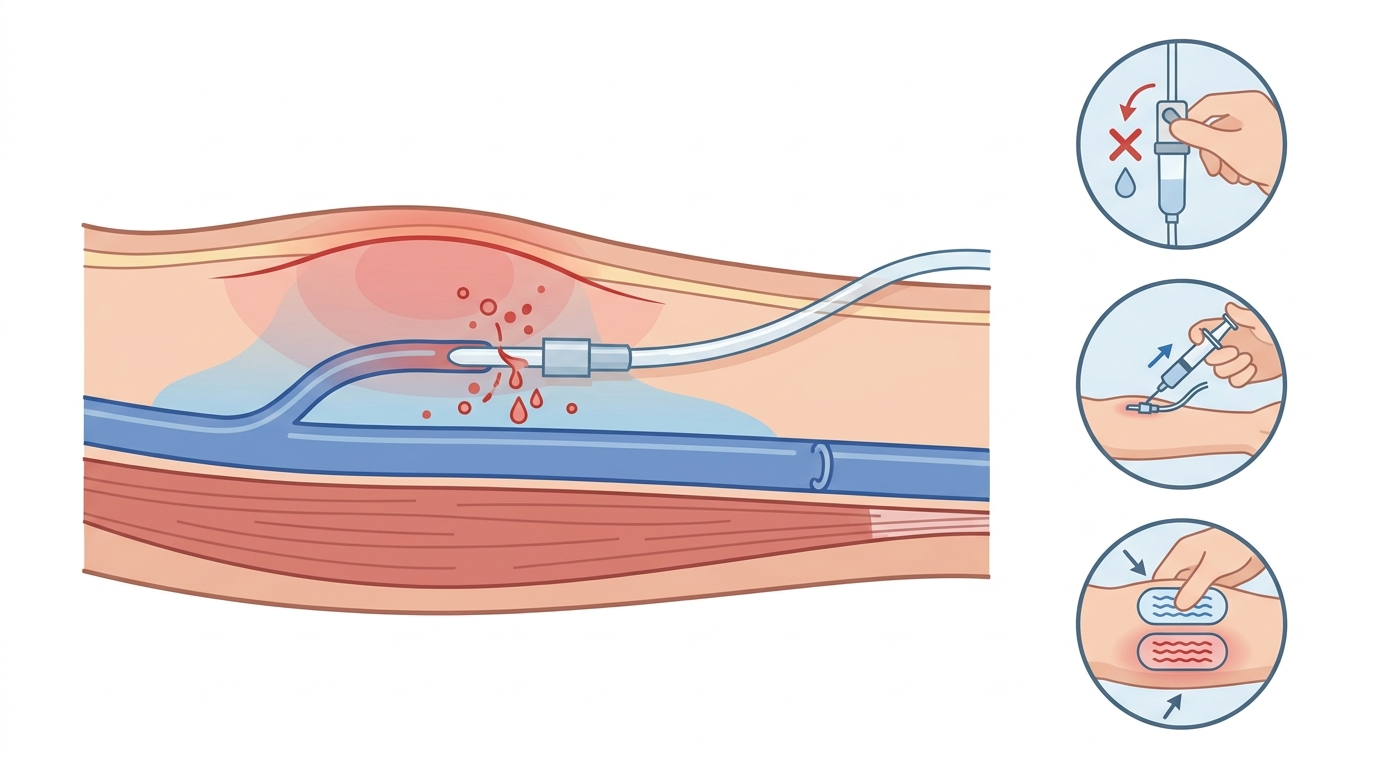
Now let's talk about the other meaning of what doctors call 'extravasation'. This is especially true when cancer patients are given chemotherapy drugs intravenously (IV) , which is a type of medication that is given through a tube (cannula) into a vein.
You may have noticed that some medications are given directly into a vein. In cancer treatments, this medication is given directly into the bloodstream through an IV tube. This IV tube is usually connected to a vein in your arm or wrist. The medication is then pumped through a tube from a plastic bag into your bloodstream. Sometimes a cannula is used, which slowly injects the medication into your body over a period of time.
Now, there are some anticancer drugs that are called ``vesicants.'' The word means ``that causes vesicants.'' If these ``vesicants'' drugs leak out of the IV line or the ``cannula,'' they can damage the surrounding healthy tissue. That's what we medically call ``extravasation,'' when the drug leaks out of the vein and damages the tissue .
If this happens, the person receiving the medication may feel burning and pain at the site of the IV. If the medication leaks through a cannula, the area may feel hard, swollen, and red.
But here's something very important to remember . If you're being given a 'vesicant' type of cancer drug, your doctors and nurses are well aware of it. Hospitals have clear policies and guidelines to prevent this 'extravasation'. They monitor you very carefully when they give you the drug, and if they see any problems, they fix them quickly.
Is this 'extravasation' common in cancer treatments?
No, this is not that common., but it's not impossible. One study found that about 6% of cancer treatments have a minor 'extravasation'. Medical staff who give cancer drugs through an IV are specially trained to prevent this and to treat it quickly if it occurs.
Is this a serious problem?
Yes, sometimes this can be serious . Think about it, the drugs that are strong enough to kill cancer cells can also damage healthy tissue, right? So if the medicine leaks out of the IV, it can cause pain and damage tissue. Symptoms may appear right away, or they may appear a few days later.
What are the symptoms of an 'extravasation'?
- Sudden pain where the IV or cannula is inserted.
- A burning or stinging sensation .
- The skin is red in that area.
- Pockmarks or blisters .
- Injury .
- Whitening of the skin (this may be a sign of tissue damage).
Are there any factors that increase the risk of extravasation?
Yes, some factors can increase this risk a little. But medical staff are aware of these risk factors, so they take steps to reduce this risk.
- For those with small or weak veins .
- For those whose blood vessels burst more quickly than normal .
- For people whose blood vessels have thickened or hardened due to cancer treatment.
- For those who have blood vessels moving around when trying to insert an IV.
How is this 'extravasation' treated?
The medical staff who administer cancer drugs make it their top priority to prevent this 'extravasation'. However, if, unfortunately, it does occur, they are also trained to quickly resolve any problems that arise. Here are some steps they typically take:
- The medication through the IV will be stopped immediately.
- As much as possible, remove any spilled medication from the area.
- The IV is removed and discarded.
- The affected arm is slightly elevated (elevating).
- Apply a cream to reduce symptoms.
- Cold compresses are applied. The cold compress reduces pain. It also contracts the blood vessels, which reduces the spread of any remaining medication.
- In some cases , warm compresses are applied.Warm compresses increase blood flow, which can help to remove or reduce the amount of medication around the IV site. (Your doctor will decide whether a warm or cold compress is appropriate.)
What happens after an 'extravasation'?
It may vary depending on your condition. Your medical team will treat the problems caused by the extravasation. After that, they will monitor your condition to see if any new problems develop or if the condition gets worse.
Sometimes, you can continue treatment by using a different IV site. Other times, your doctor may recommend that you postpone treatment for a few days until you recover. However, they will give you detailed instructions on how to care for yourself at home. For example:
- After an extravasation, you may be asked to apply cold or hot compresses to your hand for at least a day (about 15-20 minutes, four to six times a day). Your doctor will tell you exactly how to do this.
- You can tell them to keep the affected hand elevated .
Will I be able to continue treatment?
It also depends on your condition. Studies show that most people can continue treatment . Sometimes, the IV can be replaced and treatment can be started soon after the extravasation. Other times, treatment can be delayed until the symptoms of the extravasation have completely resolved.
When should I notify the doctor?
If symptoms of extravasation persist longer than you expected, be sure to notify your doctor .
In summary, here are the things we need to remember (Take-Home Message):
Now you know that the word 'extravasation' has two meanings. One is the natural process used by cancer cells to spread throughout the body. The other is a medical condition that can occur when chemotherapy drugs leak out of the IV.
Importantly, this complication called 'extravasation' is not uncommon in cancer treatment. Medical staff are specially trained to prevent it and treat it quickly if it occurs.
If you are going to have chemotherapy for cancer, talk to your doctor or nurse about what to expect during treatment and what the common side effects are. That way, if you notice anything different, you can figure out if it's normal or something you need to report right away. Don't worry, your medical team is here to help.
` Extravasation, cancer treatment, chemotherapy, IV leak, drug leakage from the vein, cancer spread, cell migration
ukat juk’ampinaka Doctoran qillqatapa
ukat juk’ampinaka Extravasación ukax ch’aman qullanak jan ukax químicos (juk’ampirus anticáncer quimioterapia qullanaka) infusión intravenosa ukamp muyuntat tejidos ukar fugas ukanakaw fugas ukanakax utji. Ukax wali usuchjasiña, inflamación, blistering ukat necrosis tisular ukanakaw utjaspa. Uka inyección ukan usuchjasiña, inflamación jan ukax punkiña uñstaspa ukhaxa, jank’akiw qulliriru jan ukax enfermera ukar yatiyañapa.
❓ ukat juk’ampinaka Mä qawqha juk’amp jiskt’äwinakampiw jikisipxasma (FAQ) .
ukat juk’ampinaka ¿Kunas Extravasación ukat Infiltración ukanakax mayj mayjaxa?▼
ukat juk’ampinaka Infiltración ukaxa fugas de líquidos inofensivos (p.e., salina) ukanakawa vena uksatxa mistu, ukatxa extravasación ukaxa fugas de drogas agudas ukanakawa, ukaxa tejidos ukanakaruxa sinti jan walt’ayaspawa.
ukat juk’ampinaka ¿Kunas extravasación ukar puriyi?▼
ukat juk’ampinaka Ukax aguja IV jan ukax catéter ukax venan jan sum uchatätapata, jisk’a jan ukax jan ch’aman venanaka ukat usutarux sinti kuynt’atapatw utjaspa.
¿Kuna lurañanakas ukham jan waltʼayasiñatak lurasispa?▼
ukat juk’ampinaka Dispositivos de acceso venoso central ukanak apnaqañax juk’amp seguro ukhamawa, kunjamatix líneas Port-a-cath jan ukax PICC ukanak apnaqañax agujas regulares IV ukanak apnaqañat sipansa, jaya pacha ch’aman qullanak churañataki.


💬 Comments (0)
No comments have been posted yet. Add your comment here for the first time.
Add your comment