
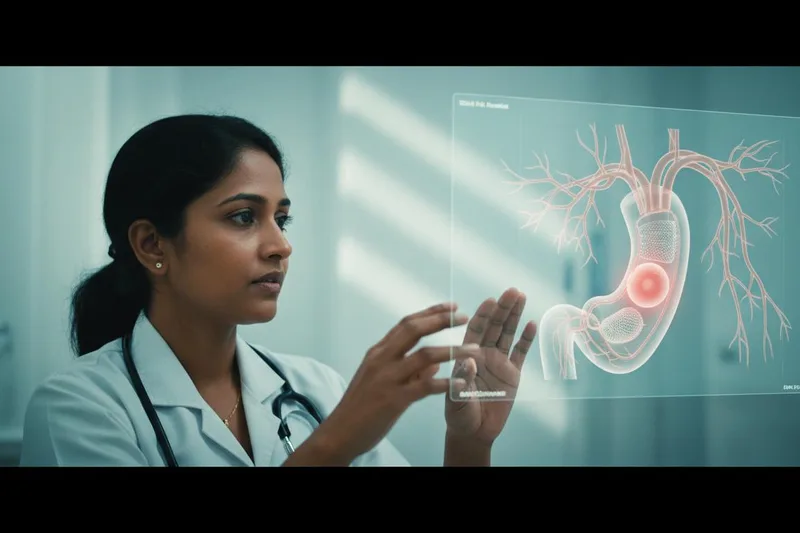
The largest blood vessel in our body is the aorta, which we call ``Aorta'' in English. Think of it like the main water pipe in our body. It is this that distributes blood from the heart to the entire body. Sometimes, the wall of this blood vessel becomes weak and starts to bulge out like a balloon. This is what we call ``Aneurysm'' in medicine. The most dangerous thing is that this bulge increases and there is a chance that it will suddenly burst. So today we are going to talk about a modern treatment method that can avoid this dangerous situation without making a big incision in the body and with very little effort.
Simply put, what is EVAR?
The full meaning of EVAR is `(Endovascular Aneurysm Repair)`. In Sinhala, it is a repair done inside a blood vessel. This is not a major surgery . That means instead of doing a major operation by cutting open the abdomen, this treatment is done using only a very small hole.
Imagine that an old water pipe has become swollen and is about to burst. Instead of cutting the pipe and removing it, what happens here is similar to repairing it by inserting a thinner, stronger pipe inside it. Doctors insert a specially designed tube (Stent Graft) into the swollen blood vessel. This is like a special lining made of cloth and metal mesh. When this is inserted, the blood flows through the new tube. Then, no pressure is applied to the weakened, swollen wall. Therefore, the risk of it bursting is completely eliminated.
Why do we need EVAR treatment?
The main and only purpose of this is to prevent the Abdominal Aortic Aneurysm from rupturing . Because if that happens, it is a very life-threatening and fatal condition.
When the wall of a blood vessel becomes weak, the pressure of the blood that comes in with each heartbeat causes that weak spot to swell. It's like a bubble in a tire. It can't expand indefinitely. At some point, it bursts. If that happens, a large amount of blood can flow into the body, and death can occur within minutes.
So what EVAR treatment does is insert that ``(Stent Graft)``, changes the blood flow, and relieves the pressure on the swollen wall. That almost completely stops the risk of rupture.
Simply put, this is like defusing a bomb. You eliminate the danger before it explodes.
Who is this EVAR treatment suitable for?
This treatment is not done immediately for everyone with an abdominal aneurysm. Your doctor will look at several factors to decide if this treatment is right for you.
- If your aneurysm is large enough , orIf scans show that it is growing rapidly within a short period of time.
- If you cannot bear the risk of major surgery such as gastric bypass surgery due to other medical conditions (such as heart disease or lung disease).
- If the blood vessels above and below the bulge are healthy and strong (because there needs to be a good place to insert the new tube).
It is after considering factors like these that the doctor decides that EVAR treatment is best for you.
What is the special method called FEVAR?
The great iliac artery in our stomach is like a tree trunk. It branches off into small blood vessels that carry blood to organs in our stomach (like the kidneys and intestines). Sometimes an aneurysm forms very close to where those branches branch. In that case, the straight tube that is used in a regular EVAR cannot be inserted, because doing so would cut off the blood flow to those branches.
It is for such complex cases that a special method called FEVAR (Fenestrated Endovascular Aneurysm Repair) is used. In the `(Stent Graft)` used here, small window-like holes are made to fit the branches. After the main tube is inserted, a separate small `(Stent)` is inserted through those windows into the branch-like blood vessels to ensure blood flow. Although this is a bit complicated, it is a great advantage to be able to heal `(Aneurysm)` in such difficult places without having to undergo major surgery.
What is the difference between EVAR and TEVAR?
These are both similar treatments. The difference is in the location of the treatment.
- EVAR: It is done for abdominal (abdominal) aneurysms.
- TEVAR (Thoracic Endovascular Aneurysm Repair): is performed for aneurysms in the chest (thorax) .
What are the advantages of EVAR treatment?
Compared to major surgery, EVAR treatment has several clear advantages. It is a much less invasive procedure.
| Benefit | Simply put... |
|---|---|
| Less time in the hospital | While a major operation takes about a week, this one will take two or three days. |
| The amount of blood loss is low. | Since there is no major cut, there is very little bleeding. |
| Less pain during healing | Since there is no major injury, the pain is very minimal. Painkillers are only needed for a short time. |
| You can return to normal life quickly. | You can go back to work within a month, without having to wait months. |
| The risks during surgery are low. | The risk of heart attack or death during surgery is lower than during major surgery. |
| The surgery time is less. | This treatment can be completed in less time than open surgery. |
Are there any risks with EVAR treatment?
Although EVAR is a very successful and safe treatment, as with any medical procedure, there are some minor risks that can occur. However, these are very rare.
| Risk | Description |
|---|---|
| Blood clotting | There is a risk of blood clots forming in the blood vessels, especially in the deep veins of the legs (Deep Vein Thrombosis - DVT). |
| Endoleak | A very small amount of blood leaks between the newly inserted stent graft and the wall of the blood vessel, causing the aneurysm to fill with blood again. This is the main complication that can occur during this treatment. |
| Other complications | Heart attacks, infections, kidney failure, and excessive bleeding can occur, but these are very rare. |
How is EVAR surgery performed? Step by step
Okay, now let's see how this treatment is actually done. Once you have a clear understanding of this, there will be no unnecessary fear.
1. Anesthesia: First, you will be given anesthesia to make sure you don't feel any pain or discomfort. You may be put completely to sleep, or you may be only partially unconscious.
2. Access: The doctor will use the main blood vessels in your groin area (Femoral Arteries). Only a small incision will be made in the skin.
3. Insertion of the catheter: Next, a very thin, flexible tube (catheter) containing the stent graft is inserted through the hole into the blood vessel.
4. Guidance: This catheter needs to be guided along the blood vessel, right to the location of the aneurysm in the abdomen. To see this exactly, the doctor uses a special imaging technology like X-ray (Real-time imaging). This means that they do this by watching the catheter move live inside the body.
5. Stent Graft Placement: Once in the correct location, the doctor will extend the stent graft inside the catheter. It will then expand inside the blood vessel and attach itself firmly to the walls, creating a new, stronger path for blood to flow.
6. Finishing: Once the `(Stent Graft)` is properly positioned, the catheter is carefully removed. The hole in the groin is so small that it doesn't even need to be stitched . A small plaster like thing may be applied.
How long does it take to recover after surgery?
Although the healing time may vary from person to person, this is what usually happens.
- You will have to stay in the hospital for a few days.
- After anesthesia, you will be able to eat and drink shortly after.
- With the help of the nurses, they tell him to get out of bed and start walking as soon as possible.
- You'll feel a little tired for the first few days after you go home, and you'll need to take pain medication. That's normal.
- Do not drive until you have taken painkillers .
- Most people are able to return to their jobs within about a month .
- You should avoid lifting weights for 4-6 weeks .
If you have these symptoms, see a doctor immediately!
After you go home, it's important to pay attention to your body. If you experience any of the symptoms below, call your doctor right away.
- Swelling, pain, or cool skin in the legs, especially the lower legs (these could be signs of DVT).
- If you feel dizzy or faint .
- If you experience severe pain in your stomach, chest, or back .
- Palpitations are when you feel your heart beating fast.
- If you experience redness in the groin area or other unusual leg pain .
EVAR treatment is a much better, less painful alternative to traditional open surgery. You can recover quickly and go home. However, you can't forget that the treatment was successful. As the doctor says, it is imperative to come back at the scheduled time and have another scan. That is how you can check whether the `(Stent Graft)` that was placed is working well and whether there are any problems like `(Endoleak)`.
Take-Home Message
- EVAR is a minimally invasive, modern treatment method used to prevent the rupture of an aneurysm in the main blood vessel in the abdomen, the aorta.
- Here, a stent graft is inserted into the blood vessel using a thin tube called a catheter, which is inserted through the groin, without making a large incision.
- The hospital stay, pain, and recovery time are much less than with open surgery.
- Even after treatment, it is essential to continue to attend for check-ups as prescribed by the doctor. This will help identify potential complications early.
- If you experience any unusual symptoms (swelling in the legs, severe pain, dizziness) after surgery, seek medical advice immediately.


💬 Comments (0)
No comments have been posted yet. Add your comment here for the first time.
Add your comment