
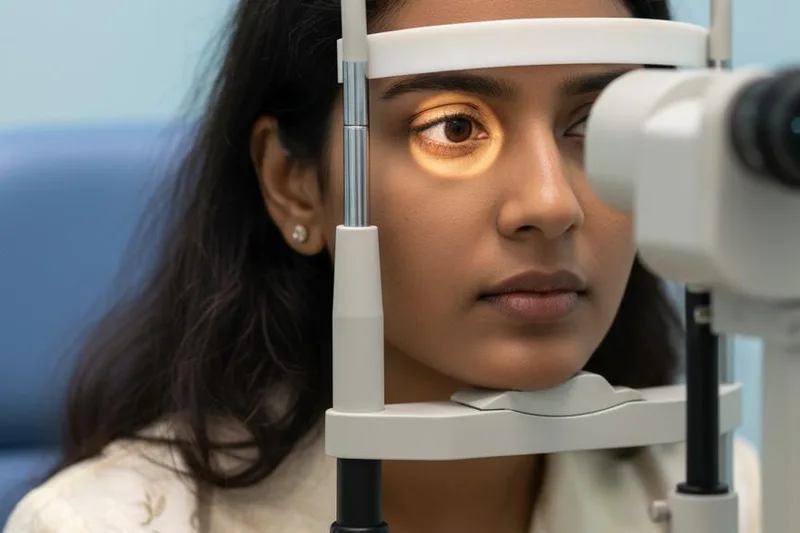
How valuable are your eyes to you? It's really something that can't be put into words. Sight is one of the most valuable resources we have to see the beauty in this world. But sometimes, there are diseases that secretly damage our vision without any major symptoms. One such silent enemy is "Glaucoma". Many people get scared when they hear this name, and they also have great fear and doubt about the tests that are done for this. So today, let's talk about what tests are done to detect glaucoma early, do they hurt, and should we be afraid?
What exactly is glaucoma?
Simply put, glaucoma is a general term for a group of eye diseases that damage the optic nerve , the main nerve that carries messages from the eye to the brain. Think of your eye as a camera, and the optic nerve is the cable that goes from that camera to the brain. If this cable is damaged, images don't get to the brain properly, and that's when you gradually lose your vision.
The main reason for this is that the pressure inside the eye is higher than normal. Fluid builds up inside the eye, and it needs to drain. If something interferes with this drainage, the pressure inside the eye increases. This increased pressure is what damages the delicate optic nerve. Over time, this damage can increase and even lead to complete loss of vision.
Who is at higher risk of developing this?
Although glaucoma can affect anyone, some people are at higher risk. See if any of these factors apply to you.
- If someone in your family has it: If your mother, father, or siblings have glaucoma, your risk of developing it is significantly higher.
- If you are over 40 years old: This risk increases with age.
- Other diseases: People with diabetes and hypertension are at higher risk of glaucoma.
- Eye injuries: If you have previously suffered an eye injury or undergone complex eye surgery.
- Certain medications: For those who use corticosteroid medications (e.g. prednisone) for a long time.
- Other eye problems: People with farsightedness can develop some types of glaucoma.
When should I get a glaucoma test?
Glaucoma often has no symptoms in its early stages, which is why it is called the "silent enemy that steals sight." However, sometimes these symptoms can appear.
- Blind spots in vision.
- Blurry vision.
- Feeling pain or pressure in the eyes.
- Headache.
- Seeing round things like rainbows when looking at light.
- Redness of the eyes.
- Tunnel vision.
If you have any of these symptoms, it is very important to see an ophthalmologist immediately and have your eyes examined.
Even if you don't have symptoms, if you have risk factors for glaucoma, the best thing you can do is continue to have your eyes checked.
In general, the recommended schedule for those at risk is as follows:
- 40-54 years: once every 1-3 years.
- 55-64 years: once every 1-2 years.
- 65 years and older: Every 6-12 months.
How do these tests work? Let's look at them one by one.
There are several tests to check for glaucoma. Your doctor may do one or more of these. The best part is that most of these tests are quick, painless , and non-invasive. Let's take a look at the main tests.
1. Examining the 'angle' inside the eye (Angle exam / Gonioscopy)
This looks at the angle where the clear part of your eye (the cornea) and the colored part of your eye (the iris) meet. The fluid that forms inside your eye flows through this angle. This test checks to see if it is narrowed or blocked. If it is blocked, it could be a sign of glaucoma.
- How it's done: The doctor will first put some eye drops to numb your eyes. Then, they will slowly place a special lens on your cornea and examine the angle.
2. Corneal thickness measurement (Corneal thickness measurement / Pachymetry)
The thickness of your cornea also helps give you some idea of your risk of glaucoma. If the cornea is thinner than normal, your risk is slightly higher.
- How it's done: This involves putting in eye drops to numb the eye. Then, a very small instrument (probe) is used to gently touch the surface of the eye and measure its thickness.
3. Dilated eye exam
This is a very important test. It allows the doctor to clearly see the optic nerve and retina inside your eye.
- How it's done: Eye drops are used to dilate the pupil. Then, using a special light and magnifying glass, the color, size, shape, and blood vessels of the optic nerve are carefully examined. This can help determine if the nerve has been damaged.
4. Eye pressure check / Tonometry
One of the main symptoms of glaucoma is increased pressure inside the eye. This test measures that pressure.
- How to do it:The eye is numbed by applying eye drops and a small instrument is used to gently touch the surface of the eye to measure the pressure. This is not painful. However, it is important that you remain relaxed and still.
5. Optic nerve imaging
This is a test using cutting-edge technology that takes very clear, detailed pictures of the optic nerve and retina.
- How it's done: The most commonly used scan is called Optical Coherence Tomography (OCT) . All you have to do is place your chin on the chin rest of the machine and look into a lens. Nothing is injected into your eye. In a few minutes, a map-like image of all the layers inside your eye is taken.
6. Visual field test
In glaucoma, the first thing that is damaged is the peripheral vision. This test looks for dark spots, or areas of darkness, anywhere in your field of vision.
- How to do it: While looking at an object with one eye closed, you are asked to see if you can see light signals coming from around you. Sometimes a special machine is used for this.
After the tests and about the results
After the test, especially if you have been given medication to enlarge your cornea, your vision may be blurry for a few hours . You may also have a blue-tinged vision when exposed to light.
Therefore, it is best not to drive on the day of the test and to have someone drive you home. Also, bringing a pair of sunglasses will be a great relief for your eyes.
The best part is that most of the results of these tests are available right away . Your doctor will explain the results to you.
| Name of the test | What could be an unusual result? |
|---|---|
| Gonioscopy | Narrowing or blockage of the angle through which fluid drains from the eye. |
| Corneal Thickness (Pachymetry) | The cornea is thinner than normal (this is a risk factor). |
| Eye pressure (Tonometry) | Eye pressure greater than 22 mmHg (millimeters of mercury). |
| Optic nerve imaging | The optic nerve is swollen or has an abnormal shape. |
| Visual field test | The presence of blind spots in certain areas of the visual field. |
What to do if the results show glaucoma?
If you are diagnosed with glaucoma, don't panic. If detected early, there are effective treatments available today that can help control and stop the damage to your vision caused by glaucoma . Your doctor will recommend the treatment that is best for you.
The following treatments may be suggested:
- Medication: Eye drops or pills to lower eye pressure.
- Laser treatment: Laser treatment that helps the fluid in the eye drain more easily.
- Surgery: Making a small incision to drain the excess fluid from the eye or inserting a small tube into the eye to drain the fluid.
The most important thing is to continue taking your medication as prescribed by your doctor and to go for follow-up check-ups at the scheduled time.
Take-Home Message
- Glaucoma is a disease that causes silent vision loss and has no symptoms in the early stages. That's why regular eye exams are so important.
- Don't be afraid of glaucoma tests. Most of them are painless, quick, and safe.
- If you are over 40 years old, have a family history of glaucoma, or have risk factors like diabetes or high blood pressure, be sure to have regular eye exams.
- If the disease is detected early, vision damage can be successfully controlled. So never skip an eye exam.
- If you have any problems with your eyes, see your doctor immediately.


💬 Comments (0)
No comments have been posted yet. Add your comment here for the first time.
Add your comment