

Have you ever heard of a way to see inside your body while you're having an operation ? One such new technology is called iMRI. This allows surgeons to see what's inside your body clearly while you're performing the surgery. Isn't it amazing? Let's talk about this in more detail.
What is this iMRI?
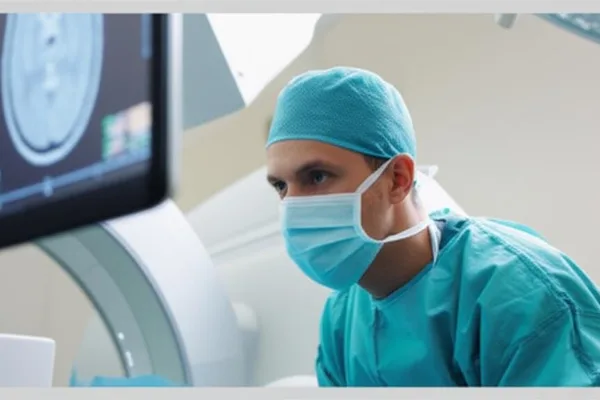
Simply put, iMRI is an acronym for Intraoperative Magnetic Resonance Imaging . In Sinhala, it means 'Magnetic Resonance Imaging performed during surgery'. Now you may think this is a bit complicated. But don't worry, I will explain it simply. Imagine that your surgical team is performing an operation , and at the same time, they are doing a scan that allows you to clearly see the organs and tissues inside your body. That's what iMRI is.
This has a big advantage. For example, imagine that a brain tumor is being removed. With this iMRI, the surgeon can see exactly whether the tumor has been completely removed or if a small piece remains. If it does, then they may have to do another surgery. This is very useful to prevent things like that.
What is the difference between an MRI and an iMRI?
Now you might be thinking, 'Oh... an MRI is a scan done with that big machine, so is an iMRI the same thing?' Yes, both use the same technology, which is to take pictures of the inside of the body using magnetic fields and radio waves. But the main difference is when it's done .
A regular MRI (Magnetic Resonance Imaging) is done to diagnose a disease or to prepare for surgery. That is, your doctor will prescribe an MRI for you, and you will go and have it done on a separate day. However, an iMRI is done during a surgical procedure . That is what makes it special.
Why do surgeons use iMRI?
In fact, some surgeries are very complex. Like working with threads. In those cases, wouldn't it be a great help if you could clearly see what's going on inside the body while the surgery is being performed? That's what iMRI does. It can clearly see even the smallest details that are too small for the human eye or a microscope to see.
What are the most common surgeries that use iMRI?
iMRI technology is particularly useful for surgeries that require very delicate, careful procedures. Here are a few examples:
- Removing brain tumors: This is the most common use of MRI. The brain is a very sensitive area. This helps to remove the tumor completely without damaging the healthy brain tissue. This also applies to tumors in the pituitary gland.
- Craniotomy surgery:This involves opening the skull and accessing the brain. iMRI is very helpful in this type of surgery.
- Deep Brain Stimulation (DBS) Implantation: In this surgery, which is performed on people with neurological diseases like Parkinson's disease, iMRI helps to place the stimulator in the exact right place.
- Removing a type of brain cancer called glioma.
- Surgery for epilepsy.
How does an iMRI work?
This is a bit scientific, but I'll try to explain it to you in a simple way. Did you know that more than half of our bodies are made up of water? Water is made up of hydrogen and oxygen atoms. Inside this hydrogen atom, there are tiny particles called protons . These protons have an electrical charge, and they just spin around inside the atom like a spinning wasp.
When an electric current is passed through the coils inside the MRI machine, a temporary magnetic field is created in your body. It's like a big magnet. Then, all those protons in your body that I mentioned are aligned, pointing towards the magnet in the MRI machine. Just like a compass needle points north. That's because of the Earth's magnetic field.
Then, the MRI machine sends radio waves through this magnetic field. This works like a camera shutter when you take a picture. These radio waves momentarily change the arrangement of the protons that were in that line. When the radio waves stop, the protons rearrange themselves. Those changes are captured by a scanner and sent to a computer. The computer uses that data to create the picture we see.
You won't feel any of this because you're under anesthesia and probably sound asleep. The MRI machine is either in the same operating room where the surgery is performed, or it's set up so that you can easily access it.
Do you need to prepare for an iMRI?
There is really no special preparation you need to do for an iMRI, as it is done during your surgery. Therefore, your surgical team will prepare you and the operating room for this test when the time comes. All you need to do is follow the instructions your doctor gives you before your surgery.
Let's learn about anesthesia.
When you have an MRI, you are under general anesthesia . This means you are completely asleep. The MRI is not painful, but it can be a little noisy. Sometimes, there are awake procedures where you are not put to sleep. Even in those cases, the medical team will prepare you and make sure you are comfortable during the scan.
Be careful with metal things!
This is very important!MRI machines use strong magnets, so there can't be any metal inside or outside your body.
Things you should definitely tell your doctor before surgery include:
- Are you pregnant?
- Do you have any metal objects inside your body? For example:
- A pacemaker.
- Implants - metal parts placed in places like the knee and hip.
- Artificial joints.
- Some dental fillings.
- Metal fragments embedded in the body (e.g., bullet fragments).
If there is something like this, the magnetic effect of the MRI can cause those metal parts to move, heat up, or become inoperable. That is very dangerous. So if you tell the doctor these details in advance, they will follow special safety procedures and perform your surgery safely.
Also, you will need to remove all jewelry and metal objects you are wearing before surgery. You will also need to remove earrings, underwire bras, and hair pins.
What are the advantages of an iMRI?
There are several benefits that patients can gain from this iMRI technology. Let's take a look at what they are:
- The area of the body being examined can be viewed in very fine detail: you can clearly see exactly what is happening and where the problem lies.
- This information can be viewed in real-time: that is, you can see the current state of the operation as it occurs, not like looking at an old scan.
- Changes in the affected area can be assessed during surgery: for example, when removing a tumor, you can see right away how much has been removed and how much is still there.
- Complications can be prevented and reduced: The chances of having to undergo a second surgery are greatly reduced because the first surgery can attempt to completely resolve the problem.
- No radiation: Unlike X-rays or CT scans, MRIs do not use radiation. So it won't harm you in any way.
When will the doctor receive the iMRI results?
This is also very important. The surgeon can view the images within seconds or minutes of the iMRI scan. This means that decisions can be made immediately and the surgery can continue without any delay. This saves time and increases the success of the surgery.
Finally, remember this.
Okay, so I hope you now have a good idea about iMRI, which stands for Intraoperative Magnetic Resonance Imaging , which we talked about today.
Simply put, iMRI is a special scanning method that helps surgeons see clearly what's inside the body during surgery.
This is especially important for complex surgeries like brain tumor removal. It can help to make sure the tumor is completely removed, which can help to avoid the need for a second operation. Your medical team will take every precaution to make this scan safe for you. However, remember that if you have any metal objects in your body (such as a pacemaker), tell your doctor about them before the surgery . If you have any other questions about your surgery, talk to your surgeon at least a day before the surgery to make sure everything is okay.
Don't worry, as medical science advances, new technologies like these come to provide you with the best treatment.
👩🏽⚕️ Additional questions (FAQs)
💬 Is Intraoperative MRI (iMRI) the same as a regular MRI?
No! A normal MRI is done before a patient undergoes surgery. But this iMRI is an MRI scan of the patient's nerves or brain 'while' an operation is being performed (right inside the theater). There are special operating rooms built for that purpose today.
💬 Why do a scan during the operation?
When a brain tumor is removed, if even a small piece of the tumor remains, the cancer will grow back. When an iMRI is performed during the operation, the doctors can see exactly that 'there is more to be removed.' Then, the operation can be successfully completed in one go without having to cut the patient a second time.
💬 Is it true that this increases the safety of the patient's nerves?
100% true! The brain can easily be damaged during brain surgery. But since iMRI shows everything live, it is very easy for doctors to use neuro-navigation to reach only the tumor without damaging important nerves.
` iMRI, MRI, surgery, brain surgery, tumor, cancer, medical technology




💬 Comments (0)
No comments have been posted yet. Add your comment here for the first time.
Add your comment