

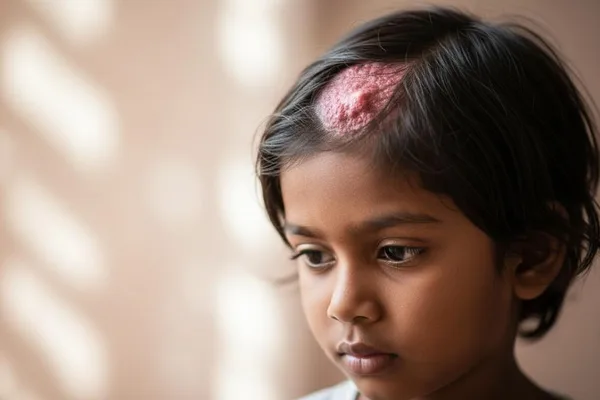
Oh, do you have a big, red, swollen bump on your head, or maybe your neck, or your face that's bothering you? Sometimes it may even ooze pus. This is not a normal pimple, but a condition called Kerion, which we're going to talk about today. Don't worry, let's get to the bottom of this.
What is Kerion? Who gets it most often?
Simply put, a kerion is a pus-filled, swollen lesion that forms on our skin, especially on the scalp. To be precise, this is a type of eczema called ``ringworm`` or ``tinea corporis``. This kerion is formed when our body's immune system overreacts to a fungal infection called ``tinea corporis``. It's like our body's security guards are a little nervous.
These are most commonly seen on the scalp , but can sometimes appear on the face, neck, shoulders, and upper arms.
Kerion can develop in anyone, but it most often occurs in young children . It is most common among school-age children or children who play together.
How does a Kerion affect the body?
Kerion is not just a small wound. They are usually large, thick, very swollen, and red bumps that may feel soft and watery when touched.
If not treated properly , this kerion can cause scarring and permanent baldness (alopecia) . Therefore, it is not a good idea to take this lightly.
Also, when you have a head injury like this, you may feel stressed about how others view you. You may feel embarrassed, anxious, and even depressed . So you need to think about your mental health as well as your physical health.
What are the symptoms of a kerion? Is it painful?
If you suspect you have a kerion, take a look at these symptoms:
- A large, thick, pus-filled boil -like wound.
- It feels soft and boggy when touched.
- Sometimes you may see pus oozing from the hair follicles at first .
- The area around the wound is swollen and red .
- Severe itching may occur.
- The hair in that area breaks or falls out .
- Some people may get a fever .
- There is also a possibility that the neck muscles may swell .
Yes, kerion can be painful because the skin is stretched and swollen, which can cause pain.
Why does this kerion form? What is the cause?
The main cause of kerion is an infection caused by a type of fungus called dermatophyte.When it occurs on the scalp, it is also called ``tinea capitis.`` These fungi react with a protein called ``keratin`` found in our hair, nails, and skin.
Some of the main types of fungi that can cause ringworm and develop into kerion are:
- Microsporum canis (this can often be transmitted from dogs and cats)
- `Trichophyton mentagrophytes`
- `Trichophyton tonsurans`
- `Trichophyton verrucosum` (this can be transmitted from animals such as cattle)
Imagine, what's happening here is that some types of fungi that normally live on our skin suddenly grow too much for some reason and start fighting with our body.
Is Kerion contagious? How long is it contagious?
Yes, Kerion is a contagious disease. It can be easily spread through skin-to-skin contact with an infected person, or by touching an infected animal (like a dog or cat).
Therefore, it is very important to wash your hands after handling animals . Also, if you have Kerion, do not share your combs, brushes, hats, towels, and bedding with others .
How long will this remain contagious?
Even with proper treatment, kerion can remain contagious for several weeks . If left untreated, the sores will get bigger and start spreading. Therefore, it is very important to follow your doctor's instructions exactly. You need to use the medicine prescribed by your doctor exactly for the prescribed period , only then will it be completely cured and will stop coming back.
How does a doctor determine for sure that this is a kerion?
When you go to see a doctor, he or she will first ask you about your symptoms. Then they will do a physical exam . They will take a close look at your wound, hair, skin, and scalp.
The doctor may also decide to take a sample (biopsy) from the wound. This means that a small piece of hair, some pus, or a small piece of skin may be scraped from the wound and sent to a laboratory for testing. The sample will be examined there.
What tests are done to confirm Kerion?
To confirm whether you have ringworm, your doctor may order the following tests:
- KOH stain test:
In this, the doctor will take a small scraping of your skin, either from your wound or from your scalp. They may also take a few hairs or a little pus. Once this is sent to the lab, a technician will place the sample on a microscope slide and add a few drops of potassium hydroxide (KOH) solution to it. This KOH solution dissolves the skin cells, allowing you to see if the fungus is present. The results are usually available within 24 hours.
- Culture Test:
A culture is a medium that allows fungi to grow. In this, the type of fungus in the sample is grown and the exact fungus that is causing the kerion can be identified. This is more accurate than the `KOH` test, but it can take several weeks for the results to come back.
- Wood's lamp test:
A Wood's lamp is a light that emits a special type of ultraviolet light. The doctor will hold this light up against your scalp and look at it. Some types of ringworm glow under this UV light. If they do, the doctor can get a rough idea of what type of fungus is causing it. Your kerion may glow yellow, green, or blue.
What are the treatments for kerion? Are there things I can do at home?
Once your doctor has confirmed that you have a kerion, he or she will likely prescribe oral antifungal medications . For example:
- `Fluconazole`
- `Griseofulvin`
- `Itraconazole`
- `Terbinafine`
The total treatment period can usually last six to eight weeks . It is essential to take this medication exactly as your doctor prescribes, for the full duration.
Also, your doctor may prescribe an oral corticosteroid, also known as a steroid . Steroids help reduce swelling and reduce the risk of scarring and hair loss.
To help stop ringworm from spreading, your doctor may prescribe a shampoo that contains ketoconazole or selenium sulfide . But remember, these shampoos don't kill the fungus . They only control the fungus from spreading further. You should wash your hair with this shampoo at least twice a week.
Can't I use a topical antifungal cream on the wound?
No, topical antifungal medications such as creams, ointments, gels, and sprays are of no use for a Kerion. They are not effective enough to penetrate deep into the scalp and kill the fungus.
Are there any treatments that can be done at home?
No, there are no specific home remedies for Kerion. You must take the prescribed medication as directed by your doctor.
How soon will I recover after taking the medicine? Will my hair grow back?
If you are diagnosed and treated properly, your kerion should clear up in six to eight weeks . Most people will start to feel relief from symptoms such as pain and itching after about two weeks. However, it is important to take the full course of medication prescribed by your doctor. Otherwise, it may come back.
Hair will usually grow back after treatment.However, sometimes there may be a slight loss of hair. It depends on things like the size of the wound and how long it has been there.
What can be done to reduce the formation of kerion?
You can do these things to reduce your risk of developing kerion:
- Do not share your combs, brushes, pillowcases, hats, or sports helmets with others.
- Keep your scalp clean and dry. If you bathe frequently, dry your hair thoroughly.
- Wash pillowcases and bed sheets regularly.
- Wash your hands thoroughly with soap and water after handling animals such as dogs and cats. Some animals can have this fungal infection, even if they don't show symptoms.
Remember, personal hygiene is the best way to avoid many diseases.
What should you keep in mind if you have a kerion? How to take care of it?
Kerion can sometimes be difficult to treat. Also, because its symptoms are similar to those of certain types of tumors and bacterial infections, it can sometimes be misdiagnosed. The longer you have a kerion, the more likely it is to become infected, scar, and permanently lose your hair. That's why it's important to get treatment quickly.
If you have ringworm, check everyone else in your home, including pets, for a fungal infection. Ringworm is very contagious, so it's a good idea to check close contacts and family members. Even if they don't have symptoms, they may need treatment too.
Do not touch your Kerion. If you do, wash your hands thoroughly with soap and hot water afterward. This will help prevent the fungus from spreading to other people, animals, or other surfaces. In addition, wash your pillowcases, bed sheets, towels, and hats regularly. Clean and disinfect combs, brushes, and hairpins, or use new ones.
When should you definitely see a doctor?
If you have any of these symptoms, definitely see a doctor:
- If you have a lump on your scalp that is itchy, painful, or pus-filled .
- If hair is falling out from the wound area.
- If your kerion does not reduce or heal despite treatment.
- If the kerion spreads to other parts of your body .
What are the important questions to ask the doctor?
When you see a doctor, it may be helpful to ask these questions:
- How do you know for sure that I have a Kerion?
- What other conditions could there be if I don't have a kerion?
- How did I get Kerion?
- What type of fungus caused my kerion?
- What can I do to prevent Kerion from spreading to other areas of my scalp?
- What can I do to prevent spreading Kerion to others?
- What can I do to prevent kerion from forming again?
- Should I see a dermatologist?
Finally, remember (Take-Home Message)
Kerion can be a really uncomfortable and painful condition. It can also make you feel embarrassed about your appearance. But the most important thing is that it is a treatable condition .
It is very important to follow the treatment plan your doctor gives you exactly. You may need to take treatment for up to eight weeks. If you do not finish the entire course of medication prescribed, the kerion may come back, possibly becoming more severe and difficult to treat. If your kerion does not get better, be sure to see your doctor again. Don't worry, with proper treatment, this condition can be controlled.
👩🏽⚕️ Additional questions (FAQs)
💬 Is Kerion a cancer that forms on the scalp?
No! This is not cancer. 'Kerion' is a very painful infection caused by a fungus (Fungus) that infects the scalp (Ringworm of the scalp / Tinea capitis). The skin of the scalp becomes severely swollen, looks like a large red lump, and starts to ooze pus.
💬 Who is most susceptible to this fungus?
This mostly occurs in young children. When a parasitic fungus (zoophilic dermatophytes), especially found on dogs, cats, and farm animals, gets on a child's head, the child's body's allergic-like reaction to the fungus causes this crusty swelling.
💬 Does this fermented fruit make your hair grow longer?
Yes! When the Kerion becomes so severe, the hair follicles in that area will first fall out (Alopecia). If this is not treated quickly with antifungal pills that are taken for months, the hair follicles will die forever and hair will not grow back from that area for the rest of your life (Scarring alopecia).
` Kerion, scalp lesions, fungal infection, tinea capitis, ringworm, skin diseases, hair loss, alopecia, pediatric diseases




💬 Comments (0)
No comments have been posted yet. Add your comment here for the first time.
Add your comment