
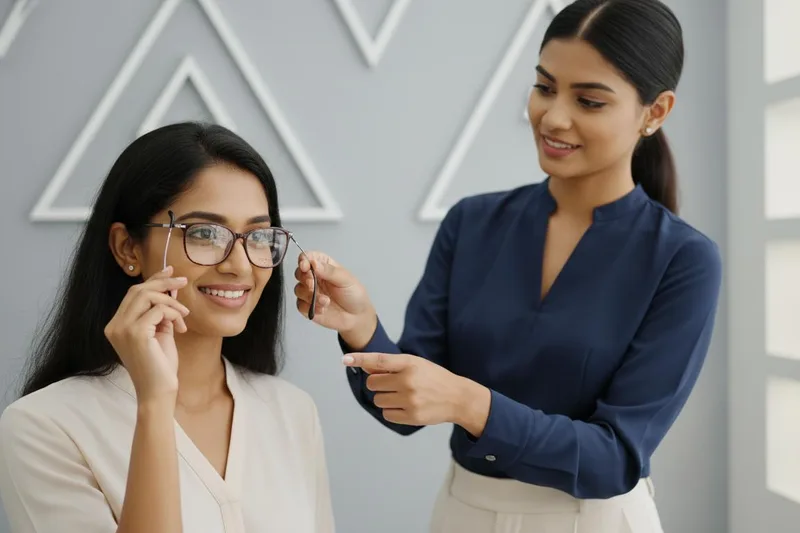
When you had your eyes checked, the doctor gave you a prescription, a pill-like prescription, for a pair of glasses, right? Now, take this and choose a nice, matching frame for your face, and go to a place where the right lenses are fitted. That's where we meet and the person who helps us with this task is what we call an 'Optician'. But many of us think that all those who work with eyes are eye doctors. Since this is a bit confusing, let's talk about it clearly today.
Is an optician really a doctor?
Simply put, no . An optician is not a doctor. They do not have a medical degree (Medical Doctor - MD). They are not qualified to diagnose or treat eye diseases.
So who are these people?
An optician is a technician who has received special training in eye care . To be precise, their main job is to make and fit glasses or contact lenses that an eye doctor (either an optometrist or an ophthalmologist) prescribes for you. They work with ophthalmologists and surgeons to help you maintain good vision.
So what exactly does an Optician do?
Imagine you went to an eyeglass store. There, an optician helps you a lot.
- Helping you choose the right lenses and frames: Your doctor will review your prescription and explain which type of lenses is best for your vision needs. They will also help you choose a frame that suits your face shape and your preferences.
- Adjusting the glasses: After choosing the frame, the lenses are attached to it and it is made to fit your face perfectly, without getting stuck on either side of your ears or over your nose, and to be easy to wear.
- Contact Lens Education: If you wear contact lenses, an optician will teach you how to safely insert, remove, and clean them.
- Repairs: They can also fix minor scratches or bends on your mirror.
The most important thing is that an optician never examines your eyes, checks for vision impairment, and then gives you a prescription. They only work on a prescription given by a doctor.
Optician, Optometrist and Ophthalmologist - What is the difference between these three?
These three names are confusing to many people. To understand this very simply, look at the table below. After this, you will have a clear understanding of these three.
| Profession | Main Role | Is a Doctor? |
|---|---|---|
| Optician | Prepare and fit eyeglasses and contact lenses according to medical recommendations. | No. These are technicians. |
| Optometrist | Examining eyes, diagnosing vision impairments, prescribing eyeglasses and contact lenses, and diagnosing and treating certain eye diseases such as cataracts. | Yes. But not surgeons. They can't perform surgery. |
| Ophthalmologist (eye surgeon) | Provides a full range of ophthalmology services. Eye examinations, diagnosis, treatment, prescription of medications, and cataract surgery . | Yes. These are fully qualified doctors and surgeons. |
Now it's clear, right? If you have any problems or changes in your eyes, you should first go to an Optometrist or Ophthalmologist. You should go to an Optician with the prescription they give you.
How often should you have your eyes checked?
Eyes are a very valuable organ in our body. Therefore, it is important to take care of them regularly. Generally, the time to have your eyes checked changes with age.
- Young children: Have your child's eyes checked by a pediatrician at every clinic visit until they start school, and then every year or two after that.
- Adults under 40 years old: Every 5 or 10 years.
- Adults between 40 and 54 years of age: Once every 2 to 4 years.
- Adults over 55 years of age: Once every 1 to 3 years.
But this is just general advice. If you already wear glasses, contact lenses, or have a medical condition like diabetes, you should have your eyes checked more often, as recommended by your doctor.
If you have these symptoms, definitely see a doctor.
If you notice any unusual changes in your eyes or vision, don't ignore it. If you have any of the symptoms below, go straight to an optometrist or ophthalmologist, not an optician .
- If your vision feels blurry.
- Feeling like you are seeing two things (diplopia) .
- If you have new eye pain and it doesn't go away in a few days.
- If your eyes become blue when you go outside, or you experience light sensitivity.
- If you feel that your vision is gradually decreasing significantly.
Seeking medical advice promptly at times like this can help protect the health of your eyes.
Take-Home Message
- An optician is not a doctor. They are technicians who have received special training in eyeglasses and contact lenses.
- An optician cannot diagnose, treat, or prescribe eye diseases. For that, you should see an Optometrist or Ophthalmologist.
- The Optician's main job is to select the glasses that best suit your face and needs, based on the prescription given to you by a doctor, and to adjust them correctly.
- If you experience any changes in your vision (blurry, double vision) or eye pain, see an ophthalmologist immediately.


💬 Comments (0)
No comments have been posted yet. Add your comment here for the first time.
Add your comment