Small accidents and falls can happen at unexpected times in our lives, right? When an arm or leg is injured, or perhaps a bone is broken (fracture), you may have seen doctors put a splint on it. So today, let's talk about what a splint is, what it does,
and how to take care of it properly. This will be very important for you, especially if something like this happens to you or someone in your family.
What is a 'splint'? Simply put...
Simply put, a `(Splint)` is
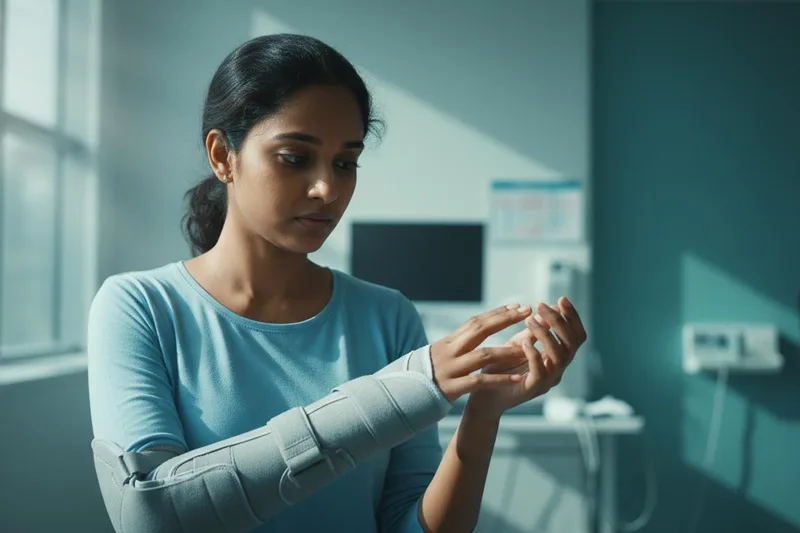
a support used to keep an injured or broken part of an arm, leg, or finger immobile. It's like putting something like a small board in place and tying it down. It's made of a slightly stronger material. Then, since the injured part stays in one place without moving, it helps it heal faster. Imagine, you have a broken bone in your hand. If you move your hand at that time, the broken bone pieces can move even more, and the injury can get worse. That's what this `(Splint)` is used to stop.
What are these 'splints' made of?
Various materials are used to make this `(Splint). They are:
- Plastic: Some splints are made from lightweight, yet strong plastics.
- Metal: Sometimes, metal sheets are also used, especially where more strength is needed.
- Plaster: You may have seen splints sometimes made from something like white plaster. That is called a plaster `(Splint).`
- Fiberglass: This is similar to plaster, but is lighter, stronger, and somewhat more water resistant.
Some splints come in pre-made sizes. Some are moldable, meaning they can be made to fit your injury. This means they can be made to fit your hand or leg exactly. Some splints come in one long piece, while others are made from several pieces that are joined together.
What happens when you put on a splint? What are the benefits?
The main function of a `(Splint)` is
to keep injured bones and joints in one place, immobile. By doing this: 1.
Healing after a fracture: When a bone is broken, the broken parts need to be immobilized in order for them to fit together properly and heal again. `(Splint)` does exactly that. 2.
After injuries and surgeries: After an injury or surgery, `(Splint)` helps protect the area and heal quickly. 3.
Relief from joint-related diseases: Some people have diseases like arthritis. In such cases, `(Splint)` is used to give rest to those joints and reduce pain. 4.
For muscle weakness: For those with certain muscle weakness (palsies), that is, those whose muscles do not function properly, a splint can also be used as a support for that particular part.
Simply put, a ``(Splint)`` is like a ``rest'' given to an injured area. That rest is what helps it heal faster.
Why do doctors sometimes put a 'splint' instead of a 'cast'?
You may be wondering, "Why don't you just put a big `(Cast)` on every injury, but sometimes you put a `(Splint)`?" There's a good reason for that. The main reason is
swelling. Imagine, you broke your leg, and at the same time, that area is very swollen. What happens if you suddenly put a tight `(Cast)` on it at a time like that? The swelling can make the `(Cast)` even tighter from the inside, which can interfere with blood flow and increase pain. That's dangerous. But a `(Splint)` is not like that. Since a `(Splint)` is usually open on one side, or is made in a way that it can be easily loosened,
there is room for it even if the swelling increases. Doctors usually put a `(Splint)` on it first while the swelling is still there, and after a few days, when the swelling goes down, they put a `(Cast)` on the wound to give it more protection. Do you understand? Therefore, a splint is the best temporary solution when there is swelling.
How to properly care for a splint? Be sure to remember these things!
Okay, now that you have a splint, it
's very important to take good care of it. If you don't take good care of it, it can not only delay the healing of the wound, but it can also cause skin rashes/irritation. Here are some things to keep in mind:
- Do not attempt to adjust the splint at home: Keep it in place as your doctor prescribed. If you feel it is too tight, painful, or uncomfortable, call your doctor immediately. Do not attempt to adjust or loosen it yourself.
- Do not get the splint wet: This is the most important thing. If the splint gets wet, it can lose its support for the bones. Not only that, but when it gets wet, there is a high chance of blisters and rashes on the skin.
- Do not put anything inside the `(Splint)`: Some people have a habit of putting things like pieces of a pen, sticks, etc. inside the `(Splint)` while scratching. Do not do that. Doing so can damage the skin and cause infection. Also, do not put any lotion or powder inside the `(Splint)`.
- Tell your child not to scratch the splint: If it's a small child, explain this to them. Instruct them to tell the doctor if it itches.
- Check the skin around the edges of the splint: Check at least once a day for any blisters, sores, or redness that may be stuck to the edges of the splint. If you see any of these, let your doctor know.
How do you bathe while wearing a splint?
This is also a problem for many people. If the doctor told you not to take off your splint even when bathing, then
you should take care not to get it wet.Here are the things you can do with it:
- For a child under 5 years old: The best thing to do is to give him a ``Sponge bath.`` That is, to wash him with a damp cloth or sponge. Do not immerse the child in water.
- For those over 5 years old: It is better to bathe in a ``(Bath tub)`` than a ``(Shower)`` because it is easier to keep the ``(Splint)`` from getting wet.
- Before bathing, cover the arm or leg with the splint tightly with a plastic bag.
- Seal the top of the bag tightly with a rubber band or tape so that no water can get in.
- When bathing, keep the splinted area completely out of the water. You can keep it propped up on the side of the tub.
Most importantly: If, no matter how careful you are, even a little water leaks out, or if the splint gets really wet, call your doctor right away. It may need to be changed. Keeping a wet splint won't do you any good.
>
If you only get a little water, you can use a hair dryer on the cool or fan-only setting and blow dry your hair. But if it gets really wet, be sure to tell your doctor .
When should I call the doctor?
If you or your child has any of these symptoms while wearing a splint,
you should seek medical advice immediately. Don't delay, as these may be signs of a serious condition.
- If the pain is getting worse: After applying the `(Splint)`, the pain should usually gradually decrease. Otherwise, if the pain is getting worse, or if the pain is unbearable.
- If your fingers or toes are swollen, discolored, or numb: If your fingers or toes on the splinted hand or foot appear blue, white, or black, or if you experience tingling or numbness, this could be a sign of a blood clot. This is an emergency!
- If the `(Splint)` feels too tight or too loose: If the `(Splint)` feels tight and restricts blood flow, or if the `(Splint)` feels too loose and does not support the injured area properly.
- If the Splint gets wet or breaks: As mentioned earlier, if the Splint gets wet, if any part of it breaks or becomes loose, it is okay.
If you see anything like this, don't just do whatever you feel like doing,
but call your doctor directly and get advice. That's the safest thing to do.
What else do I need to know?
A splint is a temporary aid that is given to an injury while it heals. If it is used properly and taken care of properly, your injury will heal quickly and you will be able to resume your normal activities. If your child has a splint, encourage him. Help him keep the splint in place. Let him know that in a few days all this discomfort will be over and he will be able to play, run, and jump again.
Finally, the most important things to remember (Take-Home Message)
Okay, we've talked a lot about `(Splint)` now, haven't we? The main things you need to remember from all of this are these:
- A splint is a support used to immobilize injured bones and joints.
- If the injured area is swollen, a ``Splint'' is the first thing to be applied rather than a ``Cast''.
- Do not let the splint get wet. Be very careful when bathing.
- Do not put anything inside the splint or scratch it.
- If the pain increases, the color of your fingers changes, the splint feels too tight/loose, or gets wet/broken, tell your doctor immediately.
- Follow the doctor's instructions exactly.
If you follow these instructions correctly, you won't have any problems with the splint, and your wounds will heal quickly!





💬 Comments (0)
No comments have been posted yet. Add your comment here for the first time.
Add your comment