
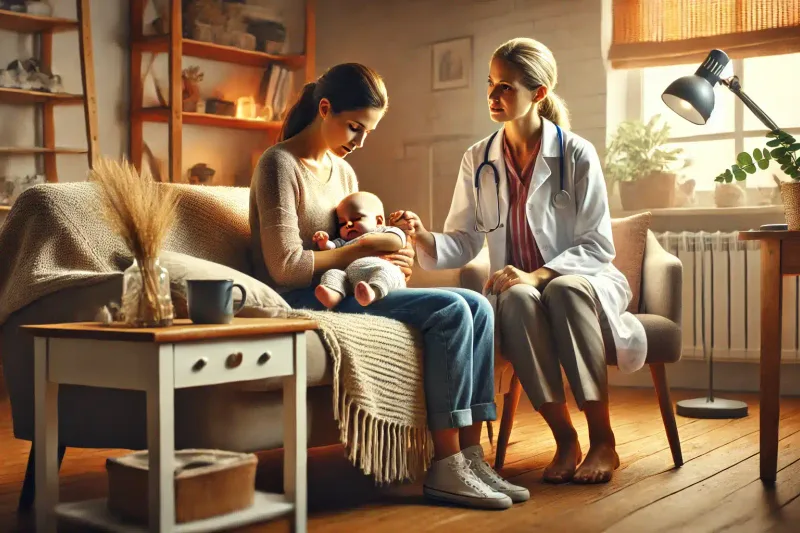
That day, the door to our clinic suddenly opened. Shanika (age 31) came in, looking down, holding a small baby in her arms. It was a normal day, but as soon as I saw Shanika's face, I realized that this was not a normal day for her. She seemed very tired and had a heavy heart.
"Come in, Shanika, sit down," I said, smiling. She tried to fake a smile, but her eyes were filled with tears. She took a deep breath and sat down.
"Dr. Priya, I thought I would be very happy after having the baby. But now I feel so empty. Sometimes I feel irrationally scared. I feel like I'm going crazy when the baby cries. Am I not a good mother, Doctor? I don't understand if something is wrong with me." Shanika started crying.
I held her hand and calmed her down. "Shanika, don't worry. You're not alone in this. What you're feeling is medically very normal. This is not your fault. So today, let's talk about these mental changes that new mothers experience after having a baby and how to recover from them."
What are Baby Blues? (When emotions overflow)
The short-term mood swings that many new mothers experience within the first two weeks after giving birth are medically known as the Baby Blues .
This is a very common condition that affects about 80% of mothers after giving birth.
Causes of Baby Blues:
- Hormonal changes: Immediately after giving birth, the levels of estrogen and progesterone in the mother's body drop rapidly.
- Physical fatigue and sleep deprivation: Sleep deprivation and fatigue for days on end.
- New responsibilities: new expectations and the pressure felt when caring for a baby.
What happens during Baby Blues:
- Frequent thoughts of crying or tears falling for no reason.
- Getting angry over trivial things and becoming emotionally unstable.
- Difficulty relaxing and insomnia.
- This condition usually begins 2-3 days after delivery and goes away naturally within 2 weeks without treatment.
If baby blues last more than 2 weeks: Postpartum Depression
Like Shanika, for some mothers, these sad feelings don't go away even after 2 weeks. If they get worse, it could be a serious condition called Postpartum/Postnatal Depression (PND) .
This is not just sadness or emptiness. This is a medical condition that needs treatment.
The main symptoms of postpartum depression are:
- Persistent hopelessness: A feeling of intense sadness, hopelessness, and emptiness that lasts throughout the day.
- Difficulty bonding with baby: Reluctance to look at or hold one's own baby or lack of affection for the baby.
- Extreme fatigue: Feeling of lack of energy to do any work and constant lethargy.
- Sleep problems: Insomnia or trying to sleep too much, even when the baby is sleeping.
- Guilt: Constantly blaming yourself for not being a good mother.
- Anxiety: Constant, irrational fear that the baby will be in danger.
🚨 Red Flags that require immediate medical attention
If you experience the following severe symptoms of postpartum depression, you should seek immediate medical attention:
- Thoughts of harming oneself or the baby: Feeling that there is no point in living, thinking about suicide, or having thoughts of harming the baby.
- Postpartum Psychosis: Feeling that the baby is not yours, seeing things or hearing sounds that are not there (hallucinations), and extremely violent behavior.
- Being completely alone: isolating oneself in one's room without any interaction with the outside world and completely refusing to breastfeed or care for the baby.
How to cure postpartum depression?
This is a condition that can be completely cured with proper medical treatment.
1. Counseling & CBT: Psychological counseling and talk therapy (Cognitive Behavioral Therapy) can help the mother change her thoughts to be positive and manage stress.
2. Antidepressants: Your doctor may prescribe medications to help control depression. These medications are safe for breastfeeding mothers and do not affect the baby.
3. Support Groups: Exchanging ideas with other mothers who have had the same experience provides psychological relief.
Practical Self-Care Tips (Caregiver Tips)
- Get help from others: Let your husband or family do chores like housework, cooking, or washing the baby's clothes. Don't try to do everything yourself.
- Get some rest: Make it a habit to sleep or rest every time your baby sleeps.
- Be active: Taking your baby outside to get some fresh air and taking a leisurely walk can help to relax your mind.
- Don't beat yourself up: Mistakes are likely to happen when you're first starting out with breastfeeding or babysitting. Remember that you're learning.
Do's & Don'ts
| ✔️ Things to do (Do) | ❌ Don'ts |
|---|---|
| Talk openly about your stress and feelings with your husband or family. | Don't keep your feelings bottled up inside, feeling ashamed or guilty. |
| While taking care of your baby, set aside at least 15 minutes a day for yourself. | Don't put unnecessary pressure on yourself by trying to be the perfect mom 24 hours a day. |
| If necessary, contact your midwife or doctor immediately. | Do not use sleeping pills or other medications unnecessarily without medical advice. |
❓ Some other questions you may have (FAQ)
Can fathers get postpartum depression? ▼
Yes. Postpartum depression can affect fathers too. Research has shown that up to 10% of fathers also experience this condition as they deal with new responsibilities, financial pressures, lack of sleep, and their wife's emotional changes.
Are medications for depression safe for breastfeeding mothers? ▼
Yes. Doctors recommend safe medications that are especially suitable for breastfeeding mothers and that pass only minimal amounts to the baby through breast milk (e.g., SSRIs such as Sertraline). Therefore, it is safe to take medications under medical advice.
What happens if postpartum depression is left untreated? ▼
If left untreated, this condition can last for months or even years. It damages the mother-child relationship, negatively affecting the child's development and family relationships.
What is the main difference between Baby Blues and Postpartum Depression? ▼
Baby blues are mild anxiety that occurs in the first few days after giving birth and resolves naturally within 2 weeks. Postpartum depression is a more profound depressive state that lasts more than 2 weeks, interferes with daily life, and requires professional treatment.





💬 Comments (0)
No comments have been posted yet. Add your comment here for the first time.
Add your comment