
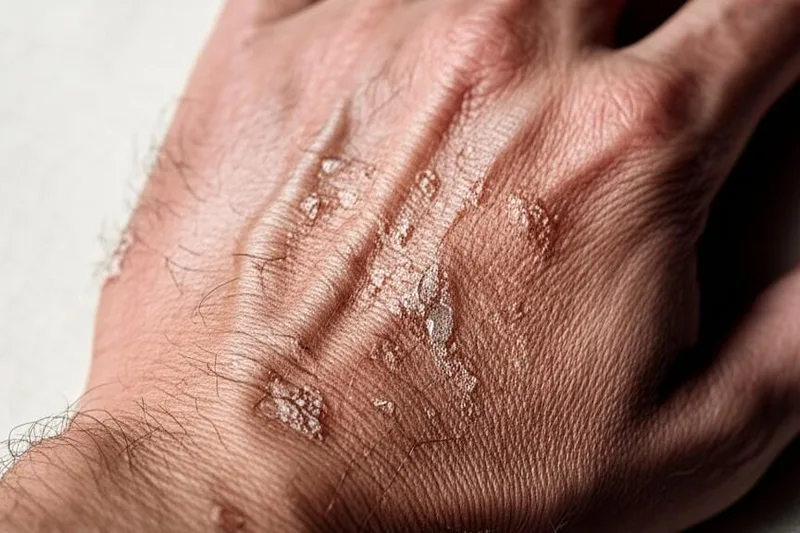
Do you have rough spots on your skin? It could be Actinic Keratosis!

Do you have rough spots on your skin? It could be Actinic Keratosis!

Have you ever noticed small, rough, scaly spots on your skin, especially in areas exposed to the sun? Sometimes you might not pay much attention to them. However, some of these spots could be a condition called Actinic Keratosis . It's important to be aware of this. So let's talk about it a little bit today, shall we?

What is Actinic Keratosis?

Simply put, actinic keratosis , also known as solar keratosis, is a type of skin condition that causes rough, scaly patches on your skin. These are usually caused by years of sun exposure.

The important thing is, this `(Actinic Keratosis)` is a precancer . This means that if these spots are not treated properly, some of them can turn into `(Squamous Cell Carcinoma)`, a type of skin cancer . Don't worry, not all `(Actinic Keratosis)` will turn into cancer. However, it is important to be careful about them because they are risky. In fact, this is the most common precancerous skin condition . Millions of people around the world have this condition.

Who is more likely to develop this?

No one wants to deal with these things. However, some people are more likely to develop ``Actinic Keratosis''. See if you fall into this category:

  • People who don't protect their skin from the sun: This is the main reason. People who are constantly in the sun without sunglasses, hats, and sunscreen are at higher risk.
  • People with fair skin, brown or red hair: People with blue or green eyes are also at higher risk. This is because their skin has less melanin, the pigment that protects it from the sun.
  • People with a history of frequent or severe sunburns: If you have been sunburned since childhood, that can also be a factor.
  • People with a weakened immune system : This condition is more likely to occur when the immune system is weakened due to certain diseases (e.g., HIV ), or treatments such as immunotherapy for cancer, or medications taken after an organ transplant.
  • People over 40: These can appear as we age due to years of accumulated sun exposure. However, younger people can also develop them, especially if they spend a lot of time in the sun.

Why does actinic keratosis occur?

The main cause of this is ultraviolet (UV) rays in the sun.Yes, it's the same sunlight that gives us all vitamin D, but too much of it can cause problems. UV rays don't just come from the sun, they also come from artificial light devices like tanning beds that some people use to make their skin look better.

These `UV` rays can damage the cells in the top layer of our skin, called `Keratinocytes`. When this damage continues over time, those cells start to grow abnormally. That's when these `Actinic Keratosis` spots appear. Just like a plant rots when it is watered too much, our skin also gets damaged when it is exposed to `UV` rays too much.

What are the symptoms of this? How do you recognize it?

Often, the first sign of Actinic Keratosis is a rough, raised bump or spot on the skin. It may feel rough, like sandpaper when touched. These can come in a variety of colors:

  • Gray color
  • Pink color
  • Red color
  • Same skin color as yours, but rougher.
  • Sometimes there may be something like yellow or brown scales on these spots.

These can range in size from a few millimeters to about two centimeters . They are most commonly seen in areas that are frequently exposed to the sun, such as the face, ears, scalp, neck, back of the hands, and forehead .

There may also be other symptoms:

  • Bleeding from the spot (especially from the vagina)
  • Burning, tingling, or itching sensation in the area
  • Dry and flaky lips (also called `Actinic Cheilitis`)
  • Sometimes you can see a skin growth (a `cutaneous horn`) that protrudes upward like an animal's horn .
  • Lip discoloration
  • Pain or tenderness in that area

Important: If you notice a new spot, lump, discoloration, or any change in an existing spot (such as enlargement, discoloration, or bleeding) on ​​your skin, don't ignore it. See a doctor right away.

How does a doctor know for sure if this is present?

If you have any doubts about a mole like this, you can see your family doctor or a dermatologist .

A doctor usually does:

1. Thorough skin examination: Examine the skin of your entire body, especially areas exposed to the sun.

2. Using a magnifying lens: Sometimes a magnifying glass is used to see the spot clearly.

3. Skin Biopsy: DoctorIf there is any doubt about the mole, or if it looks unusual, a small piece of skin is taken and sent to a lab to be looked at under a microscope. This is very simple. It involves a little bit of numbing. This is what allows for an accurate diagnosis .

What are the treatments for this?

The good news is, there are treatments for `(Actinic Keratosis)`! Your doctor will decide on the treatment based on the number of spots you have, their appearance, and their location.

There are several main treatment methods:

Treatments performed at the doctor's office:

  • Chemical peels: This is like a medical-grade face mask. Your doctor applies a special chemical to your blemish. This works by destroying the outermost layer of skin cells. The area may be red and sore for a few days. But as the skin heals, new, healthy skin emerges.
  • Cryotherapy: This method can be used if you have one or two small moles. The doctor uses a very cold substance, such as liquid nitrogen, to freeze the mole. In a few days, the mole will blister, dry out, and fall off.
  • Excision: In this procedure, the doctor first numbs the area where the mole is. Then, the mole is scraped off, or cut out, and one or two stitches are placed in the area. The wound heals in two to three weeks.
  • Photodynamic therapy (PDT): If you have a lot of spots, or if they keep coming back despite treatment, your doctor may recommend this treatment. In this treatment, a special cream (a ``photosensitizing agent``) is applied to the spots, and after a few hours, a special light (``blue light`` or ``red light``) is focused on them. This destroys the pre-cancerous cells. You should avoid the sun completely for a few days after this treatment.

Home treatment:

Sometimes, if you have a lot of spots, or if the spots are so small that they are barely visible, your doctor may prescribe topical creams or gels to use at home. These need to be applied daily for several months (maybe up to 4 months).

Here are some examples:

  • `Diclofenac skin gel ( Voltaren ® gel)` – Important: Although `Voltaren®` gel is now available over the counter, you should not use it on your own unless a doctor has specifically recommended it for `(Actinic Keratosis)`.
  • ``Fluorouracil, or 5-FU skin cream (Fluorac®)''
  • ``Imiquimod skin cream (Aldara® or Zyclara®)''
  • ``Ingenol mebutate topical gel (Picato®)''

Some people may experience redness, burning, or peeling of the skin when applying these creams. But that's part of the treatment. If you have any discomfort, tell your doctor .

How long does it take to recover after treatment? Can I come back?

The healing time will vary depending on the number of Actinic Keratosis spots you have, their size, and the treatment you received. Usually, the spots will be almost completely gone by about 3 months after treatment.

After the spots have disappeared, it is very important to see a doctor for a checkup once or twice a year . If you have a weak immune system, you may need to see a dermatologist four or five times a year.

Yes, Actinic Keratosis can come back, especially if you don't continue to protect your skin from the sun. Therefore, it is essential to protect your skin from the sun during and after treatment.

Most importantly! How to avoid Actinic Keratosis?

This is the best part of this story. There are many things we can do to prevent the development of `(Actinic Keratosis)`. The main thing is to reduce unnecessary exposure to `UV` rays.

Here are the things you can do with it:

  • Apply sunscreen every day: Don't skip applying sunscreen, even on cloudy days or in the winter. Choose a sunscreen with at least SPF 30 (Sun Protection Factor) or higher, and a broad-spectrum (that is, one that protects against both UVA and UVB rays). Apply 15-30 minutes before going outside, and reapply every two hours if you sweat, swim, or swim.
  • Avoid the sun's strongest rays: UV rays are at their strongest between 10 am and 2 pm (in some places, 4 pm). Minimize your exposure to the sun during these hours as much as possible.
  • Avoid artificial sunlight: Do not use things like `(Tanning salons)`, `(sun lamps)`, `(tanning beds)`. They also emit harmful `UV` rays.
  • Wear sun-protective clothing: Wear long-sleeved clothing, long pants, a wide-brimmed hat, and UV-protective sunglasses as much as possible.

Should we be afraid of this situation?

Actinic Keratosis is a condition that should be considered, but it is not something to worry about . In most cases, these spots can be completely cured with proper treatment. About 90% of people with Actinic Keratosis do not develop skin cancer.

But, remember, most skin cancers start as Actinic Keratosis. That's why we shouldn't take this condition lightly. The sooner it's recognized and treated, the less likely it is to develop into cancer.

When is it best to see a doctor?

If you notice any of these signs on your skin, be sure to see a doctor:

  • If a spot on the skin is bleeding, blistering, burning, or itching .
  • If you see a growth on the skin that protrudes like an animal horn .
  • If new, raised, red, or scaly patches appear or if existing ones change.

Simply put, if you notice something new, a change, or something suspicious on your skin, don't ignore it.

What are the important questions to ask the doctor?

When you see a doctor, don't forget to ask these questions:

  • “Doctor, why do I have this `(Actinic Keratosis)`?”
  • “What are the best treatment options for me?”
  • “What risks or side effects might these treatments cause?”
  • “What complications should I watch out for?”
  • "What should I do after treatment, and how should I take care of myself?"
  • "What should I do to prevent something like this from happening again?"

Finally, things to remember

Okay, so, `(Actinic Keratosis)` is a skin condition that needs prompt treatment and care . In most cases, these can be cured with surgery or cosmetics. The most important thing is to protect your skin from sunlight and `UV` rays . Then you can greatly reduce the risk of this condition.

If you think you have Actinic Keratosis, please see a doctor immediately for advice . The sooner you seek treatment, the lower your risk of developing skin cancer. Take care of your skin, because it is your most valuable asset!

⚠️ Important: The medical articles and information on Nirogi Lanka are for general awareness only, and are by no means a substitute for professional medical advice, diagnosis, or treatment. For any medical problem you have, consult a qualified physician immediately.

💬 Comments (0)

No comments have been posted yet. Add your comment here for the first time.

Add your comment

Please calculate: 1 + 8 =
Do you have rough spots on your skin? It could be Actinic Keratosis!
Preventive HealthSeptember 4, 2025

Do you have rough spots on your skin? It could be Actinic Keratosis!

Have you ever noticed small, rough, scaly spots on your skin, especially in areas exposed to the sun? Sometimes you might not pay much attention to them. However, some of these spots could be a condition called Actinic Keratosis . It's important to be aware of this. So let's talk about it a little bit today, shall we?

What is Actinic Keratosis?

Simply put, actinic keratosis , also known as solar keratosis, is a type of skin condition that causes rough, scaly patches on your skin. These are usually caused by years of sun exposure.

The important thing is, this `(Actinic Keratosis)` is a precancer . This means that if these spots are not treated properly, some of them can turn into `(Squamous Cell Carcinoma)`, a type of skin cancer . Don't worry, not all `(Actinic Keratosis)` will turn into cancer. However, it is important to be careful about them because they are risky. In fact, this is the most common precancerous skin condition . Millions of people around the world have this condition.

Who is more likely to develop this?

No one wants to deal with these things. However, some people are more likely to develop ``Actinic Keratosis''. See if you fall into this category:

  • People who don't protect their skin from the sun: This is the main reason. People who are constantly in the sun without sunglasses, hats, and sunscreen are at higher risk.
  • People with fair skin, brown or red hair: People with blue or green eyes are also at higher risk. This is because their skin has less melanin, the pigment that protects it from the sun.
  • People with a history of frequent or severe sunburns: If you have been sunburned since childhood, that can also be a factor.
  • People with a weakened immune system : This condition is more likely to occur when the immune system is weakened due to certain diseases (e.g., HIV ), or treatments such as immunotherapy for cancer, or medications taken after an organ transplant.
  • People over 40: These can appear as we age due to years of accumulated sun exposure. However, younger people can also develop them, especially if they spend a lot of time in the sun.

Why does actinic keratosis occur?

The main cause of this is ultraviolet (UV) rays in the sun.Yes, it's the same sunlight that gives us all vitamin D, but too much of it can cause problems. UV rays don't just come from the sun, they also come from artificial light devices like tanning beds that some people use to make their skin look better.

These `UV` rays can damage the cells in the top layer of our skin, called `Keratinocytes`. When this damage continues over time, those cells start to grow abnormally. That's when these `Actinic Keratosis` spots appear. Just like a plant rots when it is watered too much, our skin also gets damaged when it is exposed to `UV` rays too much.

What are the symptoms of this? How do you recognize it?

Often, the first sign of Actinic Keratosis is a rough, raised bump or spot on the skin. It may feel rough, like sandpaper when touched. These can come in a variety of colors:

  • Gray color
  • Pink color
  • Red color
  • Same skin color as yours, but rougher.
  • Sometimes there may be something like yellow or brown scales on these spots.

These can range in size from a few millimeters to about two centimeters . They are most commonly seen in areas that are frequently exposed to the sun, such as the face, ears, scalp, neck, back of the hands, and forehead .

There may also be other symptoms:

  • Bleeding from the spot (especially from the vagina)
  • Burning, tingling, or itching sensation in the area
  • Dry and flaky lips (also called `Actinic Cheilitis`)
  • Sometimes you can see a skin growth (a `cutaneous horn`) that protrudes upward like an animal's horn .
  • Lip discoloration
  • Pain or tenderness in that area

Important: If you notice a new spot, lump, discoloration, or any change in an existing spot (such as enlargement, discoloration, or bleeding) on ​​your skin, don't ignore it. See a doctor right away.

How does a doctor know for sure if this is present?

If you have any doubts about a mole like this, you can see your family doctor or a dermatologist .

A doctor usually does:

1. Thorough skin examination: Examine the skin of your entire body, especially areas exposed to the sun.

2. Using a magnifying lens: Sometimes a magnifying glass is used to see the spot clearly.

3. Skin Biopsy: DoctorIf there is any doubt about the mole, or if it looks unusual, a small piece of skin is taken and sent to a lab to be looked at under a microscope. This is very simple. It involves a little bit of numbing. This is what allows for an accurate diagnosis .

What are the treatments for this?

The good news is, there are treatments for `(Actinic Keratosis)`! Your doctor will decide on the treatment based on the number of spots you have, their appearance, and their location.

There are several main treatment methods:

Treatments performed at the doctor's office:

  • Chemical peels: This is like a medical-grade face mask. Your doctor applies a special chemical to your blemish. This works by destroying the outermost layer of skin cells. The area may be red and sore for a few days. But as the skin heals, new, healthy skin emerges.
  • Cryotherapy: This method can be used if you have one or two small moles. The doctor uses a very cold substance, such as liquid nitrogen, to freeze the mole. In a few days, the mole will blister, dry out, and fall off.
  • Excision: In this procedure, the doctor first numbs the area where the mole is. Then, the mole is scraped off, or cut out, and one or two stitches are placed in the area. The wound heals in two to three weeks.
  • Photodynamic therapy (PDT): If you have a lot of spots, or if they keep coming back despite treatment, your doctor may recommend this treatment. In this treatment, a special cream (a ``photosensitizing agent``) is applied to the spots, and after a few hours, a special light (``blue light`` or ``red light``) is focused on them. This destroys the pre-cancerous cells. You should avoid the sun completely for a few days after this treatment.

Home treatment:

Sometimes, if you have a lot of spots, or if the spots are so small that they are barely visible, your doctor may prescribe topical creams or gels to use at home. These need to be applied daily for several months (maybe up to 4 months).

Here are some examples:

  • `Diclofenac skin gel ( Voltaren ® gel)` – Important: Although `Voltaren®` gel is now available over the counter, you should not use it on your own unless a doctor has specifically recommended it for `(Actinic Keratosis)`.
  • ``Fluorouracil, or 5-FU skin cream (Fluorac®)''
  • ``Imiquimod skin cream (Aldara® or Zyclara®)''
  • ``Ingenol mebutate topical gel (Picato®)''

Some people may experience redness, burning, or peeling of the skin when applying these creams. But that's part of the treatment. If you have any discomfort, tell your doctor .

How long does it take to recover after treatment? Can I come back?

The healing time will vary depending on the number of Actinic Keratosis spots you have, their size, and the treatment you received. Usually, the spots will be almost completely gone by about 3 months after treatment.

After the spots have disappeared, it is very important to see a doctor for a checkup once or twice a year . If you have a weak immune system, you may need to see a dermatologist four or five times a year.

Yes, Actinic Keratosis can come back, especially if you don't continue to protect your skin from the sun. Therefore, it is essential to protect your skin from the sun during and after treatment.

Most importantly! How to avoid Actinic Keratosis?

This is the best part of this story. There are many things we can do to prevent the development of `(Actinic Keratosis)`. The main thing is to reduce unnecessary exposure to `UV` rays.

Here are the things you can do with it:

  • Apply sunscreen every day: Don't skip applying sunscreen, even on cloudy days or in the winter. Choose a sunscreen with at least SPF 30 (Sun Protection Factor) or higher, and a broad-spectrum (that is, one that protects against both UVA and UVB rays). Apply 15-30 minutes before going outside, and reapply every two hours if you sweat, swim, or swim.
  • Avoid the sun's strongest rays: UV rays are at their strongest between 10 am and 2 pm (in some places, 4 pm). Minimize your exposure to the sun during these hours as much as possible.
  • Avoid artificial sunlight: Do not use things like `(Tanning salons)`, `(sun lamps)`, `(tanning beds)`. They also emit harmful `UV` rays.
  • Wear sun-protective clothing: Wear long-sleeved clothing, long pants, a wide-brimmed hat, and UV-protective sunglasses as much as possible.

Should we be afraid of this situation?

Actinic Keratosis is a condition that should be considered, but it is not something to worry about . In most cases, these spots can be completely cured with proper treatment. About 90% of people with Actinic Keratosis do not develop skin cancer.

But, remember, most skin cancers start as Actinic Keratosis. That's why we shouldn't take this condition lightly. The sooner it's recognized and treated, the less likely it is to develop into cancer.

When is it best to see a doctor?

If you notice any of these signs on your skin, be sure to see a doctor:

  • If a spot on the skin is bleeding, blistering, burning, or itching .
  • If you see a growth on the skin that protrudes like an animal horn .
  • If new, raised, red, or scaly patches appear or if existing ones change.

Simply put, if you notice something new, a change, or something suspicious on your skin, don't ignore it.

What are the important questions to ask the doctor?

When you see a doctor, don't forget to ask these questions:

  • “Doctor, why do I have this `(Actinic Keratosis)`?”
  • “What are the best treatment options for me?”
  • “What risks or side effects might these treatments cause?”
  • “What complications should I watch out for?”
  • "What should I do after treatment, and how should I take care of myself?"
  • "What should I do to prevent something like this from happening again?"

Finally, things to remember

Okay, so, `(Actinic Keratosis)` is a skin condition that needs prompt treatment and care . In most cases, these can be cured with surgery or cosmetics. The most important thing is to protect your skin from sunlight and `UV` rays . Then you can greatly reduce the risk of this condition.

If you think you have Actinic Keratosis, please see a doctor immediately for advice . The sooner you seek treatment, the lower your risk of developing skin cancer. Take care of your skin, because it is your most valuable asset!

⚠️ Important: The medical articles and information on Nirogi Lanka are for general awareness only, and are by no means a substitute for professional medical advice, diagnosis, or treatment. For any medical problem you have, consult a qualified physician immediately.

💬 Comments (0)

No comments have been posted yet. Add your comment here for the first time.

Add your comment

Please calculate: 1 + 8 =