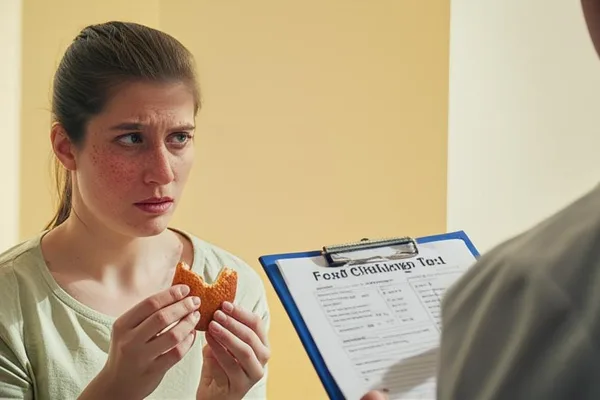
Do you also suspect a food allergy? Then let's find out about this (Food Challenge Test)!

Do you also suspect a food allergy? Then let's find out about this (Food Challenge Test)!

Many people experience various symptoms such as stomach upset, skin rashes, and difficulty breathing when they eat certain foods, right? Sometimes it's hard to tell if it's really an allergy or something else. At times like these, there is a special test that can help you know exactly and definitively whether you are actually allergic to a certain food or not. Today, we are going to talk about the so-called ``Food Challenge Test'', or the food challenge test.

What is this ``Food Challenge Test''?

Simply put, this is the most reliable way to determine if someone is allergic to a particular food . Imagine that you feel something strange when you eat peanuts. This test can then determine whether you are actually allergic to peanuts, or if it is just a figment of your imagination. Also, some people outgrow allergies they had as children as adults. This test can also determine whether the allergy has gone away or whether you should continue to avoid that food .

This involves gradually introducing the food you suspect you are allergic to in increasing doses, under the full supervision of your doctor or an allergist.

The most important thing is to never try to do this test yourself at home, as sometimes severe allergic reactions can occur.

Here's how this test usually works:

  • First, the doctor will give you a very small dose of the food you suspect you are allergic to. Sometimes this will be given to you in the form of a capsule.
  • The doctor will then monitor you closely for any signs of allergy.
  • If there is no reaction after about 15 minutes, give another small dose of the suspect food.
  • In this way, these steps are repeated until either an allergic reaction occurs or the entire prescribed dose (usually divided into four or six doses) is administered.
  • If any allergy symptoms appear, the test will be stopped immediately and the doctor will confirm that you are allergic to that food.
  • If there is no reaction even after giving the full dose, it means you are not allergic to that food.
  • Most of the time, only one food is tested in this way at a time .

This is considered the "gold standard" for diagnosing food allergies.

Why is this test done? When is it necessary?

Usually, the first step in diagnosing food allergies is to do a skin prick test or an allergy blood test. However, sometimes these tests may not be definitive.. That's when this `(Food Challenge Test)` comes in. But remember, other tests (skin and blood tests) are also reliable and very useful for doctors.

Many people do this test to see if they have an ``IgE-mediated'' food allergy. ``IgE-mediated'' is an allergic reaction caused by ``IgE'' antibodies in our body. In such allergies, a reaction usually occurs immediately after eating the food.

How exactly do you do this `(Food Challenge Test)`?

Doctors use various methods to perform this test. All methods involve gradually increasing doses of the suspected food under medical supervision.

What happens during the test?

Sometimes the suspect food is given as is. For example, if you are testing for a peanut allergy, you might give a few peanuts. Other times, the food is mixed with something else, like peanut butter spread on a cookie. Sometimes, to make it difficult to identify the food, it is put in a capsule and swallowed like a pill.

These food preparation methods are used to reduce the chance that the person will recognize the food by sight or smell , which could potentially affect the outcome.

In some cases, your doctor may ask you to bring your own food to the test. You may also be asked to prepare a special recipe containing the suspected food. After eating the food, or after swallowing the capsule, you will be closely monitored for any reactions.

Who cannot participate in this test?

People who have had severe allergic reactions in the past are not allowed to take this test. However, they can still take this test to see if the person has no longer had an allergy. Remember, most people only test one food at a time.

What types of `(Oral Food Challenge)` are there?

There are three types of ``Oral Food Challenge'' tests. All of these tests are performed in a hospital or medical center.

1. `(Double-blind, placebo-controlled)` trial

In this method, neither you nor your doctor know which capsule or food contains the suspected allergen, and which contains the ``Placebo`` (a harmless substance that does not contain the allergen). This allergen and the ``Placebo`` are given every few hours, or every few days.

The advantage of this is that the test results are less likely to be influenced by the person's fears or the doctor's preconceptions. Simply put, all outside influences are removed . Although this is the best way to do a ``Food Challenge Test'', it is rarely used clinically and is mostly used for research purposes.

2. `(Single-blind)` test

In this test, only your doctor knows.Which food or capsule contains the allergen, and which contains the ``Placebo''. This is also given every few hours or days.

3. `(Open-food)` test

In this, both you and your doctor know what allergen you are being given. The doctor usually divides the amount of food into portions and gives it to you in gradually increasing doses over a period of about an hour. During this time, you are monitored for any allergic reaction. This is the most common method.

Do you need to prepare for this test in advance?

Yes, absolutely. Your doctor will give you a set of instructions before the test to ensure reliable results. These instructions may include things like:

  • Avoid eating foods you know you are allergic to for about two weeks before the test.
  • Stop taking any prescription or over-the-counter antihistamines (medicines for allergies) before the test .
  • Avoid eating or drinking anything for a few hours before the test.

Very important: Talk to your doctor about any allergies you have and any medications you take. Don't put off taking an inhaler for asthma or taking epinephrine in an emergency just because you have a test. Your doctor will tell you which medications to take, when, and how .

Also, if you have symptoms such as a cold or fever on the morning of the test, your doctor may ask you to postpone the test.

What can you expect during the test?

It's normal to feel a little scared or nervous about this test. But don't worry, it's a safe test . Your doctor will monitor your vital signs throughout the test.

Your doctor will give you a small amount of the food you suspect you are allergic to and watch for a reaction. If there are no symptoms, a second dose will be given. You will be closely monitored after each dose.

If you show any allergic reaction, the test is over. The doctor will give you medication to help with your allergy symptoms.

How long does the test take?

Regardless of how you respond, the test can take about three to four hours to complete . Most doctors give you small amounts of the allergen every 15 minutes. If you have an allergic reaction early in the test, the test will be stopped. However, you will be monitored for about two hours after that. This time may be longer, depending on how you respond. Even if you receive the full dose and have no reaction, your doctor may keep you under observation for about two hours after that.

What happens after the test?

If your doctor confirms that you have an allergy, they will advise you on how to avoid that food. They will also prescribe medication, such as an epinephrine auto-injector (such as an EpiPen®). If you are not allergic to that food, you can add that food back into your regular diet. In general, after passing a food challenge test, it is less likely that you will have a reaction to that food again.

Is this ``Oral Food Challenge'' safe?

There are some risks to this test. That's why it's done under the supervision of a doctor, in their office or in a hospital. Most people experience minor reactions, such as skin rashes and itching. Your doctor can prescribe medication to help relieve these symptoms.

Severe reactions are rare , but if they do occur, your doctor will be ready to provide you with the medical care you need. Serious risks of an Oral Food Challenge can include difficulty breathing or anaphylaxis (a severe allergic reaction that can be life-threatening) .

What are the benefits of this test?

The benefits of this test are that it allows you to expand the range of foods you can eat and it allows you to know for sure whether a particular food actually causes an allergic reaction. Knowing whether you have an allergy can help you prevent an allergic reaction in the future.

What do the test results say?

The results of an Oral Food Challenge Test are usually known almost immediately . Doctors usually classify the results as "Tolerated" or "Reacted."

  • `Tolerated`: This means that you did not have any allergic reaction to the food, so the food is safe to eat.
  • `Reacted`: This means that an allergic reaction occurred during the test.

Sometimes you may get an ``Inconclusive result.'' If that happens, your doctor may recommend that you avoid that food to be on the safe side.

Let's also learn about the ``Food Sensitivity Test'' that can be done at home.

There are two types of tests: a food challenge test that your doctor does and a food sensitivity test that you can do at home. Most of these at-home tests on the market are not approved by the Food & Drug Administration (FDA) and have no clinical value. This means that these tests, which you can buy online or at a pharmacy, are not a substitute for a diagnosis made by a doctor.

The ``Oral Food Challenge Test'' is considered the ` `Gold Standard'' for diagnosing food allergies. It involves deliberately ingesting a food that you think you are allergic to.It can be scary to be told you have to eat. But remember, your doctor will be with you throughout the entire examination. Talk to your doctor about any fears or concerns you may have. Don't be afraid to ask questions, such as what happens in an emergency.

Finally, things to remember

So, this `(Food Challenge Test)` is a very important and reliable test that can accurately determine whether you have a food allergy or not. This should definitely be done under medical supervision, in a place with appropriate medical facilities. This will help you overcome your fear of certain foods and adjust your diet. If you also want to know about such a test, don't forget to talk to your doctor.

👩🏽‍⚕️ Additional questions (FAQs)

💬 What is a Food Challenge Test?

If you suspect that you or your baby is allergic to a specific food, such as peanuts, milk, eggs, or shrimp, this is a special test in which a doctor gives you very small amounts of that food in a hospital to confirm it 100% or to see if it's better now.

💬 Isn't it dangerous to force-feed an allergic food?

This is something that should never be done at home! But this test is done in a hospital, with ICU facilities. In any case, the food is given in the smallest possible measured amounts. As soon as the slightest symptom appears, the food is stopped and the necessary treatment (Epinephrine) is given on the spot, so there is nothing to worry about.

💬 Why do this when there is a blood test?

Allergy blood tests and skin prick tests cannot tell you 100% for sure whether you are allergic to a food. They often give false positives. But this Food Challenge Test is the only accepted 'Gold Standard' in the world. If this is confirmed, you should definitely stop eating that food.


` Food allergies, food challenge test, allergy test, food allergies, IgE allergies, medical tests, health advice

Frequently Asked Questions (FAQ)

What happens during the test?

Sometimes the suspect food is given as is. For example, if you are testing for a peanut allergy, you might give a few peanuts. Other times, the food is mixed with something else, like peanut butter spread on a cookie. Sometimes, to make it difficult to identify the food, it is put in a capsule and swallowed like a pill.

Who cannot participate in this test?

People who have had severe allergic reactions in the past are not allowed to take this test. However, they can still take this test to see if the person has no longer had an allergy. Remember, most people only test one food at a time.

⚠️ Important: The medical articles and information on Nirogi Lanka are for general awareness only, and are by no means a substitute for professional medical advice, diagnosis, or treatment. For any medical problem you have, consult a qualified physician immediately.

💬 Comments (0)

No comments have been posted yet. Add your comment here for the first time.

Add your comment

Please calculate: 8 + 2 =
Do you also suspect a food allergy? Then let's find out about this (Food Challenge Test)!

Do you also suspect a food allergy? Then let's find out about this (Food Challenge Test)!

Many people experience various symptoms such as stomach upset, skin rashes, and difficulty breathing when they eat certain foods, right? Sometimes it's hard to tell if it's really an allergy or something else. At times like these, there is a special test that can help you know exactly and definitively whether you are actually allergic to a certain food or not. Today, we are going to talk about the so-called ``Food Challenge Test'', or the food challenge test.

What is this ``Food Challenge Test''?

Simply put, this is the most reliable way to determine if someone is allergic to a particular food . Imagine that you feel something strange when you eat peanuts. This test can then determine whether you are actually allergic to peanuts, or if it is just a figment of your imagination. Also, some people outgrow allergies they had as children as adults. This test can also determine whether the allergy has gone away or whether you should continue to avoid that food .

This involves gradually introducing the food you suspect you are allergic to in increasing doses, under the full supervision of your doctor or an allergist.

The most important thing is to never try to do this test yourself at home, as sometimes severe allergic reactions can occur.

Here's how this test usually works:

  • First, the doctor will give you a very small dose of the food you suspect you are allergic to. Sometimes this will be given to you in the form of a capsule.
  • The doctor will then monitor you closely for any signs of allergy.
  • If there is no reaction after about 15 minutes, give another small dose of the suspect food.
  • In this way, these steps are repeated until either an allergic reaction occurs or the entire prescribed dose (usually divided into four or six doses) is administered.
  • If any allergy symptoms appear, the test will be stopped immediately and the doctor will confirm that you are allergic to that food.
  • If there is no reaction even after giving the full dose, it means you are not allergic to that food.
  • Most of the time, only one food is tested in this way at a time .

This is considered the "gold standard" for diagnosing food allergies.

Why is this test done? When is it necessary?

Usually, the first step in diagnosing food allergies is to do a skin prick test or an allergy blood test. However, sometimes these tests may not be definitive.. That's when this `(Food Challenge Test)` comes in. But remember, other tests (skin and blood tests) are also reliable and very useful for doctors.

Many people do this test to see if they have an ``IgE-mediated'' food allergy. ``IgE-mediated'' is an allergic reaction caused by ``IgE'' antibodies in our body. In such allergies, a reaction usually occurs immediately after eating the food.

How exactly do you do this `(Food Challenge Test)`?

Doctors use various methods to perform this test. All methods involve gradually increasing doses of the suspected food under medical supervision.

What happens during the test?

Sometimes the suspect food is given as is. For example, if you are testing for a peanut allergy, you might give a few peanuts. Other times, the food is mixed with something else, like peanut butter spread on a cookie. Sometimes, to make it difficult to identify the food, it is put in a capsule and swallowed like a pill.

These food preparation methods are used to reduce the chance that the person will recognize the food by sight or smell , which could potentially affect the outcome.

In some cases, your doctor may ask you to bring your own food to the test. You may also be asked to prepare a special recipe containing the suspected food. After eating the food, or after swallowing the capsule, you will be closely monitored for any reactions.

Who cannot participate in this test?

People who have had severe allergic reactions in the past are not allowed to take this test. However, they can still take this test to see if the person has no longer had an allergy. Remember, most people only test one food at a time.

What types of `(Oral Food Challenge)` are there?

There are three types of ``Oral Food Challenge'' tests. All of these tests are performed in a hospital or medical center.

1. `(Double-blind, placebo-controlled)` trial

In this method, neither you nor your doctor know which capsule or food contains the suspected allergen, and which contains the ``Placebo`` (a harmless substance that does not contain the allergen). This allergen and the ``Placebo`` are given every few hours, or every few days.

The advantage of this is that the test results are less likely to be influenced by the person's fears or the doctor's preconceptions. Simply put, all outside influences are removed . Although this is the best way to do a ``Food Challenge Test'', it is rarely used clinically and is mostly used for research purposes.

2. `(Single-blind)` test

In this test, only your doctor knows.Which food or capsule contains the allergen, and which contains the ``Placebo''. This is also given every few hours or days.

3. `(Open-food)` test

In this, both you and your doctor know what allergen you are being given. The doctor usually divides the amount of food into portions and gives it to you in gradually increasing doses over a period of about an hour. During this time, you are monitored for any allergic reaction. This is the most common method.

Do you need to prepare for this test in advance?

Yes, absolutely. Your doctor will give you a set of instructions before the test to ensure reliable results. These instructions may include things like:

  • Avoid eating foods you know you are allergic to for about two weeks before the test.
  • Stop taking any prescription or over-the-counter antihistamines (medicines for allergies) before the test .
  • Avoid eating or drinking anything for a few hours before the test.

Very important: Talk to your doctor about any allergies you have and any medications you take. Don't put off taking an inhaler for asthma or taking epinephrine in an emergency just because you have a test. Your doctor will tell you which medications to take, when, and how .

Also, if you have symptoms such as a cold or fever on the morning of the test, your doctor may ask you to postpone the test.

What can you expect during the test?

It's normal to feel a little scared or nervous about this test. But don't worry, it's a safe test . Your doctor will monitor your vital signs throughout the test.

Your doctor will give you a small amount of the food you suspect you are allergic to and watch for a reaction. If there are no symptoms, a second dose will be given. You will be closely monitored after each dose.

If you show any allergic reaction, the test is over. The doctor will give you medication to help with your allergy symptoms.

How long does the test take?

Regardless of how you respond, the test can take about three to four hours to complete . Most doctors give you small amounts of the allergen every 15 minutes. If you have an allergic reaction early in the test, the test will be stopped. However, you will be monitored for about two hours after that. This time may be longer, depending on how you respond. Even if you receive the full dose and have no reaction, your doctor may keep you under observation for about two hours after that.

What happens after the test?

If your doctor confirms that you have an allergy, they will advise you on how to avoid that food. They will also prescribe medication, such as an epinephrine auto-injector (such as an EpiPen®). If you are not allergic to that food, you can add that food back into your regular diet. In general, after passing a food challenge test, it is less likely that you will have a reaction to that food again.

Is this ``Oral Food Challenge'' safe?

There are some risks to this test. That's why it's done under the supervision of a doctor, in their office or in a hospital. Most people experience minor reactions, such as skin rashes and itching. Your doctor can prescribe medication to help relieve these symptoms.

Severe reactions are rare , but if they do occur, your doctor will be ready to provide you with the medical care you need. Serious risks of an Oral Food Challenge can include difficulty breathing or anaphylaxis (a severe allergic reaction that can be life-threatening) .

What are the benefits of this test?

The benefits of this test are that it allows you to expand the range of foods you can eat and it allows you to know for sure whether a particular food actually causes an allergic reaction. Knowing whether you have an allergy can help you prevent an allergic reaction in the future.

What do the test results say?

The results of an Oral Food Challenge Test are usually known almost immediately . Doctors usually classify the results as "Tolerated" or "Reacted."

  • `Tolerated`: This means that you did not have any allergic reaction to the food, so the food is safe to eat.
  • `Reacted`: This means that an allergic reaction occurred during the test.

Sometimes you may get an ``Inconclusive result.'' If that happens, your doctor may recommend that you avoid that food to be on the safe side.

Let's also learn about the ``Food Sensitivity Test'' that can be done at home.

There are two types of tests: a food challenge test that your doctor does and a food sensitivity test that you can do at home. Most of these at-home tests on the market are not approved by the Food & Drug Administration (FDA) and have no clinical value. This means that these tests, which you can buy online or at a pharmacy, are not a substitute for a diagnosis made by a doctor.

The ``Oral Food Challenge Test'' is considered the ` `Gold Standard'' for diagnosing food allergies. It involves deliberately ingesting a food that you think you are allergic to.It can be scary to be told you have to eat. But remember, your doctor will be with you throughout the entire examination. Talk to your doctor about any fears or concerns you may have. Don't be afraid to ask questions, such as what happens in an emergency.

Finally, things to remember

So, this `(Food Challenge Test)` is a very important and reliable test that can accurately determine whether you have a food allergy or not. This should definitely be done under medical supervision, in a place with appropriate medical facilities. This will help you overcome your fear of certain foods and adjust your diet. If you also want to know about such a test, don't forget to talk to your doctor.

👩🏽‍⚕️ Additional questions (FAQs)

💬 What is a Food Challenge Test?

If you suspect that you or your baby is allergic to a specific food, such as peanuts, milk, eggs, or shrimp, this is a special test in which a doctor gives you very small amounts of that food in a hospital to confirm it 100% or to see if it's better now.

💬 Isn't it dangerous to force-feed an allergic food?

This is something that should never be done at home! But this test is done in a hospital, with ICU facilities. In any case, the food is given in the smallest possible measured amounts. As soon as the slightest symptom appears, the food is stopped and the necessary treatment (Epinephrine) is given on the spot, so there is nothing to worry about.

💬 Why do this when there is a blood test?

Allergy blood tests and skin prick tests cannot tell you 100% for sure whether you are allergic to a food. They often give false positives. But this Food Challenge Test is the only accepted 'Gold Standard' in the world. If this is confirmed, you should definitely stop eating that food.


` Food allergies, food challenge test, allergy test, food allergies, IgE allergies, medical tests, health advice

Frequently Asked Questions (FAQ)

What happens during the test?

Sometimes the suspect food is given as is. For example, if you are testing for a peanut allergy, you might give a few peanuts. Other times, the food is mixed with something else, like peanut butter spread on a cookie. Sometimes, to make it difficult to identify the food, it is put in a capsule and swallowed like a pill.

Who cannot participate in this test?

People who have had severe allergic reactions in the past are not allowed to take this test. However, they can still take this test to see if the person has no longer had an allergy. Remember, most people only test one food at a time.

⚠️ Important: The medical articles and information on Nirogi Lanka are for general awareness only, and are by no means a substitute for professional medical advice, diagnosis, or treatment. For any medical problem you have, consult a qualified physician immediately.

💬 Comments (0)

No comments have been posted yet. Add your comment here for the first time.

Add your comment

Please calculate: 8 + 2 =