
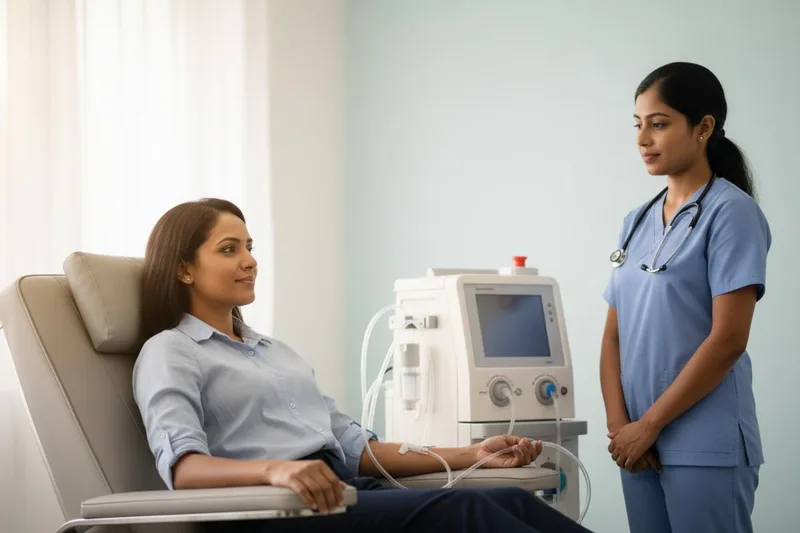
It's normal to feel scared and anxious when your doctor tells you that your kidneys are not working properly. You may have been told that you will have to undergo dialysis. Many people get worried when they hear these words, and they can't imagine what is going to happen. But if we understand this treatment method properly, you will understand that this is a very important method that can save your life. So, today we will talk about hemodialysis in simple terms.
Simply put, what is hemodialysis?
Think of your kidneys as two super filters in our body. They filter out unwanted waste, toxins, and excess fluids from our blood and excrete them as urine. But when kidney disease prevents them from doing this job properly, those toxins start to accumulate inside the body.
Hemodialysis is the process of cleaning the blood using a machine that removes nitrogenous wastes (urea), waste products from the muscles (creatinine), and acids from the blood, and returns the cleaned blood to the body.
How does this machine purify blood?
This hemodialysis machine has a special filter. It is called a 'dialyzer'. Some people also call it an 'artificial kidney'. The blood taken from your body goes into this 'dialyzer'. As the blood flows through the very fine mesh-like tubes inside it, only the waste products and excess water in the blood are filtered out.
These waste products are collected in a special liquid called 'dialysate'. This is made up of water, salts, and electrolytes. Now the clean blood, which has all the waste removed, is sent back to your body through the machine. The 'dialysate' liquid, which has the waste products, is removed from the machine. Think of it like a tea filter that filters the tea leaves and only the tea falls into the cup.
There are two main ways to perform hemodialysis:
You can talk to your doctor and decide which method is best for you.
| Treatment method | Description |
|---|---|
| Hemodialysis performed in a hospital or center (In-center hemodialysis) | This is the most common method. You will need to go to a specialized hospital or dialysis center for this. There, a trained nurse or technician will give you this treatment. You will usually need to go about three days a week. Each session will take about 3-4 hours. |
| Home hemodialysis | In this case, you can do this treatment at home. But a few weeks or months before that, the hospital will teach you how to do it properly and what to do if you have any problems. After that, you can do it yourself at your own convenience. |
There are also types of home hemodialysis.
- Conventional home hemodialysis: In this method, treatment is performed three days a week, for 3-4 hours at a time.
- Short daily home hemodialysis: This can be done with new technology. This is done about 5-7 days a week, but takes only a short time, about two hours at a time.
- Nocturnal home hemodialysis: This is done at night while you sleep. The machine runs for 6-8 hours at a time, about 4-6 days a week. This allows the blood to be cleaned for a longer period of time, so it removes waste products better than other methods.
Who really needs this treatment?
If you have severe kidney disease, called End-Stage Kidney Disease (ESKD) , you will need hemodialysis. Also, for someone waiting for a kidney transplant, this treatment is essential to survive until the transplant.
It's important to understand this: Hemodialysis is not a cure for kidney disease. It simply helps your kidneys do the work they need to do, helping you live longer.
What happens if treatment is refused?
This is a bit of a sensitive topic, but we need to talk about it. If someone decides not to start hemodialysis, or if they start and then stop, toxins start to build up in the blood. We call this condition `(uremia)`. Unfortunately, this condition is fatal. Without treatment, you can only live for a few days or weeks.
This is a completely personal decision. However, before making such a decision, you should definitely talk to your doctor and family about your concerns, fears, and feelings.
How should I prepare before treatment?
Before starting hemodialysis, a few weeks or a month in advance, a small preparation needs to be done. That is, an 'access' needs to be created so that blood can be easily removed from the body and returned to the body during the treatment. This requires a small operation.
There are two main ways to do this:
- AV fistula (Arteriovenous fistula - AV fistula): In this, a surgeon connects an artery and a vein in your arm.
- Arteriovenous graft (AV graft): If the artery and vein in your arm are not long enough to connect, a surgeon uses a small, soft tube (graft) to connect the two.
Both of these methods create a strong blood vessel that is easier to insert needles into during hemodialysis. This also helps the blood flow faster.
If hemodialysis needs to be started suddenly, your doctor may temporarily insert a soft tube called a catheter into a large vein in your neck, chest, or leg.
It is very important to take care of your access!
This access device you have made should be treated as if it were a valuable asset. If it becomes infected or damaged, it will not be able to be treated. Signs of an infection include:
- Pain
- Pain when pressing
- Swelling
- Color change (red, gray, pink, brown, or black)
- Fever
To protect access, remember these things:
- Do not sleep with the access side facing down.
- Don't wear clothes or jewelry that will get caught in that hand.
- Don't let the bag strap fall over the access.
- Never allow someone to have their blood pressure checked or blood drawn from the arm that has access.
Do you need to make changes to your diet?
Yes, absolutely. What you eat and drink directly affects the success of hemodialysis treatment. Some foods increase waste products in the blood, water retention, blood pressure, and heart rate. Therefore, you should talk to a renal dietitian to develop a diet plan that is right for you.
In general, you should limit foods and drinks that contain these things.
| What to limit | Reason and examples |
|---|---|
| Potassium | If potassium levels increase, the heart rate may become abnormally fast. Examples: Banana, avocado, orange, pear, dried fruits (dates, raisins), potatoes. |
| Phosphorus | If phosphorus increases, bones can become weak and skin rashes can occur. Examples: milk and dairy foods (yogurt, cheese), chicken, sausages, canned food, lentils, cashews. |
| Sodium - salt | When you eat too much salt, you become more thirsty and retain water in your body. Examples: salt, sauces, ketchup, packaged soups, instant noodles, store-bought foods. |
What happens during treatment?
The nurse or technician will insert two needles into the access created in your arm. One needle will draw blood from your body and send it to the machine. After the blood is cleaned by the dialyzer in the machine, the other needle will send the clean blood back into your body.
The machine monitors your blood pressure throughout the treatment. The machine can also increase or decrease the blood flow rate as needed.
Does this hurt?
You will feel a slight stinging sensation when the two needles are inserted into your access. However, you will not feel any pain for several hours after the treatment. Many people read a book, watch TV, or sleep during this time.
Why is this taking so long?
Two healthy kidneys continuously purify blood 24 hours a day, even while you sleep. A hemodialysis machine cannot do that. Healthy kidneys purify about 140 liters of blood per day. But the efficiency of hemodialysis treatment is much lower. That's why it has to be done for at least 3-4 hours at a time.
After treatment and possible side effects
When the treatment is finished, the needles will be removed, the area will be cleaned, and a plaster will be applied. After that, you can go home as usual.
Many people feel a little tired or fatigued after treatment. This may last for a few hours. This is normal. But if you are feeling very uncomfortable, tell your doctor about it.
There are several other side effects that can be associated with hemodialysis. Not everyone will experience these, but they are good to be aware of.
| Common side effects | |
|---|---|
| Low blood pressure (Hypotension) | Dizziness and fainting may occur. |
| Muscle cramps | It can occur especially in the legs. |
| Nausea and vomiting | Some people have this difficulty. |
| Itching (Pruritus) | This can be reduced by controlling the phosphorus level in the blood. |
| Headache, chest or back pain | These can also sometimes occur. |
What time should I see the doctor?
If you have any of the following symptoms, inform your doctor immediately.
- Symptoms of low blood pressure (dizziness, fainting (syncope))
- Nausea and vomiting
- Signs of an infection in the access (swelling, redness, pain, fever)
- Severe stomach pain
Take-Home Message
- Hemodialysis is a life-saving treatment that helps keep you alive when your kidneys fail. It is not a cure.
- It is extremely important to control your diet with this treatment.Follow the instructions given by your doctor and nutritionist exactly.
- The access you have made is your lifeline. Protect it well from infections and accidents.
- It's normal to feel tired after treatment. However, don't be afraid to talk to your doctor about any discomfort you experience.
- You are not alone on this journey. Your family, friends, and medical staff are there to support you. You are the most important person on your healthcare team. So make every decision informed.


💬 Comments (0)
No comments have been posted yet. Add your comment here for the first time.
Add your comment