
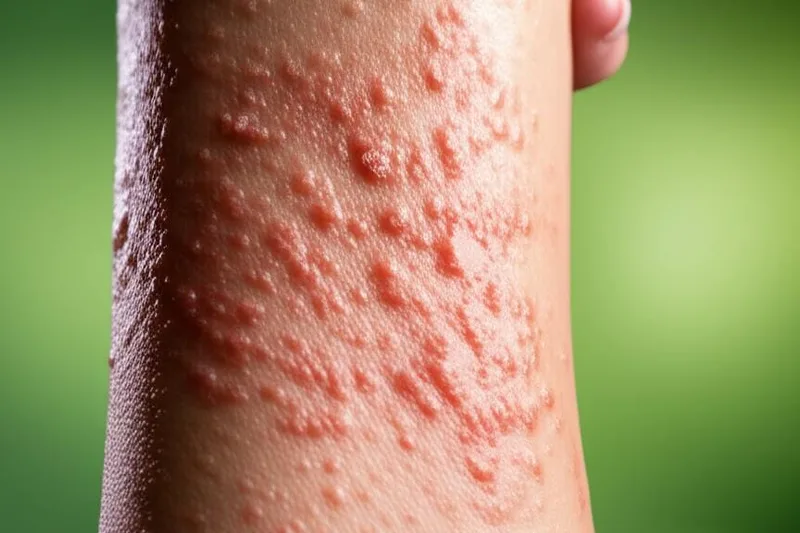
Hello! Have you ever been out walking in the woods or doing some gardening and suddenly your skin started to itch, turn red, and sometimes develop small blisters filled with water? This unimaginable discomfort can be caused by certain poisonous plants. Today we're going to talk about three such plants: poison ivy, poison oak, and poison sumac.
What are these poisonous plants? Why are they so troublesome?
Simply put, Poison Ivy, Poison Oak, and Poison Sumac are three types of plants that are not very common in our country, but are especially common in countries like America. The leaves, stems, and roots of these plants contain an oily liquid. This is called `(Urushiol)` . When that chemical `(Urushiol)` comes into contact with our skin, it causes the itchy, red bumps or blisters that are caused by the allergy. Medically, this is called `(allergic contact dermatitis)` . That is, an allergic skin inflammation caused by contact.
How common is this poisonous plant allergy?
Can you imagine, this chemical called `(Urushiol)` causes these allergic reactions in a large percentage of people, about 90% of whom come into contact with their skin. Even if you come into contact with a small amount of `(Urushiol)`, that is , 50 micrograms (`50 micrograms (mcg)`), this reaction is likely to occur. Even if someone has never been allergic to these plants before, they can become sensitive to them at any time in their life. So, it's better not to say, "I don't care about that," right?
Who is more likely to develop allergies to these poisonous plants?
Actually, anyone who comes into contact with `(Urushiol)` on their skin can get this condition. However, some people are more likely to come into contact with these plants. For example:
- Campers or hikers
- Farmers or gardeners
- Groundskeepers or landscapers
- Forestry workers
- Forest firefighters
- House painters
- Roofers
People who work outdoors like this, with trees and leaves, are at a slightly higher risk.
How do you identify these poisonous plants?
These three types of plants all have their own unique appearance. Let's see what they are.
What does poison ivy look like?
The easiest way to identify poison ivy is to look at its leaves. If there are three leaves on a single stem, the general rule is to be careful ("leaves of three, let them be"). Poison ivy leaves are reddish in spring, green in summer, and yellow, orange, or red again in autumn.
This plant can grow as a shrub or a vine. Poison ivy has a somewhat wiry, rope-like appearance. It is commonly grown as a vine in the eastern United States and as a low-growing shrub in the western United States. Poison ivy does not have thorns. Some poison ivy bushes also produce white berries.
What does Poison Oak look like?
Poison oak leaves are similar to poison ivy, with three leaves on a single stem. However, the tips of the leaves are rounded. The underside of the leaf is slightly hairy and lighter in color than the upper side.
This is also commonly found as a shrub in the eastern and southern parts of the United States. Sometimes these shrubs produce white or yellow berries. In the western regions, poison oak is also commonly found as a vine.
How to identify Poison Sumac?
The poison sumac plant has 7 to 13 small, smooth leaves arranged in pairs on a single leaf. This plant grows best in wet, marshy areas, especially in parts of the Northeast, Midwest, and Southeast of the United States.
A well-grown poison sumac tree can reach a height of about 20 feet. This tall tree has clusters of light yellow, cream, or green fruits hanging down from it. There are also harmless, non-poisonous varieties of sumac. These fruits are also red and have a rounded top. If you touch them, you will not get the allergic reaction you are talking about.
Why do these poisonous plants cause skin damage?
As we've discussed before, poison ivy, poison oak, and poison sumac all produce an oily chemical called `(Urushiol).` It is this `(Urushiol)` that many people are allergic to. When that oil comes into contact with the skin, it causes an allergic reaction that causes itchy, red welts, or blisters. This is called `(allergic contact dermatitis)`.
What are the symptoms of this allergy?
When a poisonous plant comes into contact with the skin, these symptoms are often inevitable:
- Itchy skin rash
- Redness and swelling of the skin
- Blisters
Depending on how sensitive your skin is, these rashes can appear within a few hours or a few days after the `(Urushiol)` oil is applied to the skin. The amount of itching also varies from person to person. While some people may get just one or two small rashes, others may develop rashes all over their body.
What exactly do these scars look like?
Poison ivy rash usually appears as red, itchy bumps. However, very rarely, some people may develop black spots or streaks instead of the red rash. This is called ``black-spot poison-ivy dermatitis.'' In this case, there may be very little swelling or redness, or none at all.
Are poison oak and poison sumac the same thing?
Yes, the effects of poison oak and poison sumac are exactly the same as those of poison ivy. This is because the allergic reaction to the oil ``(urushiol)`` from all three plants is the same.
Are there different scenarios in which these problems arise?
No matter how long it takes for the rash to appear, it usually goes through several stages. It can peak within 1 to 14 days of contact with urushiol. However, in someone who has never been exposed to it, it can take up to 21 days for symptoms to appear.
For many people, the chances of this happening are as follows:
1. Itching: First, the skin starts to itch a lot before the rash appears.
2. Rash: Rashes appear soon after scratching the skin. For many people, this is a severe, blistering rash.
3. Fluid-filled blisters: If you get blisters, they will burst after a few days and start to ooze a watery fluid.
4. Crusting and itching: Even if the blisters have crusted over, the itching may still be present.
Why is my pain spreading like this?
You may think that the rash spreads from one area to another. But what is actually happening is that new rashes appear on the skin that has been exposed to the urushiol oil. You may have accidentally touched some parts of the plant. For example, a strap on your bag may have come into contact with the urushiol, which then rubbed against your exposed shoulder. Some rashes take longer to appear. How far the rash spreads depends on the sensitivity of your skin and how much urushiol oil you have applied to your skin.
Is poison ivy contagious?
This is a question that many people ask. One person's skin does not transmit poison ivy to another. However, if the urushiol oil is on someone else's clothing or skin, you can still get poisoned if you touch it. You can also get poisoned if your pet has this oil on their fur, or if it is on a piece of equipment you have used in the garden or on camping equipment. The fluid that comes out of the blisters does not contain urushiol, so it is not contagious. This is something to keep in mind.
What are the possible complications from exposure to these poisonous plants?
In some cases, exposure to these poisonous plants increases the risk of problems. Factors such as:
- Inhaling smoke: When these poisonous plants burn, `(Urushiol)` is released into the air. If the smoke comes into contact with the face, it can cause irritation. Also, if the smoke is inhaled, it can cause irritation to the lining of the nasal passages, mouth, and throat. This oil in the air can also affect the lungs and cause serious breathing problems . This is very dangerous.
- Scratching: These lesions are very itchy, so it's hard to stop scratching. However, if you scratch until the skin breaks, you can get an infection . Bacteria from your nails can enter through any open wound.
How does a doctor diagnose this condition?
A doctor will look at your skin lesions, ask about your symptoms, and check to see if you may have been exposed to a poisonous plant. Not only poisonous plants, but also other allergens and irritants can cause ``contact dermatitis,'' or itchy rashes. If you haven't been outdoors or come into contact with plants, your doctor will check for other skin conditions or causes.
How to quickly cure poison ivy? (Quick remedies)
It's not possible to completely cure poison ivy in one day, but here are some steps you can take to get relief as quickly as possible:
- Rinse: Wash the skin with soap and lukewarm water as soon as possible. If you don't wash away the urushiol, it can spread to other parts of the body and to other people.
- Wash your clothing: Immediately wash any clothes you have been wearing. Urushiol oil may remain on your clothes and can cause irritation if you touch them again.
- Wash everything else: Wash anything that you think might have gotten oil on it, such as pets, garden tools, camping gear, and golf clubs.
- Avoid scratching: It's hard, but don't scratch. Scratching can lead to infection.
- Don't touch the blisters: If you have blisters on your feet, don't do anything to them. Don't try to pick or remove the skin on top. That skin is what protects the wound and prevents infection.
- Prevent infection: As with any scratch, scratching can break the skin, making it easier for infection to occur. Keep the skin clean and dry. If there are signs of infection (e.g., pus, increased redness and swelling, fever), tell a doctor immediately.
How do you treat poison ivy rashes?
The itching caused by these poisonous plants usually goes away on its own within a week or two. In the meantime, there are over-the-counter (OTC) medications you can buy at the pharmacy to help reduce the itching:
- Anti-itch creams: Examples include `Calamine lotion (Caladryl®)` and `Hydrocortisone cream (Cortizone®) .` If the blisters are oozing, you can use lotions containing `Aluminum acetate (Burow's Solution® or Domeboro® astringent solution)` .
- Antihistamines: Examples of these are medications like Diphenhydramine (Benadryl®) . These reduce itching and allergic reactions.
Important: If your rash is very severe, or if it affects the mucous membranes of your eyes, nose, mouth, or genitals, see a doctor. He or she may prescribe an oral steroid, such as Prednisone .
Also, if a secondary infection occurs, the doctor will prescribe treatment for that as well.
What else can you do at home to reduce itching?
Try these things to get relief from poison ivy itching at home:
- Cold compresses: Take a clean cloth, soak it in cold water, wring it out well, and place it over the itch.
- Lukewarm baths: Soaking in lukewarm water with colloidal oatmeal (Aveeno®) (available at drugstores) can help relieve itching. Alternatively, try adding a cup of baking soda to your bathwater. Short, cool showers can also help.
How do you prevent poison ivy from getting in your way?
The best way to prevent these pesky pests is to learn what these poisonous plants look like and avoid them.
If you think you've come across a poisonous plant, do these things:
- Remove oil by applying isopropyl (rubbing) alcohol to exposed body parts, gardening tools, or other items that you suspect may have oil on them.
- Use a brush to clean the nail bed thoroughly.
- If you touch a poisonous plant, wash your hands thoroughly using dishwashing soap and cold water.
- Wash your clothes after going out.
- Wear long-sleeved clothing, long pants, and gloves when working in the garden, gardening, farming, or climbing mountains.
- Wear rubber gloves when bathing pets that have come into contact with poisonous plants.
How long does poison ivy last?
Symptoms of poison ivy rash are usually mild (but very annoying!), and resolve within a week or two. Rarely, skin rashes can last for more than a month. Remember, don't scratch! Scratching can cause skin breakdown and infection.
How long do poison oak and poison sumac poisons last?
Poison oak and poison sumac should usually get better within a week or two.
When should I see a doctor?
If you have been bitten by a poisonous plant and have any of the following symptoms, see a doctor:
- If you have scars covering more than a quarter of your body .
- If you have an infection in the mucous membranes of your eyes, nose, mouth, or genital areas .
- If it looks like a red streak, if there is a fever, or if there are other signs of infection (e.g., pus, excessive swelling).
- If you have symptoms of a severe allergic reaction called anaphylaxis (e.g., difficulty breathing, hives, swelling) , go to the hospital immediately.
What should I ask the doctor?
If you have been bitten by a poisonous plant, you can ask your doctor questions like these:
- Do I need to do any tests to confirm whether these lesions came from a poisonous plant?
- How can we prevent this kind of harm from happening again?
- How can I protect the rest of my family from this harm?
- What treatments can I use to reduce itching?
- How long will this damage last?
- What symptoms should I look out for regarding complications?
What is the difference between Poison Hemlock and other poisonous plants?
Poison hemlock is another poisonous plant that grows throughout America. But it's different from poison ivy, sumac, and oak. Because, touching poison hemlock usually doesn't hurt. Poison hemlock is mainly poisonous if you eat it. The plant is even more poisonous than poison ivy - and can be fatal if eaten. So it's good to be aware of that too.
Finally, I have to say...
Poison ivy rashes can be very itchy, and can be difficult to deal with. Fortunately, most of the time, these rashes will go away within a week or two with simple treatment. Ask your doctor about ways to reduce the itching. Again, don't scratch! While this may provide temporary relief, scratching can introduce bacteria into the skin and cause infection. So be careful!
` Poison ivy, poison oak, poison sumac, skin allergies, urushiol, rashes, itching, skin diseases


💬 Comments (0)
No comments yet. Be the first to share your thoughts here.
Add Your Comment