
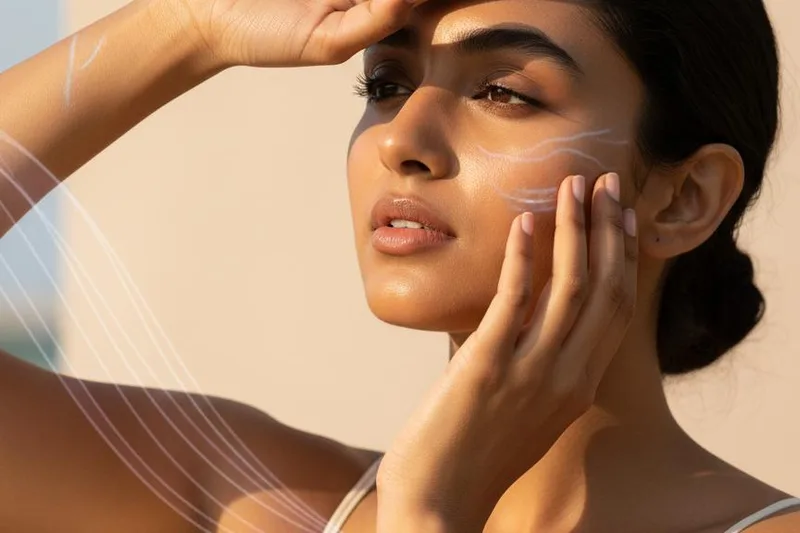
When the sun shines on our Sri Lanka, it really does, doesn't it? Many of us love the sun. We can't do things like play outside, work, go to the beach, and play cricket without it. But did you know that there is something in this friendly sunlight that our eyes cannot see, but is not good for our skin? That's what we are going to talk about today. This could be something that will be important for the rest of your life.
What is UV radiation?
Simply put, ultraviolet (UV) radiation is a form of energy emitted by the sun. These rays are invisible to our eyes because their wavelength is shorter than normal light.
Imagine, when this UV energy from the sun reaches the earth, it helps our bodies make vitamin D. It is essential for us to survive. But the problem is, too much of anything is not good, and so is this. Excessive exposure to UV rays greatly increases the risk of skin cancer. These UV rays are not only emitted by the sun, but also by some artificial light sources, especially those used to tan the skin, such as tanning beds.
There are three main types of UV rays:
These UV rays are divided into three main types based on their wavelength. Each of them affects our skin differently. Let's take a look at what they are.
| Type of UV rays | Effect on the skin |
|---|---|
| UVA rays | These are the main causes of skin wrinkling, skin discoloration (tan), and skin burns. Long-term exposure to these can cause skin cancer. |
| UVB rays | These damage the outermost layers of the skin. They can cause sun spots, darkening of the skin, and blistering. This damage can also lead to skin cancer in the future. |
| UVC rays | We don't have much to worry about this type, because UVC rays are almost completely absorbed by the Earth's atmosphere. Therefore, only UVA and UVB rays reach the ground. |
What happens to your skin when exposed to the sun?
Many people think that a little sun exposure makes your skin look beautiful and healthy. But the truth is, sun exposure can change the color of your skin, speed up the aging process, and increase your risk of cancer. Here are some things that can happen to your skin:
- Skin cancer .
- Wrinkling of the skin.
- Freckles .
- Liver spots occur as we age.
Over time, the sun's UV rays damage the elastin fibers in our skin. Think of it like a new rubber band. It stretches well and goes back to its original shape. But what happens when it gets old? It loses its elasticity and breaks easily. That's what happens to our skin. When elastin fibers break down, the skin starts to sag and stretch. It also bruises and tears easily, and it takes longer for a wound to heal.
So even if you don't see much sun damage when you're young, you'll definitely see its effects as you get older.
To further explain sun-related skin changes:
- Precancerous lesions and cancerous growths can develop into cancer. An example is Actinic Keratosis .
- The occurrence of skin tumors.
- Skin discoloration, spots or yellowing of the skin.
- Small blood vessels in the skin begin to appear on the surface (Telangiectasias) .
- Skin wrinkling (Elastosis) due to damage to elastin fibers.
- Eye damage, for example cataracts or macular degeneration.
- Premature aging.
How does UV rays cause cancer?
This is very simple to understand. When we are exposed to too much UV rays, those rays damage our skin cells. Inside every cell is a DNA molecule. This DNA is like a computer program. It contains all the instructions on how a cell should grow and what it should do.
UV rays directly target this DNA. Then that DNA is damaged. It's like a virus infecting a computer program. Then the cells can't do their job properly. They start dividing and multiplying uncontrollably, very quickly. These abnormally dividing cells come together to form tumors . These tumors may or may not be cancerous.
The most important thing is that the main cause of skin cancer is UV rays from the sun. And remember, sun exposure in the winter is just as dangerous as in the summer.
Years of repeated sun exposure can lead to Basal cell carcinoma and Squamous cell carcinoma . However, if you get a severe sunburn and blisters on your skin at least once in your life, especially before the age of 18, it can lead to the development of Melanoma , the most dangerous type of skin cancer, in the future.
What are the main types of skin cancer?
Skin cancer is the uncontrolled growth of skin cells. There are three main types of skin cancer:
1. Basal Cell Carcinoma
2. Squamous Cell Carcinoma
3. Melanoma
Of these, basal cell and squamous cell are the two most common types (accounting for 95% of all skin cancers). These are considered non-melanoma cancers, meaning they can be completely cured if detected and treated early .
However, Melanoma is the most dangerous and serious type of skin cancer that begins in the cells called ``melanocytes`` that give skin its color. Melanoma is the cause of 75% of skin cancer deaths. If left untreated, this cancer can spread to other parts of the body, making it very difficult to control.
Who is at higher risk of developing skin cancer?
Anyone can develop skin cancer from UV rays, but some people are at a slightly higher risk.
- For those with very fair skin
- For those with a lot of freckles on their skin
- For those whose skin turns red and burns easily when exposed to the sun
- For those with light-colored eyes (blue, green)
- For those with blonde or red hair
Here's an important point. People like us with darker skin have a lower risk of developing skin cancer than those with lighter skin. This is because the melanin pigment in our skin naturally provides some protection from UV rays. However, that doesn't mean we don't get skin cancer. People with darker skin can get skin cancer too, so protection is just as important for everyone.
In addition to skin color, there are other risk factors:
- If you or someone in your family has had skin cancer before.
- If you work outdoors in the sun for a long time (e.g. farmers, construction workers).
- If you live in an area with a sunny climate.
- If you have ever been badly sunburned in your life.
- If you have large, irregularly shaped birthmarks on your body.
What are the symptoms of skin cancer?
The most common warning sign of skin cancer is a change in the skin . This can usually be a new mole, a lump on the skin, a sore that won't heal, or a change in an existing mole.
- Basal Cell Carcinoma: This usually appears as a small, smooth, pearly or waxy lump that appears on the face or neck. Sometimes it can also appear as a flat, pink/red or brown spot.
- Squamous Cell Carcinoma: This can appear as a hard, red lump or a rough, scaly, flat patch on the skin. These may itch, bleed, and crust over.
- Melanoma: This usually starts as a pigmented (black, brown) spot or lump. Although it may look like a normal birthmark at first glance, a melanoma is usually irregular in shape, edge, and color.
The ABCDE method for diagnosing melanoma
There is a very easy way to help you detect melanoma, a dangerous skin cancer, early. It is called the ABCDE rule . When looking at moles on your skin, keep these things in mind.
| Letter | Meaning (see if these features are present) |
|---|---|
| A - Asymmetry | If the spot is divided in half, one side will not be the same as the other. |
| B - Border | The edge of the spot becomes unclear, rough, jagged, or blurred. |
| C - Color | The spot is not a single color throughout, but rather a mixture of several colors such as brown, black, red, white, or blue. |
| D - Diameter | The size of the mole is larger than the size of a pencil eraser (6 mm) or is getting larger. |
| E - Evolving | Changes in the size, shape, color, or nature of the spot (e.g., itching, bleeding) over time. |
How can you protect your skin from the sun and reduce the risk of cancer?
While skin cancer cannot be completely prevented, there are many things we can do to reduce our risk. The most important thing is to make these habits a habit.
- Use sunscreen: Use a sunscreen with an SPF (Sun Protection Factor) of 30 or higher. Apply generously 30 minutes before going out in the sun. If you are in the sun, reapply every two to three hours. Reapply before sweating or swimming.
- Wear protective clothing: Wear long-sleeved clothing and long pants that cover as much skin as possible.
- Wear a wide-brimmed hat: Use a wide-brimmed hat that protects your face, ears, and neck from the sun.
- Wear sunglasses: Use sunglasses with UV protection to protect your eyes and the delicate skin around your eyes from UV rays.
- Avoid the sun's hottest hours: Avoid direct sun exposure between 10 a.m. and 4 p.m. as much as possible. This is when UV rays are strongest.
- Do a regular skin self-examination: At least once a month, go in front of a mirror and examine your entire body. Look for new spots and changes in old spots. Remember the ABCDE rule.
When should you see a doctor?
It's very simple. If you notice any changes in your skin that you are suspicious of or that are a cause for concern, see a doctor right away. It could be a new spot, a lump, a sore that won't heal, or a change in an old spot.
When it comes to skin cancer, especially melanoma, early detection is the best way to save lives. So don't delay, saying, "Let's wait and see." If you have even the slightest doubt, seek medical advice.
Some questions you should ask your doctor:
- What are the effects of prolonged exposure to the sun?
- What type of skin cancer do I have? (If diagnosed)
- What caused my skin cancer?
- How can I protect myself from the sun's UV rays?
Take-Home Message
- The main cause of skin cancer is excessive exposure to UV radiation from the sun.
- No matter what your skin color, anyone can get skin cancer, so protection is important for everyone.
- Check your skin regularly. Be on the lookout for new spots, lumps, or changes in existing spots (especially following the ABCDE rule).
- Always protect yourself from the sun. Use an SPF 30+ sunscreen, wear clothing that covers your skin, a hat, and sunglasses. Avoid the sun between 10 a.m. and 4 p.m.
- If you notice any suspicious changes in your skin, do not delay and see your doctor immediately. Early detection can lead to successful treatment.




💬 Comments (0)
No comments yet. Be the first to share your thoughts here.
Add Your Comment