

Has a doctor told you that you need to have an `Echocardiogram`, or `TTE`, to check your heart? It's normal to feel a little scared when you hear that. But, it's actually a very simple, painless test. Today, we'll talk about what this `Transthoracic Echocardiogram (TTE)` is, what it looks for, and how it's done.
What is `Transthoracic Echocardiogram (TTE)`?
Simply put, a Transthoracic Echocardiogram, or TTE for short, is a test that takes pictures of your heart . It's like an ultrasound scan of your baby. But this one is for your heart. It uses sound waves called ultrasound to take pictures of your heart. This is the most common type of echocardiogram.
This test allows doctors to see your heart, its four chambers, four heart valves, and the large blood vessels that connect to it. It's like watching a video of what's going on inside your heart.
Why are you being asked to do this `TTE` test?
Doctors use the TTE test in many ways. That means you may be asked to do it for a variety of reasons.
Assess heart health
Sometimes, after you've been diagnosed with heart disease, or after you've been treated for it, this `TTE` helps to see how your heart is doing. It's also used to get an idea of your heart's health before a disease is diagnosed.
A `TTE` can look at things like:
- Whether your heart valves are working properly . Whether they open and close properly, and whether blood leaks backward.
- How well your heart pumps blood . That is, how strong your heart is (ejection fraction).
- How is the blood pressure and blood flow inside the heart?
- Are the rooms in your heart the exact size and shape ? Are they big, are the walls thick?
Find the cause of some symptoms
If you have certain symptoms, a TTE can also help determine if they are caused by a heart problem. For example:
- Chest pain : Check to see if this is due to a blockage in the blood vessels of the heart or if it is due to another cause.
- Edema : Is heart failure a factor in swelling in the hands and feet?
- Heart murmur : If a doctor hears an abnormal sound when listening to your heart, they may want to investigate whether the cause is a valve defect.
- Shortness of breath / Dyspnea : If you have difficulty breathing even with a little exertion, it could be due to a change in heart function.
Identify and follow up on certain medical conditions
TTE is used to check for certain medical conditions and to monitor their progress if they are present.
- Whether there is an aortic aneurysm or a tear in the aorta (aortic dissection).
- Whether blood clots have formed inside the heart.
- What is the cause of the changes in your Electrocardiogram (ECG) test?
- Are there any congenital heart conditions , or how is the condition after treatment?
- In heart failure, how weak is the heart?
- The nature and severity of heart valve disease .
- Whether there is an abnormal thickening of the heart muscle (`Hypertrophic cardiomyopathy`).
- Are there any tumors or cancer in the heart?
What is the difference between `TTE` and `TEE`?
There are two main types of `Echocardiogram`. One is the `Transthoracic Echocardiogram (TTE)` that we are talking about. The other is the `Transesophageal Echocardiogram (TEE)`.
`TTE` is the most common and simplest method. It involves nothing being put into your body (noninvasive), or sometimes just a small `injection` (minimally invasive).
A TEE is a slightly invasive procedure in which a doctor passes a small camera-equipped tube (endoscope) down your esophagus.
Even after a `TTE`, a `TEE` is usually ordered if the doctor needs more clear, detailed images. Because the esophagus is very close to the heart, a `TEE` can sometimes provide clearer images.
Who performs this `TTE` test?
Usually, your primary care provider or cardiologist will recommend a TTE. This test is performed by a technician (sonographer) trained in ultrasound technology. He or she will perform the test and send the report to your doctor.
How does `TTE` work?
This procedure, called `Echocardiography`, uses `ultrasound` technology. It sends high-frequency sound waves through your body. These sound waves hit the heart tissue and bounce back. These reflected sound waves are called `echoes`.
Using computer technology, these "echoes" are used to create images of your heart as it beats. Some echo tests also use a special technique called Doppler ultrasound. This can measure and assess things like the way blood flows through the chambers and valves of the heart, such as the speed and direction of blood flow.
These moving images are displayed on a screen so that both you and the doctor can see them.
Do you need to prepare in advance for `TTE`?
No, there is no special preparation required. You should eat and drink normally and take any medications you take. Don't worry about that.
What happens during the `TTE`?
A TTE test usually takes about an hour. The technician (sonographer) or other healthcare professional performs the test as follows:
Before the test
Sometimes, before doing a TTE, a doctor may inject a special liquid (contrast dye) into your vein. This helps to see more clearly how blood flows through your heart. This is not given to everyone, but only if necessary.
During the test
1. You will be made to lie down on an exam table.
2. Small patches (electrodes) are placed on your chest. These record your heart rate and rhythm.
3. Then, a special gel is applied to the surface of your skin. This gel helps the sound waves pass through your skin properly.
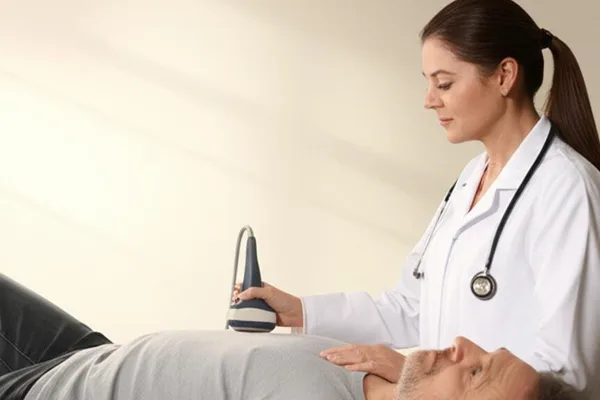
4. Next, a device called a `transducer` (a small device that looks like a microphone) is pressed against your skin and moved around. This `transducer` is what sends out the sound waves and picks up the `echoes` that come back.
5. The person doing the test will tell you to stay still for a while, change your body position, or change your breathing pattern. This will help you get better pictures from different angles.
Think about it, this is like having a "live movie" in your heart. So it's very important to support silently, as you say.
Are you being anesthetized?
No. `TTE` is a noninvasive procedure, so you are not sedated. It is done while you are awake. So there is no reason to be afraid.
What happens after `TTE`?
After the technician has taken all the pictures he needs, he will wash off the gel that was applied to your body and remove the electrodes. After that , you can go straight home. You can resume your normal activities. You can even drive yourself home.
Are there any risks in `TTE`?
There are no specific risks associated with the `TTE` test. This test does not use radiation, nor does it involve an electric shock. Apart from a slight stinging sensation when the `contrast agent` is `injected`, there is no pain associated with this test. Therefore, it is a very safe test.
When will the `TTE` results be available?
The technician who performed the test will send the report to the doctor who ordered the test for you. This usually takes about a day or two. After that, your doctor will call you to discuss the results, diagnosis, treatment plan, and whether further tests are needed.
So don't worry until the results come. The doctor will tell you all the details.
Brief points to remember
A Transthoracic Echocardiogram (TTE) is a test that uses ultrasound technology to take pictures of the structure and function of your heart. It is a very simple, safe, and painless test.
If you are asked to do this test, your doctor will explain to you in detail what the reason is and what the results mean. So don't be afraid of anything. This will help you a lot in knowing about the health of your heart.
` Heart scan, Echocardiogram, TTE, heart disease, heart tests, heart function, ultrasound




💬 Comments (0)
No comments yet. Be the first to share your thoughts here.
Add Your Comment