
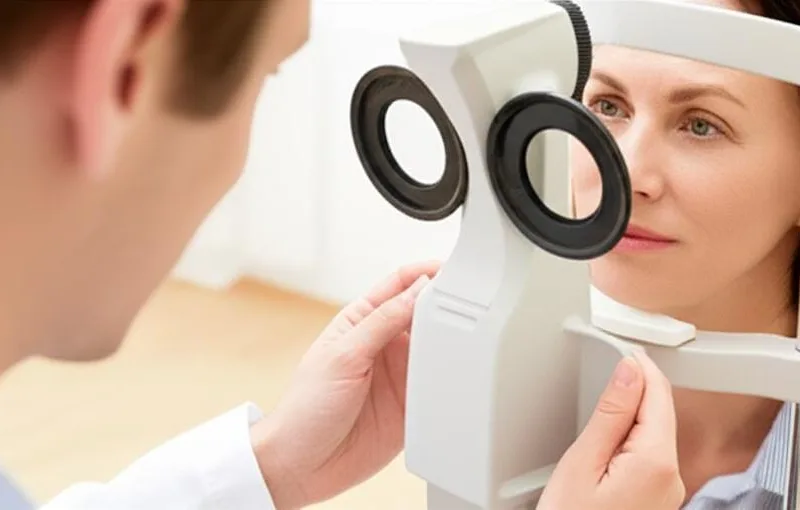
Have you ever gone to an eye doctor and had them do a special test to see how far your vision is? That's what we call a ``Visual Field Test.'' It's actually a very simple, painless test. So let's talk about it in more detail.
What does this `(Visual Field Test)` look at?
Simply put, this test measures two main things.
- It's how far your eyes can see up, down, left, and right when you look straight ahead without moving your head.
- The other thing is, you have the entire area you can see (we call this the `visual field`), and how sensitive your vision is in each part of it.
You know, our eyes can see a large area in front of us at once. Even if you don't move your eyes, you can see not only what's straight ahead, but also what's above, below, and to the sides. Doctors call what you see outside of this straight ahead area ``peripheral vision.' ' What you see straight ahead is ``central vision.''
Normally, we see most clearly in the middle of this `visual field`. That's why you turn your eyes to look at something you want to see clearly. As you move away from the center of your vision, things become less clear. When an object moves too far to the side, it disappears from your view completely.
When is a ``Visual Field Test'' performed?
When you see an eye doctor (an optometrist or ophthalmologist), they will do a visual field test as part of a routine eye exam. This can help your doctor detect early signs of conditions like glaucoma , which can slowly damage your eyes. Some people with glaucoma may not notice any changes in their vision at first. However, a visual field test can detect loss of peripheral vision.
This test can also tell you something else. It tells you how the parts of the nervous system that help you see work. The parts of the nervous system that help you see include:
- Your retina : This is like a transducer inside your eye. It takes light energy and converts it into electrical signals.
- Your optic nerve : This nerve carries those electrical signals to the brain, where they are converted into images.
- Your Brain : Ultimately, those signals become the images you see inside your brain.
Imagine, if there is a problem anywhere in this system, it can affect your visual field. There are certain patterns in the results of this test. By looking at those patterns, doctors can easily understand what kind of damage or disease there is.
Also, by repeating this ``Visual Field Test'' at specific intervals, doctors can see whether your condition is improving or worsening.
For what types of illnesses would a doctor recommend this test?
If you have certain medical conditions, or if your doctor suspects you have one, he or she may recommend that you have a ``Visual Field Test''. Doctors use the results of this test to ``diagnose'' and ``monitor'' the condition. For example:
- `(Glaucoma)`
- Stroke
- Macular degeneration
- `(Multiple sclerosis (MS))` (This is a disease that affects the nervous system)
- `(Graves' disease)` (This is a disease related to the thyroid gland)
- Pituitary gland disease
- Blind spot (scotoma)
Why do some people have to do this ``Visual Field Test'' multiple times?
Sometimes, your eye doctor may ask you to do this ``Visual Field Test'' again quickly to make sure the results are accurate. Remember, if you are feeling tired, the test results may not be as reliable.
Or, your doctor may ask you to have this test again in a few weeks, months, or even a year. This can help identify any new problems early on. If you have certain eye conditions, your doctor will do this ``Visual Field Test'' regularly to see how well your treatment is working.
This test is especially important when treating people with glaucoma. Even if you don't realize it, if your vision is decreasing, the doctor can tell from this test. That's one reason why people with glaucoma should go to every appointment their doctor has prescribed .
What happens when you do a `(Visual Field Test)`?
There is no special preparation you need for this `(Visual Field Test). It is not invasive, so the chances of you experiencing any side effects are very low.
There are several types of ``Visual Field Test''. But they all have one thing in common: you have to look straight ahead at a point, and then signal when you see an object or light to the side.
Your doctor will explain to you exactly where to look to perform the test correctly.
There are two basic types of ``Visual Field Test'', and they are very simple:
- Amsler grid: This is like a square grid. It's a pattern of straight lines drawn in a square pattern. You look at the big dot in the middle. Then, you tell me if the lines look blurry, wrinkled, or broken in any part. The Amsler grid is a quick test. But it only measures the center of your visual field (called central vision). It only gives the doctor a small amount of information.
- `(Confrontation visual field)` test: In this, the word 'confrontation' means that the person doing the test sits in front of the person facing the test, about 3 to 4 feet (about a meter) away. The person doing the test holds his arms out to the sides. You have to look straight ahead. Then he brings one hand, then the other, towards you. You have to signal as soon as you see his hand.
This ``Confrontation visual field'' test only measures the outermost edge of the ``visual field.'' It is not very accurate.
Are there other types of `(Visual Field Test)`?
Yes, you may hear about other types of `(Visual Field Test)` and other names for them. For example, `static perimetry` and `kinetic perimetry` tests. (`Perimetry test` is also another name for `peripheral vision test`, which means a test that checks peripheral vision.)
- `(Kinetic perimetry)` test: In this, the person doing the test moves an object around, and you have to tell them when you see it. Doctors often use the `(Goldmann perimetry test).`
- Static perimetry test: Automated peripheral vision tests are a type of static perimetry test. In this test, you look into a ball-shaped machine. When you see an object, you press a button to indicate it. Examples of static tests include the Humphrey and Octopus machines.
How long does a `(Visual Field Test)` take?
Usually, it doesn't take more than five to ten minutes per eye.
What kind of `(Visual Field Test)` provides the most detailed information?
There are now computerized instruments to perform the Visual Field Test and calculate the results. The results obtained from these instruments are more accurate and reproducible. There are several reasons for this:
- Your head stays in one place the entire time you take the test.
- You can see that this device has a large central 'target', so the center of the visual field can be kept fixed in one place.
- These devices use tiny spots of light to test vision. The doctor can measure the sensitivity of vision in each spot, changing the brightness and color of this light.
- There are clear standards for what constitutes 'normal' results. This device can compare every new test it performs to these standards.
What do the results of the `(Visual Field Test)` say?
A 'normal' result on a ``Visual Field Test'' means that you can see as well as someone without any vision problems.
This test shows how much vision is reduced and what areas are affected. The device prints the results as either `patterns of dots` or `numbers`. These patterns tell your doctor how well your eyes and visual field system are working. This helps your doctor determine what the underlying health condition is and what treatment you need.
A test that shows visual field loss means that your vision is not as sharp as it should be in some areas. The test can show that you have lost vision in a small area, or that you have completely lost vision in large areas.
When will I know the results of the test?
Usually, your doctor should be able to give you the results right away.
If the results are abnormal, what happens next?
Abnormal results can mean many different things. These results can indicate different types of problems, such as `(Glaucoma)`, `(Macular degeneration)` or `(Stroke`). Therefore, the next steps (`follow-up`) may be different.
Your eye doctor will talk to you about your treatment options.
When should I call my doctor ?
If you experience new vision loss or eye discomfort, you should always contact your eye doctor. If you experience sudden vision loss or severe eye pain, you should go to an emergency room immediately.
It's a good idea to have regular eye exams. As part of your exam, you'll likely have a visual field test to see how well you can see above, below, and to the sides of your eyes. If there are any problems with your visual field, the results can help your doctor diagnose a medical condition you may have or see how well current treatments are working.
So, what do we need to remember from all of this?
A ``Visual Field Test'' is a simple, painless test that measures the full range of your vision, meaning how well you can see not only straight ahead, but also around you.
This is a great help in early detection of diseases like glaucoma and monitoring existing conditions.
If your eye doctor recommends this test, be sure to do it, as it can be very important in preserving your precious eyesight .
If you experience sudden changes in your vision or pain, don't forget to see a doctor without delay.
` Visual field test, eyesight, glaucoma, peripheral vision, eye exam, optic nerve, Amsler grid




💬 Comments (0)
No comments yet. Be the first to share your thoughts here.
Add Your Comment