
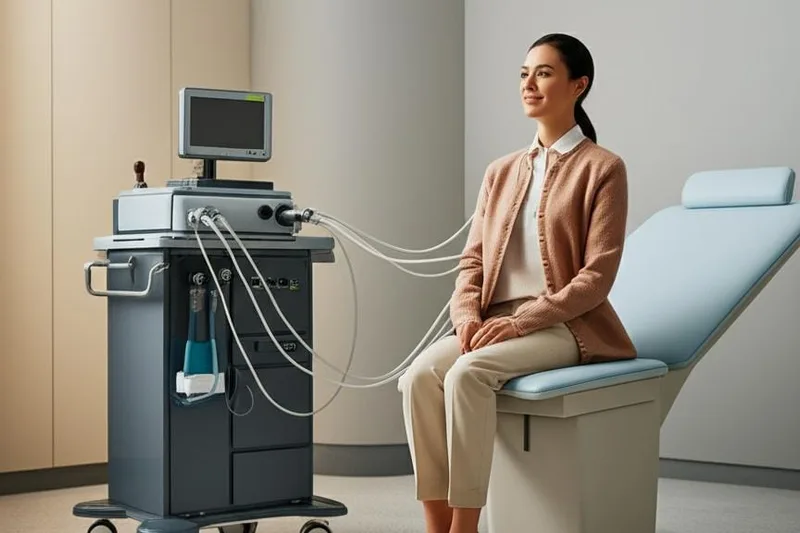
It's normal to feel a little scared when a doctor asks you to do something new. But there are some tests that can help you identify problems inside your body. Today, we're going to talk about a test that can help you know exactly how healthy your lungs are, and it's not that difficult. It's called ``Body Plethysmography''. You may have heard this name before. Let's see what it is, how it's done, and why it's needed.
What is `(Body Plethysmography)`? Simply put...
Simply put, this is a special test that checks how healthy your lungs are and how well they are working. This is a non-invasive, painless, and non-invasive test. Specifically, it measures how much air your lungs can take in when you take a deep breath (inhale) and how much air is left in your lungs when you take a deep breath (exhale). This is a type of lung function test. Some people also call it "lung plethysmography."
This test is very safe and easy. It also gives doctors very important information about how your lungs are working. This information can be used to help them create the best treatment plan for you.
Why is this ``Body Plethysmography'' test done?
There are several reasons for doing this test. The main one is to accurately identify certain diseases of the lungs and respiratory tract. For example:
- Asthma
- Chronic Obstructive Pulmonary Disease (COPD)
- Pulmonary Fibrosis
This test is very helpful in confirming whether or not you have these types of conditions. In addition, ``Body Plethysmography`` test can also do the following:
- Compare how your lungs are working now with how a healthy person's lungs should work. You can also compare it to previous tests.
- Measure how much your lung function has been affected by long-standing lung diseases.
- If there are any early changes in your lung function, identify them early. Then you can decide whether you need to make a change in treatment.
- Find out if any substances in your home environment or workplace are causing lung damage .
- Determine if your lungs are capable of withstanding medical treatments, such as certain surgeries.
When is this test needed?
If you have symptoms related to your lungs, your doctor may recommend a ``Body Plethysmography'' test. Some of the symptoms that may indicate this are:
- If you feel chest tightness, pain, or tightness.
- Cough, especially if there is a cough that comes with phlegm.
- If you feel like it's hard to take a deep breath.
- If you have difficulty breathing (dyspnea) or shortness of breath.
- If you make a wheezing sound when you breathe.
If the results of this test are not normal, that is, "abnormal," it can confirm that the doctor has a condition that prevents your lungs from holding enough air.
What are the advantages of this test?
There are two main advantages of a ``Body Plethysmography'' test.
1. Very accurate: The results obtained from this are very accurate.
2. Quick: This test can usually be completed in less than 20 minutes. Also, many measurements can be obtained within a few minutes.
Are there different types of `(Body Plethysmography)`?
Yes, there are several main types of this test. Let's see what they are.
- Pressure Plethysmograph: In this test, you are placed inside a transparent plastic box that is sealed so that no air can escape. Inside this box is a certain amount of air. As you breathe, the changes in air pressure inside the box are measured to determine the volume of air in your lungs. A special machine called a spirometer, which is attached to a mouthpiece that fits in your mouth, measures the volume of the area between your neck and your abdomen (the chest cavity). This method is very sensitive and can measure even small changes in volume. This is also called a "closed-type plethysmograph."
- Volume Plethysmograph: In this, you are placed in a transparent plastic box that is sealed. However, changes in air volume are measured by measuring the displacement of air inside the box. As the volume of air in your chest cavity changes, air inside the box is forced out through a hole connected to a spirometer. The spirometer measures that airflow. This method is a bit more complicated, so it is usually used more for medical research. This is also called an "open-type plethysmograph."
- Pressure-Volume Plethysmograph: As the name suggests, this is a combination of the two methods mentioned above. When you breathe, the volume changes in your chest cavity cause the air inside the box to flow through a hole in the box and into a spirometer. The medical staff then adds up the pressure difference or volume displacement measurements to make calculations.
Who performs this ``(Body Plethysmography)`` test?
This test is usually done by a Respiratory Therapist . This is someone who helps treat your lung or breathing conditions. This is done in a Lung Function Lab. Then, a Pulmonologist reviews and confirms the results of this test.
How does this ``Body Plethysmography'' test work?
It's very simple. You are placed inside a sealed, air-tight, but light-permeable plastic box. As you breathe through a tube (a mouthpiece) that is attached to your mouth, a sensor inside the box measures the changes in air pressure. That mouthpiece also has a sensor that measures the air flow and pressure inside your mouth.
When you breathe in, your chest moves forward, and when you breathe out, it moves back in. As your chest expands and contracts, the volume and pressure of the air inside the box are measured by a sensor inside the box. At the same time, a sensor in the mouthpiece also measures the pressure changes. This data is used to calculate information about your lungs.
What does the ``Body Plethysmography'' test measure?
This test mainly measures several air volumes in the lungs:
- Total Lung Capacity (TLC): This is the total amount of air in your lungs after you take in the deepest breath you can.
- Functional Residual Capacity (FRC): This is the amount of air left in the lungs after you exhale normally.
- Residual Capacity (RC): This is the amount of air left in the lungs after you exhale as hard as you can.
How are these measurements taken? Is there any scientific basis?
Yes, this test is based on a scientific law called `(Boyle's Law)`. You may have heard about it in school. Simply put, this law states the relationship between the volume and pressure of a gas at a constant temperature. That is, as the volume of a gas increases, the pressure decreases, and as the volume decreases, the pressure increases. That is the principle that is used in this test to calculate the volume of air in the lungs. By measuring the changes in air pressure, the volume of air can be found.
What should I do before the test?
Your doctor will ask you if you are feeling well. If you have a cold, flu, or other respiratory infection, you may need to reschedule your test date. This will prevent accurate results.
If you are taking any medications, you should also tell your doctor about them. You may be asked to stop taking certain medications on the day of the test.
In addition, the doctor will give you some advice like this:
- Do not smoke for at least an hour before the test.
- Do not drink alcohol for at least four hours before the test.
- Avoid strenuous exercise for at least 30 minutes before the test.
- Wear loose, comfortable clothing that is not tight on your chest or stomach. You should be able to breathe easily. Wearing tight clothing may change the results.
- Do not eat a heavy meal for at least two hours before the test.
Only by following these instructions correctly can you obtain the most accurate results from the ``Body Plethysmography'' test.
What happens during the test? What kind of experience will I have?
During the test, you will be placed in a sealed plastic box that is airtight, but light can still be seen. If you have claustrophobia, which means you have difficulty being in small spaces, tell your doctor beforehand. They may give you a small dose of medicine to take before the test to help you relax. Don't worry, the medical staff will talk to you throughout the test, and you will be able to see them and everything else in the room from inside the box. If you need to rest during the test, you can also say so.
Next, the medical staff will place a small clip on your nose. This will help you breathe only through your mouth. After that, they will instruct you on how to breathe through the mouthpiece.
When you're ready, they close the door of the box, and then the test begins.
Important: If you normally take supplemental oxygen (either from a tank or a machine), you will not be able to use it during this test.
Is this test painful?
No, the ``Body Plethysmography'' test is not painful at all.
However, as you take a deep breath in and out, you may feel a little dizzy, light-headed, or tired. You may also cough when you blow into the mouthpiece. These symptoms will go away after a while after the test. Remember, if you need a break, tell the staff.
Very rarely, your blood carbon dioxide levels can increase (Hypercapnia) or your blood oxygen levels can decrease (Hypoxia). These conditions can only occur if you stay in the box for a long time. But that's very rare.
Also, this test may cause your heart rate to increase slightly. If you have had a heart attack before, or have any other heart-related conditions, be sure to tell your doctor about it.
How long does the ``Body Plethysmography'' test take?
This test usually takes about 15 minutes to complete. Faster than you think, right?
What happens after the test?
After your Body Plethysmography test is complete, you can return to your normal daily activities.
If you feel dizzy during the test, the medical staff will monitor your health until your symptoms resolve and you can go home.
What is a "normal" `(normal)` `(Body Plethysmography)` result?
What is considered a "normal" or "average" ``(Body Plethysmography)`` result can vary from person to person. It depends on several factors. For example:
- your age
- Your height
- Your race (ethnicity)
- Your gender (feminine/masculine)
- Whether you use tobacco products
- Your weight
Your doctor will consider all of these factors and determine what the normal range is for your age group and other information. Therefore, your "normal" result may be different from someone else's "normal" result.
When will I know the results of the test?
You will usually know the results within a few days of the test.
When should I contact my doctor?
Your doctor will call you a few days after the test to discuss the results. If you haven't heard from your doctor about your results after a few days, contact your doctor yourself.
If this ``Body Plethysmography`` test identifies you as having a long-standing lung disease ``Chronic Lung Disease``, you may need to have lung function tests every year .
What is the difference between `(Spirometry)` and `(Body Plethysmography)`?
Spirometry is another type of pulmonary function test. In fact, it is the most commonly used test by doctors to check lung function.
However, it is not as accurate as ``Body Plethysmography``. ``Spirometry`` cannot measure ``Residual Lung Volume`` or ``Total Lung Capacity``.
With Body Plethysmography, you can measure things like the pressure difference from your mouth to your lungs (this is called Airway Resistance) and the volume of air in your chest cavity (Intrathoracic Gas Volume - ITGV).
If you notice any changes in your breathing pattern, it's best to talk to a doctor about it. The change may not be serious, or it could be a sign of a lung condition.
Finally, things to remember (Take-Home Message)
Your doctor can use a ``Body Plethysmography'' test to help diagnose any lung conditions you may have. This test is quick, accurate, and painless. The results are usually available within a few days. Once you have an accurate diagnosis, you and your doctor can work together to develop a health plan that will improve your quality of life or maintain your current condition. Therefore, it is important to follow your doctor's instructions without fear of these tests.
` Lungs, Lung Test, Body Plethysmography, Respiratory Disease, Breathing, Lung Capacity, Spirometry


💬 Comments (0)
No comments yet. Be the first to share your thoughts here.
Add Your Comment