
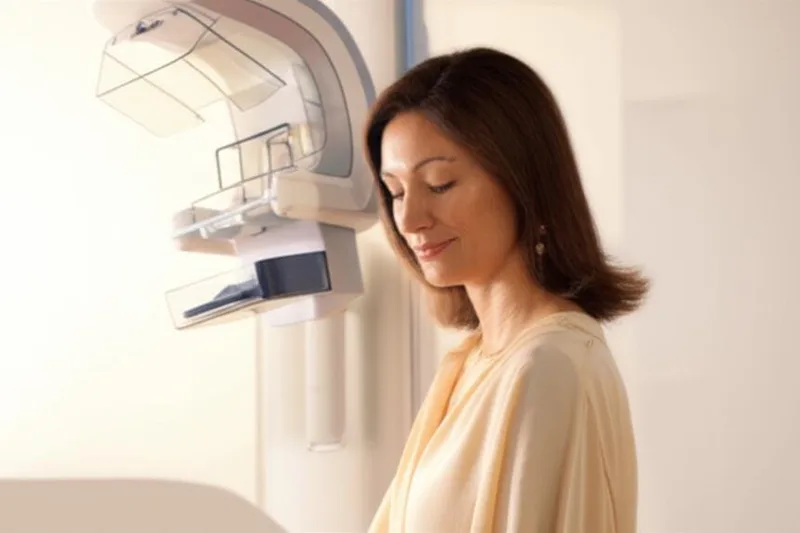
Have you ever been a little scared or suspicious about your breasts? Or have you heard about breast cancer and wanted to know more about it? Today we are going to talk about a mammogram test that comes to our aid at such times, and it works with very advanced technology. Its name is digital breast tomosynthesis, or as we all know it, 3D mammography.
What is tomosynthesis? Is it exactly a 3D mammogram?
Simply put, this `(Tomosynthesis)` is a very advanced type of mammogram used to detect breast cancer . It is especially useful if your breast tissue is a bit dense, that is, `(Dense breast tissue)`. Do you know why? It is also called `(3D mammography)`. The reason for this is that this machine takes many two-dimensional (2D) pictures of your breast and puts them all together to create a three-dimensional (3D) image .
The standard mammogram we usually do takes only two-dimensional (2D) images of the breast. It is still considered the most reliable way to detect breast cancer. However, this new technology, called tomosynthesis, was approved by the US Food and Drug Administration (FDA) in 2011. It is so good at detecting cancer that it may become the gold standard for breast screening in the future .
Who benefits most from tomosynthesis?
In fact, anyone who wants to have a mammogram can benefit from this `(Tomosynthesis)`. But, especially if your breast tissue is dense (rather than fatty tissue), this is especially valuable to you . About half of all women are said to have dense breasts. Because your breast tissue is dense, it is a little harder to find cancer with a regular 2D mammogram.
Think of it this way. Like a regular mammogram, a tomosynthesis uses a low dose of X-rays. Dense tissue – that is, bone, solid tumors, and dense breast tissue – absorbs more of these X-rays. They appear white on a mammogram. The problem is, because both cancer and dense breast tissue appear white, it can sometimes be difficult to tell the two apart.
This is where ``Digital breast tomosynthesis'' comes in. It takes pictures of your breast from more angles and more images than a regular mammogram. The resulting 3D image is very clear. This means that it can detect cancer that may be "hidden" in dense breast tissue. It can also accurately identify healthy tissue that would look "suspicious" or "likely to be cancerous" on a regular mammogram. This also reduces the number of false-positive results . That means you're less likely to be diagnosed with cancer when you don't actually have it. Isn't that a great relief?
When is tomosynthesis needed?
This ``(Digital breast tomosynthesis)`` is used in one of two ways:
As a screening test for early detection of breast cancer
The US Preventive Services Task Force (USPSTF) recommends that all women start getting mammograms at age 40. However, if someone in your family has had breast cancer (i.e., a strong family history), you may want to start getting screened earlier. Tomosynthesis is a great alternative to screening. Like a traditional mammogram, it can detect cancer early , before you have any symptoms.
As a diagnostic test when symptoms occur
If you have any breast symptoms – such as breast pain, a lump in your breast, or skin changes – your doctor may order a ``Digital Breast Tomosynthesis''. This is a ``Diagnostic'' test. This can help your doctor confirm that you do not have cancer, or decide whether a ``Biopsy'' is needed to see if there are any cancer cells.
Who is doing this test?
Typically, a radiologic technologist or mammographer will position you for this test, operate the mammography machine, and then analyze the images and report the results to your doctor .
How does this tomosynthesis machine work?
This ``Digital breast tomosynthesis (DBT)`` is very similar to a regular mammogram. The main difference is that it takes more detailed pictures of your breast, from more angles .
Imagine that in a typical mammogram, your breast is placed on a flat surface and pressed (compressed) between two horizontal plates. The machine takes two-dimensional (2D) images of your breast from two angles – top to bottom and side to side.
In DBT, your breast is positioned and pressed in the same way as a regular 2D mammogram. In Tomosynthesis, the mammogram machine's arm (X-ray tube) moves in a curved arc over your breast. As it moves, it takes many 2D images from different angles.
These 2D images are then digitized and sent to a computer. The computer combines all of these images to create a three-dimensional (3D) image . This 3D image shows a lot of detail, making it much easier to tell the difference between healthy tissue and tissue that could be cancerous.
How do you prepare for a tomosynthesis test?
It's important to tell your doctor your full medical history – especially your breast health. Here are some things to do to prepare:
- Discuss your medical history with your doctor: Tell your doctor about any breast conditions you have, any surgeries you've had, any recent injections you've had, and any hormones you're taking. Tell your doctor about your family history of breast cancer. If you're pregnant or breastfeeding, your doctor should also be aware of this.
- Have your current doctor send you the results of previous tests: If you've had a mammogram done elsewhere before, make sure to send those images to your current doctor. It's easier to spot abnormalities when you compare the images you're getting with the previous ones.
- Schedule your exam on a day when your breasts are not painful: Breast tenderness is usually less during the first week or two after your period ends. That's the best time to get a mammogram.
What to expect on the day of the test?
Expect this test to take about 30 minutes . You can go home the same day. Keep these things in mind to prepare:
- Shower normally, but do not apply any cosmetics such as deodorant, powder, or lotion. These can show up as white spots on the mammogram, which can lead to misinterpretation of the results.
- Wear comfortable clothing that is easy to change into. You will likely need to remove your top (top and bra) and put on a hospital gown that opens in the front.
- Don't wear jewelry. Necklaces and long earrings can also distort the mammogram image. It's best to leave them at home. Ask the staff if it's okay to wear something like small earrings.
How is a tomosynthesis test performed? Can you explain it a little?
This `(DBT)` is done just like a regular mammogram. The main difference is that in `(DBT)`, the machine's arm (the X-ray tube) emits X-rays as it moves slowly in an arc around your breast.
- The technologist will have you stand in front of the mammography machine and place one of your breasts on the platform. They will adjust the height of the machine to the right level and position your breast so that it can be seen clearly.
- Once you are properly positioned, a plastic plate will slowly lower, pressing your breast against the platform. You will feel some pressure at this time. It is normal to feel some discomfort. But if you feel any pain, tell the technologist. Remember, there is an important reason behind this discomfort. This pressing allows the radiologist to see your breast tissue clearly. Also, because the tissue is pressed, a lower dose of radiation can be used.
- The technologist will move a little to turn on the machine. You will need to remain still while the machine moves. The technologist may also ask you to hold your breath while the machine takes pictures (for a few seconds).
- The X-ray tube moves in an arc around your breast, emitting several low-dose X-rays.
- After taking enough pictures of one breast, the technologist does the same for the other breast.
Remember: Even though this test may seem a little uncomfortable, it is very important for your health. So stay strong.
How much radiation is used in tomosynthesis? Is it something to be afraid of?
In the United States, the FDA has only approved DBT for use in conjunction with mammography. The total radiation dose is about three times that of a regular mammogram. While "three times" may sound like a lot, it is still a very low dose of radiation, and is considered a safe amount .
There are new `(Tomosynthesis)` techniques that can create two-dimensional (2D) images from the same data used to create a three-dimensional (3D) image. This further reduces radiation exposure, only slightly more than a regular mammogram.
Mammography, including ``Tomosynthesis,'' uses the lowest possible, safest dose of radiation to provide high-quality images to detect breast cancer. So don't be unnecessarily afraid of this.
What are the results like? What do they tell us?
A radiologist will examine your images to look for signs of breast cancer. If he or she sees anything suspicious, he or she may compare the 3D image with your previous mammogram results or 2D images. He or she will write a report for your doctor, who will tell you the results.
Depending on the results, you may be told that you do not have cancer. Or, you may be told that additional tests are needed to further examine the suspicious tissue. This may include another mammogram, an ultrasound, an MRI, or a biopsy. The only way to know for sure that you have cancer is to have a biopsy.
How long does it take to know the results?
Results are usually available within a few days , but sometimes it can take longer. Before you leave the testing facility, ask how you will receive your results and when you can expect them.
So, is tomosynthesis better than a regular mammogram?
Tomosynthesis gives a more detailed image of your breast than a regular mammogram. It is better at detecting cancer in people with dense breast tissue and reducing false-positive results. However, research is still being done to see if 3D mammograms are better than 2D mammograms for screening for breast cancer in general.
It's best to follow your doctor's recommendations about what breast exams you need based on your medical history and the nature of your breast tissue.
Are tomosynthesis and 3D mammogram the same thing?
Yes, that's right! Tomosynthesis, breast tomosynthesis, digital breast tomosynthesis, and 3D mammogram are all names for the same test procedure.
Is it true that tomosynthesis is better for people with dense breasts?
Yes, that's right. This gives a more detailed image of your breast, making it much easier for a radiologist to tell the difference between dense breast tissue and cancer.
The most important things you need to remember from what we have discussed (Take-Home Message)
Okay, so now you have a good idea about what we've been talking about, Digital Breast Tomosynthesis (DBT). The important thing is that if you have dense breast tissue, this can be a great option for detecting breast cancer.
- If it's time for you to have a mammogram, ask your doctor if tomosynthesis is performed as part of the test.
- Depending on your health, even a routine mammogram may be enough to detect cancer.
- In some cases, tomosynthesis may increase the chance of finding cancer, or it may also reduce the stress of receiving a false-positive result.
- Never hesitate to ask your doctor anything about this test, including why it's right for you (or not). It's important to be informed about your health.
` Breast cancer, tomosynthesis, 3D mammogram, mammogram, breast exam, dense breasts, cancer detection


💬 Comments (0)
No comments yet. Be the first to share your thoughts here.
Add Your Comment