

Today we're going to talk about a special scan that can show you a lot of information about your heart. It's called a cardiac `CT` scan (Cardiac Computed Tomography - CT scan). Maybe your doctor has told you to do this, or you've heard about it somewhere. So let's take a look at what it is, how it's done, what you need to know before you have it, and what the pros and cons are.
What is a cardiac CT scan?
Simply put, a cardiac CT scan is a special type of X-ray test that uses multiple X-ray beams from different directions to produce very clear, three-dimensional images of your heart, the great vessels that connect to it, and the surrounding tissues.
Doctors use the latest CT technology to perform this `Cardiac CT` scan. Sometimes, a special fluid (intravenous (IV) contrast / dye) is injected into your vein. This allows the structure of the heart and the blood vessels connected to it to be seen more clearly. This multi-slice scanning method allows doctors to obtain very high-quality, three-dimensional images of your moving heart and large blood vessels.
What can a CT scan of the heart detect?
Your doctor can get a better understanding of many things about your heart from this scan. For example:
- The condition of the coronary arteries that supply blood to your heart.
- How the heart chambers, heart muscle, and heart valves work.
- The nature of the pulmonary veins .
- Whether there is a problem with the thoracic aorta and sometimes the abdominal aorta .
- The protective sac around the heart (pericardium) .
Because all of this can be seen very clearly on this scan, it will be a great help for the doctor to make a good decision about your heart health.
When is a cardiac CT scan needed?
A cardiac CT scan can provide more detailed and clearer data than other imaging tests. There are several reasons why your doctor may order this scan. Let's take a look at what they are:
- Find out what's causing your chest pain or shortness of breath.
- Check your heart arteries for calcium or plaque buildup , narrowing, or blockages.
- Assess the function of your heart valves.
- Check for any problems with your aorta, such as aneurysms or dissection .
- Plan open heart surgery or minimally invasive/robotic heart surgery .
- Plan transcatheter/percutaneous valve procedures .
- Plan arrhythmia ablation procedures for heart rhythm irregularities .
- Assess the complications that may occur after such surgeries or treatments.
- Check if you have a congenital heart problem .
- Find out if there is a tumor or mass in or around the heart and what its nature is.
- Check the sac around the heart (pericardium) for fluid accumulation (`fluid`) or calcium deposits (`calcification`).
Imagine, your uncle is constantly having chest pains, and the doctors can't figure out exactly what's causing it. At a time like this, a `CT` scan can provide a lot of useful information.
Who performs the cardiac CT scan?
Most of the time, your cardiologist will recommend this cardiac CT scan. However, there is a separate healthcare team at the location where the scan is performed to help you. They are:
- Technicians: These are the people who operate the CT scanner and obtain the images.
- Nurses: If necessary, nurses will place an `IV` line in a vein in your arm and administer medications.
- Doctors: Doctors monitor the scan, analyze the images, and provide a report (`interpret the scan`).
To get this scan, you have to go to a hospital or a place specialized in `medical imaging`.
How does a cardiac CT scan work?
It's very simple. As you lie on the bed of the scanner, the X-ray beam rotates around you. But it doesn't hit your body. You may hear a slight buzzing or clicking sound as the machine works. A computer combines these scan images to create a three-dimensional (3D) image of your heart.
What is the difference between a cardiac MRI and a cardiac CT?
You may have heard of a cardiac MRI test. Both cardiac MRI and cardiac CT can produce detailed images of the heart, but there are a few differences between the two tests. Let's take a look at what they are.
- When you go inside the machine, the CT machine is more open than the MRI machine. This means that some people feel less cramped when they are inside the MRI machine.
- An MRI scan takes longer than a CT scan.
- A CT scan uses X-ray radiation , but an MRI does not use radiation.
- The CT machine is quieter than the MRI machine.
- If you are given a contrast medium, a CT scan uses an iodinated contrast medium , while an MRI uses a gadolinium-based contrast medium .
So, it is the doctor who decides which scan is most suitable for you.
How should I prepare for this test?
You should follow your doctor's instructions exactly the day before and on the day of your cardiac CT scan, regarding what to eat and drink, and what medications to stop taking.
About food and drink
- On the day of the test, do not eat anything for four to six hours before your scheduled time. You may only drink water.
- Do not drink any caffeinated drinks the day before or on the day of the test. This means no coffee, tea, or energy drinks.
- Do not use energy pills or diet pills the day before or on the day of the test. If you have any questions about this, ask your doctor.
About medicines
- If you are someone who feels nervous in tight spaces, ask your doctor about a medication that can keep you calm during the scan.
- Inform your doctor about all medications you take, even non-prescription medications.
- Do not take Sildenafil (Viagra® or Revatio®) or similar medications the day before or on the day of the test, as these may interact with the medications you will be given during the test. Ask your doctor about this as well.
- If you have diabetes , ask your doctor how to adjust your medication on the day of the test. If you think your blood sugar is low, tell your doctor right away.
What to expect on the day of the test?
Before your cardiac CT scan, your doctor will want to know about these things:
- Are you pregnant?
- Are you allergic to iodine and/or shellfish , or to other medications?
- Are you currently receiving radiation therapy ?
- If you are over 60 years old , or have had kidney problems in the past, you may need to have a blood test to check your kidney function before the contrast fluid is given.
Preparing for a CT scan
- Take off your jewelry and leave it at home.
- You will have to wear a special hospital gown provided by the hospital.
- Perhaps the doctor can give you a medicine that slows down your heart rate .
- If you are given contrast (dye) fluid, a nurse will put an IV line in a vein in your arm. This fluid is what makes your blood vessels and heart show up clearly on the scan images.
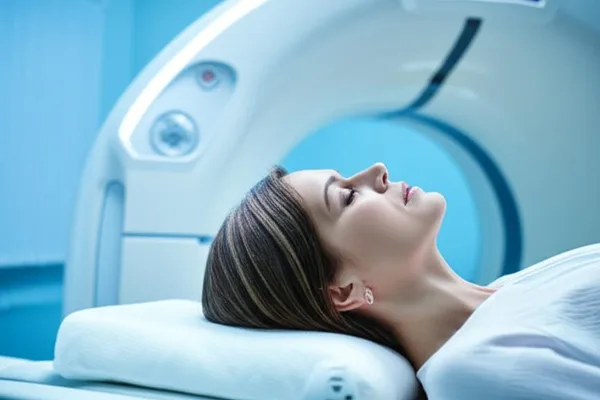
- You will be made to lie down on a special bed, and the bed will be slowly moved to the circular opening in the middle of the CT scanner.
- The doctor will clean about three areas of your chest and apply small, sticky electrode patches to them. To ensure that these electrodes stick properly, you may need to trim some of the hair on that area of your chest.
- These electrodes are connected to an electrocardiogram (EKG) monitor , which records the electrical activity of your heart during the test.
- You will be asked to lie on the scanner bed with your arms above your head until the test is over. Your head and legs will be outside the scanner.
Most importantly: It is very important to remain still during this time and follow the instructions carefully. Only then will you be able to get clear images.
What happens during the test?
A full cardiac CT scan can take between 30 and 60 minutes , including preparation time. However, the actual CT scan itself takes a little longer, about 10 minutes at most .
- You will feel the doughnut-shaped scanner move into the bed you are lying on.
- If you are given contrast fluid, a healthcare provider will inject it through your IV line. It is normal to feel a slight warm sensation as the fluid travels through your body. Some people may experience a metallic taste in their mouth for a few seconds.
- To get clear images, it is very important that you remain still and follow the instructions exactly .
- You can talk to the health care team. They may also ask you to hold your breath for a very short time .
What happens after the test?
After the doctor makes sure they have all the images they need, they will remove your IV line. Then you can change and go home.
After the test, you can go about your normal activities and eat and drink. However, if you have taken a sedative, someone will need to come and take you home.
Your doctor will talk to you about the test results either that day or in a few days.
Are there any risks with this test?
A CT scan is a low-risk procedure . However, some people may experience minor problems with the contrast fluid or other substances used in the test.
Contrast agent / dye
- Rarely, some people may have an adverse reaction to the contrast fluid (which usually contains iodine). Some people may experience itching, nausea, sneezing, or a skin rash after the fluid is injected. These symptoms usually go away without treatment. However, they can be controlled with antihistamines, steroids, and histamine blockers .
- Very rarely, a severe allergic reaction (anaphylactic reaction) can occur. It can cause difficulty breathing. This can be life-threatening, so immediate treatment and medication are needed to control these symptoms.
- If you have diabetes or kidney disease , you may be asked to drink extra fluids after the scan to help flush the iodine out of your body.
- Since the contrast medium used for a cardiac CT scan can pass into your breast milk , if you are breastfeeding, it is a good idea to express some breast milk before the scan. You can then feed your baby that milk for a day or two after the scan.
Radiation
CT scanners use X-rays. There is a very small risk of cancer from this radiation over time. For your safety, your exposure to radiation is kept to a minimum. However, X-rays can be harmful to a developing fetus, so this test is not recommended if you are pregnant . If necessary, your doctor will make arrangements to protect your baby.
Heart rate lowering medication
If you were given medicine to slow your heart rate for the test, or if you have a condition such as asthma, heart failure, or chronic obstructive pulmonary disorder (COPD) , you may have difficulty breathing during the scan. It is very important to tell your doctor if you have any of these conditions.
What are the results? What does it mean?
There can be two types of results after the scan: normal results and abnormal results.
Normal results
- Your heart and arteries look normal .
- Your calcium score is zero (`0`). That means you don't have coronary artery disease , and you have a low risk of having a heart attack.
Abnormal results
- There are fatty deposits (plaque) and narrowing (stenosis) in the coronary arteries.
- Having a high calcium score means you have coronary atherosclerosis .
- A calcium value of 100 or less indicates mild symptoms of coronary artery disease.
- If it is above 400 , it indicates widespread symptoms of coronary artery disease.
- If it is between 100 and 400 , there are moderate level characteristics.
- Often, your calcium level is given as a percentile score , which tells you where you stand compared to other people of your age, gender, and ethnicity who have taken the test.
- The heart's function or valves are not working normally .
- Pericardial disease - accumulation of fluid in the sac around the heart (`effusion`) and inflammation of the pericardium (`pericarditis`).
- There is a tumor or mass .
- There is a congenital heart problem .
- The blood vessel is enlarged (aneurysm) , has a tear (dissection) , or is narrowed (stenosis/coarctation) .
Your doctor will explain these results to you thoroughly.
When should I call the doctor?
If you feel like you are having a reaction to the contrast fluid or medication you were given during the test, or if you have not received the results of your cardiac CT scan after a few days, call your doctor.
The most important things to keep in mind (Take-Home Message)
Don't be afraid of a cardiac CT scan or the CT machine. This is a noninvasive test that gives your doctor a lot of valuable information about what's going on in your heart and its surrounding structures.
For best results, follow your doctor's instructions about eating and drinking before the test. Also, be sure to remain still and hold your breath during the test.
This test can tell you a lot about your heart health, so don't hesitate to get it done if necessary. Talk to your doctor about any questions or concerns you may have.
` Cardiac CT scan, heart, coronary artery, scan, heart disease, CT scan, 3D imaging




💬 Comments (0)
No comments yet. Be the first to share your thoughts here.
Add Your Comment