
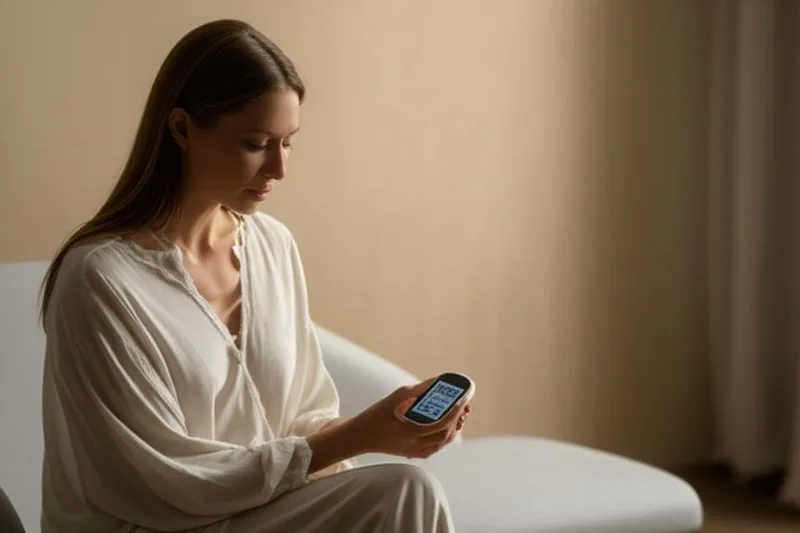
Have you ever had an ECG? Or has your doctor or nurse ever asked you to have one? Maybe this sounds a little scary and big to you. But an ECG is actually a very simple, painless , but very important test. Today, we're going to talk about what an ECG is, what it does, and what it can tell us in a very simple, understandable way.
What is ECG (Electrocardiogram)?
Simply put, an ECG (electrocardiogram) is a test that records the electrical activity of your heart . More specifically, it measures the small electrical waves that are produced when your heart beats. Doctors use it for many things, such as checking for heart rhythm issues or to see how a certain treatment is affecting your heart.
This is a very quick, noninvasive test. You can do it while you're lying in bed. Sometimes an ECG is also taken as part of a ``stress test`` during exercise. You may have heard that some ``smartwatches`` can now take an ECG. However, the best thing to do is to have a doctor do a proper ECG and review the report .
You've probably heard it called ECG and EKG. Don't worry, they're the same thing . The word EKG comes from the German language, where the letter 'k' is used instead of the letter 'c'.
Important: Is an ECG (Electrocardiogram) different from an ``Echocardiogram''? An ``Echocardiogram'' is an ``Ultrasound scan'' of the heart. It shows pictures of how the heart is beating. An ECG looks at the electrical activity of the heart.
Are there any types of ECG?
Yes, there are several types of ECG machines. Doctors use them depending on how long they need to monitor your heart rhythm. A typical ECG is done in a hospital or doctor's office. It records the heart's electrical activity for a very short period of time (usually about 10 seconds) . So, imagine if you have a heart attack that doesn't happen all the time, but only occasionally, you might miss it if you don't get an ECG right away. It's like our home internet goes down and it's working fine until someone comes to fix it.
Therefore, there are other types of ECG that can be used in times like these:
- Standard 12-lead ECG: This is the type you would normally get when you go to see a doctor. You will not be allowed to take this device home.
- Short-term, wearable monitor - e.g. Holter monitor: This is a small device. You wear it for 24 or 48 hours . It continuously records the electrical activity of your heart while you go about your normal daily activities.
- Event monitor: This device is worn for a week or more . When you experience a symptom (e.g., a heart attack), you can press a button and record your heart activity at that time.
- Implanted loop recorder: This is a very small device that a doctor implants under your skin . It can be left in place for several years.
- Exercise ECG (Stress test ECG): In this, you are connected to an ECG machine and the ECG is taken while you walk on a ``(Treadmill). This is done to see how your heart responds when you are stressed.
When is an ECG done?
A doctor may decide to perform an ECG test for a variety of reasons. The main ones are to diagnose or confirm certain medical conditions:
- Irregular heart rhythms (Arrhythmia) or abnormalities in the transmission of electrical signals.
- Reduced blood flow to the heart muscle (ischemia) - This can be caused by coronary artery disease.
- An issue with your heart valves.
- Congenital heart disease - heart disease that is present at birth.
- Check if you have had a heart attack or have had one before.
- Check for enlarged heart chambers.
- Check for heart damage or heart failure.
Also, doctors use an ECG to:
- Before you have major surgery, make sure your heart is ready for it.
- If you are at high risk for heart disease, check your heart health.
- If you have a pacemaker, see how it works.
- See how a new drug for heart disease works.
- Check the heart rhythm after a heart attack.
A doctor may order an ECG if you have any of these symptoms:
- Chest pain
- Shortness of breath
- If you feel very tired (Tiredness)
- Dizziness
- Syncope / fainting
- Cyanosis / blue hands and feet
- A flutter or skip in your heartbeat
- If you feel like your heart is beating fast (A fast heartbeat)
- Inability to increase blood supply to the heart as needed during exercise (Chronotropic incompetence)
How does the ECG test work?
Your heart has a natural pacemaker. It sends out the electrical signal that starts your heart beating. An ECG machine records this electrical signal and records how it travels throughout your heart, how the heart muscles contract and relax, with each heartbeat. This information is displayed on a computer as a waveform (either on graph paper or on a screen) . Doctors can tell the condition of your heart by looking at it.
An ECG is usually ordered or performed by a cardiologist. However, it can also be done in an ambulance, emergency room, or when you visit a regular doctor. You can have an ECG done in a doctor's office, hospital, or outpatient clinic.
How do you prepare for an ECG?
You can eat and drink normally before an ECG. But keep these things in mind before getting dressed on the day of your ECG:
- Do not apply oily or greasy skin products (creams, lotions) because the electrodes will not connect properly to the skin.
- Do not wear full-length hosiery, as this will require electrodes to be attached to the legs.
- Wear a shirt that is easy to remove, as electrodes will be attached to your chest.
What happens when an ECG is done?
A medical assistant or nurse will attach about 12 ``electrodes'' with small adhesive pads to your chest, arms, and legs. Typically, six ``electrodes'' are attached to your chest and six to your arms and legs. The information from these ``sensors'' is sent to the machine through ``wires'' or ``leads.'' That's why it's called a ``12-lead ECG.''
To get a good connection, you may need to shave some of the hair in those areas. It takes about 10 minutes to attach the electrodes and complete an ECG test. However, the heart's activity is actually recorded in a very short time, about 10 seconds.
If you have a ``resting ECG'', you have to lie down in bed and relax. If you have a ``stress test'', you have to walk on a ``treadmill''.
A computer creates a picture (either on graph paper or a screen) of the electrical waves passing through your heart. You will not feel any pain or discomfort as the information is sent to the computer from the electrodes.
The electrodes will remain on your skin until the ECG test is complete.
What happens after the ECG?
When the test is over, the doctor or nurse will remove all the electrode patches. After that, you can go about your normal activities. Very simple, right?
What does the ECG show?
When looking at an ECG, a doctor mainly looks at how much electrical activity there is, how strong it is, and how much time passes between different parts of the electrical waves (`waves or peaks`).
The main parts of an ECG and what they read are simply as follows:
- The two upper chambers of your heart (the `Atria`) - where the heartbeat begins - produce the first wave, the `P wave` .
- The two chambers at the bottom of your heart (the `ventricles`) are what create the next big hill, the `QRS complex` .
- The third wave, the 'T wave', shows how the heart is resting, or 'recovering', after it beats.
Are there any risks to this test?
An ECG is a very low-risk test. It doesn't involve any radiation or electricity being sent into your body. You may experience some redness and itching when the sticky patches are removed. Other than that, it's nothing serious. So there's no need to worry.
How are the results obtained? What does it say?
A normal, healthy ECG should have a consistent, repeating pattern of waves. A small bump (the `P wave`), then a spike (the `QRS complex`), then another small bump (the `T wave`), all in the same pattern and at the same time intervals. This means that your heart is beating regularly and rhythmically.
Abnormal wave patterns are the only way to detect a problem. By looking at the changes in the ECG, the doctor can tell which part of the heart is malfunctioning or what kind of condition it is. The process of the heart beating is very complex, and many parts of the heart are involved.
How long does it take to know the results?
If your ECG results are available immediately, your doctor will be able to tell you more about them right away, especially if you need urgent treatment. However, if your ECG was done as a routine test or as part of a series of tests before a non-heart-related surgery, it may take a few days to get the results.
Your doctor will also keep your ECG records to compare with future ECGs.
If the results are abnormal, what do you do next?
What to do next depends on the reason for the ECG.
- Imagine you have a pacemaker, and if the ECG shows that it's not working properly, the doctor might change its settings.
- If the ECG raises suspicions about a disease, your doctor may ask you to undergo further tests (e.g., echocardiogram, stress test, blood tests) to confirm it.
- If the ECG confirms that you have a heart condition, your doctor can prescribe appropriate medication, other treatments, or even surgery.
Do I need to see the doctor again?
You should definitely see your doctor again in these cases:
- What if it's been a few days since the ECG was done and you haven't heard anything about the results?
- If your symptoms (e.g. chest pain, shortness of breath) are worse than before the ECG.
- If you have any further questions about what the doctor said, what to do next, or if there is anything you need to clarify.
Finally, remember this.
It's normal to feel a little scared and nervous when we hear about heart tests. But, you now know that an ECG (Electrocardiogram) is a very quick, painless, and very important test . The information it provides can tell your doctor a lot about your heart rhythm and the health of your heart.
Depending on the results of the ECG, you can start the treatment you need sooner, helping you stay healthy and fit. So, don't be afraid to ask your doctor any questions you have about the ECG, no matter how small. They are there to help you.
` ECG, EKG, electrocardiogram, heart test, heart disease, heart rhythm, heart health


💬 Comments (0)
No comments yet. Be the first to share your thoughts here.
Add Your Comment