
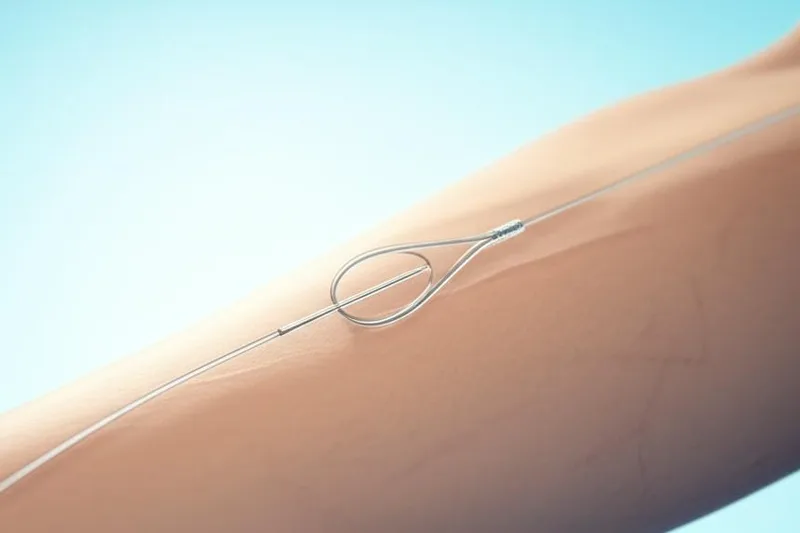
Now look, the blood vessels inside our body are like roads. Blood travels along these roads, bringing life to every part of our body. However, sometimes these roads can have small problems. Some places can become blocked or narrowed. In the past, it was a little difficult to take care of these things. But now, with the advancement of medical science, we have methods that can see inside these blood vessels. One such amazing method is called `(Intravascular Ultrasound)`. Let's talk about this today simply, in a way that you can understand.
What exactly is this (Intravascular Ultrasound)?
Simply put, this `(Intravascular Ultrasound)` is like a small camera that can be inserted into our blood vessels. But this one uses sound waves, not a camera. Yes, you heard it right! Sound waves are used to obtain clear images of the inner walls of the blood vessels and the soft tissue there. Imagine how valuable it would be to be able to insert a small device and see what's happening inside right away, without having to undergo major surgery.
This method is especially used to examine the blood vessels surrounding the heart, namely the coronary arteries . Because these are the main blood vessels that supply blood to the heart. However, this is not limited to the heart. This method (IVUS) can also be used to examine other blood vessels in the body.
It is called by other names, and your doctor may also call it one of these:
- Coronary intravascular ultrasound
- Endovascular ultrasound
- Intravascular echocardiography
Whatever the name, it does the same thing – taking a good look inside the blood vessels.
How does this (IVUS) work? It's amazing, isn't it?
Now you're probably wondering, how does this little thing go into a blood vessel and see all this? This is a very simple and very advanced technology.
In this `(IVUS)` test, doctors use a very thin, flexible tube . This is called a `(catheter).` At one end of this `(catheter)` is attached a tiny `(ultrasound probe).` It's like the head of a small scanning machine.
Next, the doctor makes a small incision in your skin. This is usually done in the groin . From there, the catheter is slowly inserted into a blood vessel. It is then guided to the blood vessel that you want to examine.
Once there, the ultrasound probe in the catheter emits high-frequency sound waves. These sound waves bounce off the walls of the blood vessels and bounce back, like echoes. The returned sound waves are analyzed by a computer and converted into real-time images. Imagine watching a 3D movie inside a blood vessel! This allows doctors to see not only the inside of the blood vessel, but also the thickness of its walls and whether there are any deposits.
What are the benefits of IVUS testing for you?
This is not just a test. It is something that can add a lot of value to your life. This ``(IVUS)`` test is of great help, especially if doctors suspect that your blood vessels are narrowed or blocked .
This test can help manage some life-threatening conditions , such as:
- Heart attack: This happens when the arteries that carry blood to the heart become blocked. IVUS can show how severe the blockage is.
- Pulmonary embolism: A blood clot in the blood vessels of the lungs.
- Stroke: Can be caused by a problem with the blood vessels that supply blood to the brain.
In addition, IVUS testing also helps doctors:
- Assess the severity of plaque buildup, which is the buildup of fatty deposits inside blood vessels. This is what doctors call atherosclerosis. It also looks at how likely it is that the blood vessels will become blocked.
- This will help you decide whether you need further treatment, such as coronary artery bypass surgery .
- Plan and deliver treatments precisely. Sometimes, if a blood vessel is blocked, a small mesh-like device called a stent may need to be inserted to keep it open. IVUS helps to ensure that the stent is placed correctly, how big it needs to be, and where it needs to be placed.
Imagine, this is like finding a bottleneck on the road, knowing exactly how big it is, and what needs to be done about it.
How do I know if this (IVUS) is suitable for me?
Not everyone needs this test. Your doctor will decide whether you need it. However, if you have any of the following symptoms, or are at high risk of developing these conditions, your doctor may recommend an IVUS test:
- Aortic aneurysm: A weakening and bulging of the wall of the largest blood vessel in the body.
- Blood clots: Blood clots form inside blood vessels.
- Carotid artery disease: Fatty deposits in the main arteries in the neck that carry blood to the brain.
- Coronary artery disease: Narrowing or blockage of the arteries that supply blood to the heart.
- Deep vein thrombosis (DVT): Blood clots in the deep veins, especially in the legs.
- Peripheral artery disease (PAD): Narrowing of the arteries in the arms and especially the legs.
- Pulmonary artery stenosis: Congenital or acquired narrowing of the artery that carries blood to the lungs.
If you have these conditions, IVUS can be of great help in accurately diagnosing the disease and planning treatment.
What is the difference between (IVUS) and (Angiography)?
You may have also heard of a test called ``Angiography.'' It also takes pictures of the inside of blood vessels. But there are some differences between the two.
- Angiography: This uses X-rays . It produces two-dimensional shadow images of the blood vessels. It's like looking at the outside of the blood vessel and getting a rough idea of what it looks like.
- (IVUS): As mentioned earlier, this uses sound waves . This produces cross-sectional images. Just like when you cut a loaf of bread into slices, you can clearly see the inside layers of the blood vessel, the thickness of the wall, and the way in which fat is deposited.
Simply put, while angiography provides something like a "map" of the blood vessels, IVUS provides detailed information about the interior of the arteries on that "map" and their condition.
How is the (IVUS) test performed?
The way this is done may vary slightly, depending on which blood vessel is being tested.
- If you are examining the coronary arteries of the heart: This IVUS test is often done in conjunction with another test called cardiac catheterization . This cardiac catheterization checks things like heart function and blood pressure. So, by doing both tests at the same time, doctors can get more information about the health of the heart at once.
- If other blood vessels not related to the heart are being examined: for example, to check for blood clots in the veins of the legs, or to check for PAD in the arteries of the legs, the IVUS test is done alone, that is, as a standalone procedure.
Who performs this (IVUS) test?
This is not a test performed by a general doctor. It is performed by people who have received special training for this purpose.
- Interventional cardiologist: These are the people who treat problems related to the blood vessels of the heart using devices such as catheters.
- Vascular surgeon: These are people who perform surgery and other treatments for diseases related to arteries and veins in various parts of the body.
This is the type of specialist who will perform the IVUS test for you.
What happens during an IVUS test? There's nothing to worry about!
Some people may be a little scared when told about a test like this. But there's really nothing to be afraid of. Doctors will do everything they can to put you at ease. Here's what usually happens:
1. You will be made to lie down on an examination table.
2. Then you will be given a sedative to help you relax and calm down. This may make you feel sleepy. You may be awake, but you will not feel any discomfort or pain.
3. Next, the skin around the catheter insertion site, that is, the incision site, is thoroughly cleaned.
4. Then, an anesthetic is injected into the area to numb it. So you won't feel any pain when the incision is made or the catheter is inserted.
5. Next, the specialist inserts a thin plastic sheath through the incision. This creates a path for the IVUS catheter to be easily inserted into the vein.
6. Once the catheter is in the exact location to be examined, the ultrasound probe begins to take images.
7. When the test is finished, the doctor will slowly remove the catheter and sheath.
8. Usually, this small incision does not require stitches.
9. Finally, a surgical dressing is applied to the area to protect against infection.
See, this isn't as big a deal as you think. You can relax.
How quickly do I get the results of the (IVUS) test?
Another good thing about this is that the results are available in real-time . The doctor can see the condition of the blood vessels as the ultrasound images are taken.
However, the doctor usually only talks to you about the results after the test is completely finished. Perhaps you can talk about this while you are in the recovery room, after the sedative you were given has worn off a bit.
How long does it take to recover after an IVUS test?
This also depends on the nature of the IVUS test you had.
- If it is a standalone IVUS test (that is, if a blood vessel other than the heart is examined), you will most likely be able to go home the same day .
- If you have a coronary intravascular ultrasound (that is, one done in conjunction with a cardiac catheterization), you may need to stay in the hospital overnight to monitor your condition.
However, your doctor will explain this to you in advance.
What are the benefits of IVUS testing?
This ``(IVUS)`` test has many benefits for both patients and doctors. The main advantage is that it can accurately identify narrowing and blockages in blood vessels in advance.
In addition, there are other advantages:
- A high degree of accuracy: The images obtained from this are very clear. Therefore, problems inside the blood vessels can be identified very accurately.
- No radiation exposure: Since this test does not use X-rays, there is no need to worry about possible radiation damage.
- Quick results and recovery: Results are available quickly, and recovery after the test does not take long.
Are there any risks to this test?
As with any medical procedure, there are some minor risks associated with this (IVUS) test. However, these are usually minor, and serious risks are very rare.
- Heart rhythm irregularities (Arrhythmia): This is especially common in patients undergoing IVUS (Intravascular Ultrasound). However, this is usually temporary.
- Blood clots: Blood clots can form at the site of the catheter or inside the blood vessel.
- Infection at the incision site: This is why it is important to keep it clean and apply a bandage.
- Dissection or damage to the vessels: This is also very rare. Doctors are very careful about this.
Your doctor will discuss these risks with you before the test. Any questions or concerns you may have can be addressed at that time.
So, in summary, here are some things to remember (Take-Home Message):
Okay, so now you have a good idea about what we've been talking about, Intravascular Ultrasound or IVUS. Finally, keep these points in mind:
Intravascular ultrasound (IVUS) is an advanced method that uses sound waves to examine the inside of your blood vessels in great detail.
If you suspect that your blood vessels are narrowed or blocked, or if you are at risk of developing such diseases, this test can be very useful for you.
This allows doctors to pinpoint the problem areas in your blood vessels, determine how serious they are, and plan the best treatment for you.
This can also reduce the risk of life-threatening complications.
The most important thing is to talk openly with your doctor about whether this test is right for you . He or she will give you the best advice based on your situation. Don't be afraid, don't doubt, and don't be afraid to ask questions. Your health is what matters!
` intravascular ultrasound, IVUS, blood vessel imaging, coronary artery disease, catheter procedure, heart health, plaque buildup


💬 Comments (0)
No comments yet. Be the first to share your thoughts here.
Add Your Comment