
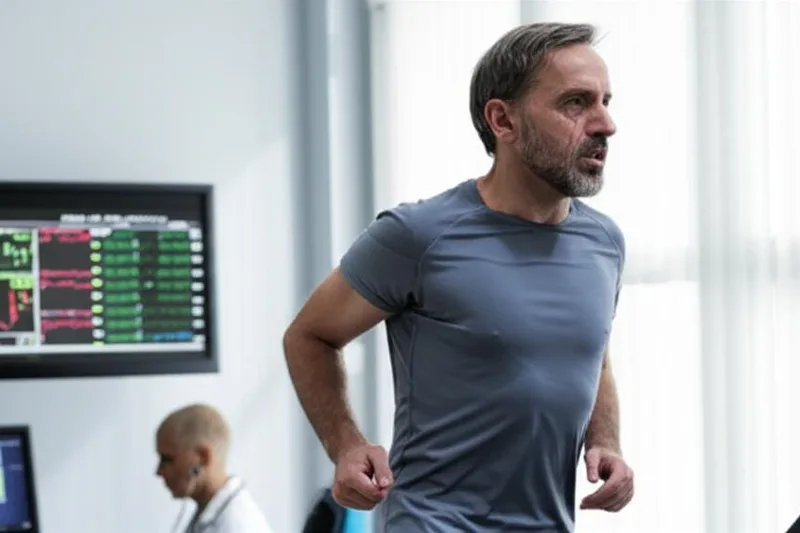
Have you ever heard of a 'Metabolic Exercise Stress Test'? Maybe you were a little scared or curious when your doctor told you to do this. Or maybe you were just curious to know about it. So, today we will talk about this test simply, in a way that you can understand.
What is the difference between this so-called metabolic exercise stress test and a regular stress test?
Simply put, this is a test that checks your health while you exercise. It is done while you are riding a bike or walking on a treadmill. A doctor or a trained technician carefully monitors you. The specialty of this is that it looks at how well both your heart and lungs work, and how well your muscles get oxygen when you exercise (`Cardiorespiratory Fitness` - CRF). Sometimes doctors also call this a ``Cardiopulmonary Exercise Test`` (`CPET`). Because ``cardio'' means heart, and ``pulmonary'' means lungs. So the function of both of these is checked at the same time.
Now you might be thinking, 'So what's the difference between a regular stress test and this one?' That's a good question! A regular stress test basically just looks at your heart. You exercise and get data from things like an EKG. But in this metabolic stress test, you breathe through a special facemask or mouthpiece. This device measures the amount of oxygen and carbon dioxide in your exhaled breath. It also measures how much air your lungs can take in. In fact, it's an advanced version of the regular stress test with all the bells and whistles. Therefore, the amount of data obtained from this is also large, and it is possible to understand exactly how the heart and lungs respond to exercise.
What can we learn from this test?
So, what exactly can this test find out? Imagine that you feel tired even after a little effort, or you feel tired all the time. This test can help you find out what is causing this. It can tell you exactly whether your exercise intolerance is caused by heart disease, lung disease, or a combination of both.
The main things expected from this test are:
- Find out why you feel short of breath and extremely tired when you exercise.
- Determine how much exercise your heart and lungs can handle .
- Identify heart and lung diseases.
- Assess the severity of your condition and get an idea of what the future holds (prognosis).
- Check the risk of complications before major surgery.
- Prepare your treatment plan .
- See how your body is responding to the current treatments .
- Assess progress in physical training programs such as cardiac rehab.
- Help you create a program that allows you to exercise safely and effectively .
You see, how important this test is? Especially if you have a condition like ``Heart Failure``, this ``CPET`` test can determine exactly how severe your condition is and what kind of treatment you need.
Very important: If you have a pacemaker or defibrillator, you should definitely have it checked by a doctor before this test . So, talk to your doctor about this before scheduling the test.
Who needs this metabolic stress test?
So, who needs to have this metabolic stress test? Actually, your doctor will decide whether you need it or not. Usually, children over 10 years old and adults of any age can have this test. Doctors recommend this test, especially to diagnose and manage the following conditions:
- `Asthma`
- Chronic Obstructive Pulmonary Disease (COPD)
- Cystic Fibrosis
- `Heart Failure`
- Interstitial Lung Disease
- Lung Cancer
- `Primary Ciliary Dyskinesia`
- Pulmonary Arterial Hypertension (PAH)
- Sarcoidosis
Also, this test is done before some major surgeries. For example:
- Lung Resection Surgery
- Lung Transplant and Heart-Lung Transplant Surgery
- Lung Volume Reduction Surgery (LVRS)
- Other major thoracic surgeries
Are there people who shouldn't take this test?
However, not everyone can have this test. There are some reasons why it may not be safe for you to have it. Doctors call these 'contraindications'. This test may not be suitable for you if you have any of the following conditions:
- An acute infection (like a fever or cold)
- Acute Myocarditis or Pericarditis (inflammation of the heart muscle or the membrane surrounding the heart)
- A ``heart attack`` that occurred within a month
- Deep Vein Thrombosis (DVT) in the legs
- Endocarditis (an infection of the inner lining of the heart)
- Hypertrophic Cardiomyopathy (abnormal thickening of the heart muscle)
- `Kidney Failure`
- Moderate or severe `Heart Valve Stenosis`
- A pregnancy with complications or near delivery
- Severe Hypertension
- Severe Pulmonary Arterial Hypertension (PAH)
- Uncontrolled Arrhythmias
- Uncontrolled Heart Failure
- Unstable Angina (heart pain)
How to prepare for the test?
Okay, now let's see how to prepare for this test. You should follow exactly the instructions given by your doctor. Here are some general instructions:
- Do not consume anything containing caffeine for 24 hours before the test. Caffeine can affect the test results. Coffee, tea, some soft drinks, and chocolate contain caffeine. Strawberries and products labeled ``decaffeinated`` or ``caffeine-free`` may also contain small amounts, so it is best to avoid them as well.
- Do not eat or drink anything except water for four hours before the test.
- Stop smoking or vaping eight hours before the test (it's best to stop for 24 hours if possible). Nicotine can also affect results.
What do I do about the medications I usually take?
You should ask your doctor about this. Some medications may need to be taken differently on the day of the test. Typically, painkillers that contain caffeine (such as some diet pills, such as NoDoz®, Excedrin®, and Anacin®) are not recommended for 24 hours before the test.
Special advice for people with diabetes:
If you take insulin to control your blood sugar, ask your doctor how much you should take on the day of the test. Most people will tell you to take half your usual dose in the morning and eat a light meal four hours before the test.
If you are taking a pill to control your blood sugar, you may be asked not to take it until after the test.
What to wear on test day?
Wear clothes that you can move around in and exercise in . Since you may sweat a little, it's best to choose clothes made of cotton that are breathable (like a sleeveless T-shirt). You can wear these clothes at home, or you can change there. Also, bring a pair of comfortable shoes (like canvas shoes or sneakers). There will be a locker there to store your belongings. However, it's best to leave valuables at home.
How is this metabolic exercise test done?
Okay, now comes the important part. How is this test done? It's done in a `stress lab`, a special room where stress tests are done. A trained technician does the test, under the supervision of a doctor. You can either `cycle on a stationary bike` or `walk on a treadmill`. Cycling is the most common. Your doctor will decide which method is best for you based on your age, health, and fitness level.
While you exercise, you will be connected to a device that measures your breathing and breathes. This can be done using a ``facemask`` or a ``mouthpiece``. You may be able to choose whichever is most comfortable for you.
Here is how the test steps work:
- Connecting an `EKG`: The technician will place small, flat sticker-like `electrodes` on various parts of your chest. These are connected to a monitor that will monitor your heart's electrical activity throughout the test.
- Resting phase: This usually takes about three minutes. The technician will help you get used to the facemask or mouthpiece and ask you to start breathing through it. Your blood pressure and blood oxygen levels (baseline vital signs) will be measured. An ECG monitor will also be used to check your heart rate. To check the oxygen and carbon dioxide levels in your blood (arterial blood gas measurements), the technician will insert a small tube (arterial catheter) into an artery in your arm (the radial artery). This will take blood samples from time to time during the test.
- Unloaded phase (warmup): This takes two to three minutes. 'Unloaded' means you are cycling or walking without any additional weight. During this time, the technician collects 'active baseline information'. This is how your heart and lungs respond to the lowest possible level of exercise.
- Incremental exercise phase: This is the most important part of the test. It lasts between 8 and 12 minutes. You ride the bike or walk continuously. The technician gradually increases the resistance of the machine. You will gradually start to feel tired. During this time, the technician will ask you how you are feeling. The most important thing is to exercise for as long as possible.
- Recovery phase (cooldown): This takes about three to five minutes. You will continue to ride or walk as usual, without any weight. The technician will check your vital signs and measure your heart rate recovery. Once your heart rate and blood pressure have returned to normal, you are ready to go.
What is the `RPE` scale?
There is a method used to describe how tired you feel during the test. It is called the `Rating of Perceived Exertion` (RPE) scale. There are several `RPE` scales. The most common one used for `CPET` is to use your fingers to indicate how hard it is to breathe and how tired your legs are on a scale from 0 to 10. The higher the number, the more tired you feel.
Even though all those devices collect a lot of data about what's going on inside your body, only you can tell how you feel. So, if you have any questions about this scale before starting the test, ask the technician.
How will I feel when I take the test?
How does the test feel? To get really, really accurate and useful results, you need to exercise until you're really tired. It's normal for your heart rate, blood pressure, and breathing rate to increase. You'll sweat, and your legs will feel a little tired. You may also feel dry mouth from breathing through the mouthpiece.
This is a test, so it feels like a test. However, if you experience any unusual symptoms during the test, you should stop exercising immediately and tell the technician. Such symptoms include:
- Pain, discomfort, tightness in the chest, arm, jaw
- Severe shortness of breath
- Dizziness, a feeling of fainting
These symptoms could be a sign of a medical emergency, such as a ``heart attack.'' Since technicians are watching the E.C.G. monitor, they will immediately stop the test if they see any dangerous changes.
How long does this test take?
Your entire appointment will take about 75 minutes, but you'll actually be exercising for about 20 minutes, including warm-up and cool-down.
How do I get the test results?
Your doctor will tell you when and how to see the results. You will likely be able to see the results in your electronic medical record. You will also have the opportunity to meet with your doctor to discuss this.
This test records thousands of measurements, which are displayed in a complex graph format called a ``nine-panel plot.'' These are complex, technical graphs that give a comprehensive picture of how your heart and lungs are working. Your doctor will analyze these results and explain them to you in a way that you can understand.
It's normal to feel a little nervous and scared when you're told you're going to have a metabolic exercise stress test. That's understandable. But don't overthink it. This is a routine test. It can give you and your doctor a great understanding of what's going on inside your heart and lungs.
Sure, it can be a bit strange to exercise while wearing electrodes and other devices. But remember, each device collects vital information that will help coordinate your treatment. If you have any questions about how to prepare for the test or what to expect when you get to the lab, don't be afraid to ask your doctor.
So, what are the most important things we want to take home from this article?
Simply put, a `Metabolic Exercise Stress Test` (`CPET`) is a special test that measures how your heart and lungs respond to exercise. It can help you find the cause of your shortness of breath and fatigue, diagnose medical conditions, plan treatment, and assess risk before surgery.
It is very important to follow the doctor's instructions (about caffeine, smoking, food, and medication) exactly before this test.
It is normal to feel a little tired during the test. However, if you experience any unusual symptoms, tell the technician immediately. Remember, this is a test that will provide valuable information about your health and help you get the best treatment. So, don't be afraid to talk to your doctor and learn more about this.
` Metabolic Exercise Stress Test, CPET, Heart Tests, Lung Tests, Exercise Tests, Causes of Fatigue, Heart Health, Respiratory Health


💬 Comments (0)
No comments yet. Be the first to share your thoughts here.
Add Your Comment