
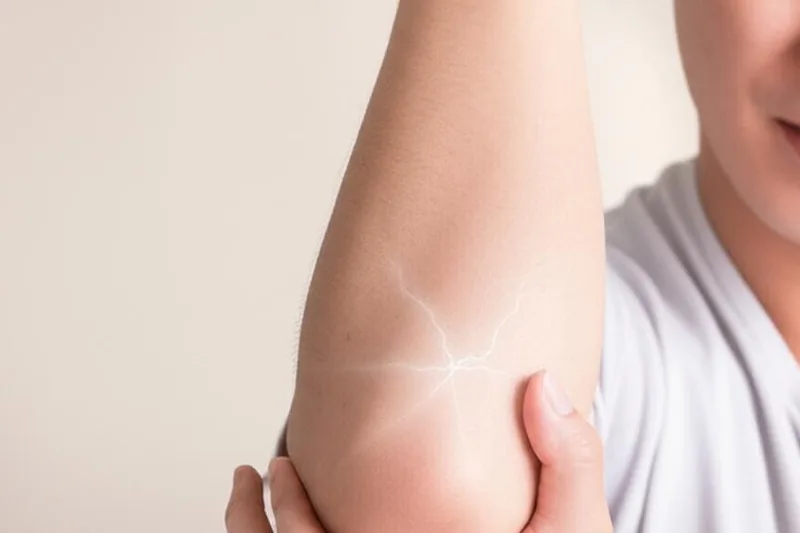
Have you ever felt a strange, electric shock-like pain in your elbow? Many of us call it a funny bone. But it's not really a bone. It's an important nerve in our hand, and today we're going to talk about the Ulnar Nerve .
What exactly is the 'Ulnar Nerve'?
Simply put, your Ulnar Nerve is the nerve that runs from your forearm to your hand, from your elbow to your wrist, and helps you move your fourth and fifth fingers (the little finger and the ring finger) . Not only does it control movement, but it also carries sensations like touch, temperature, and pain to the brain. This nerve is also commonly referred to as the 'funny bone'.
Why do we call this 'Funny Bone'?
There's a very simple reason. The Ulnar Nerve runs right under the skin, close to the first layer of skin, as it passes through the elbow. So if your elbow hits a hard surface, it can temporarily pinch the Ulnar Nerve. That's when you feel that tingling, electric shock-like, tingling, burning sensation that's called a 'funny bone'. It's not actually a bone, but a nerve that's pinched. Think of it like that weird feeling you get when you hit your elbow on a door!
What is the function of the Ulnar Nerve?
Our Ulnar Nerve is a very important nerve. It controls many small muscles in our hand. Starting from your armpit, this nerve starts working after entering your forearm. Let's see what happens with this?
How movements are controlled (Motor Functions)
As a motor nerve, the Ulnar Nerve innervates the muscles in your forearm, hand, and fingers. So you can:
- Bend and extend your pinky and ring fingers .
- Hold on to things, hold on tight .
- To do menial tasks, that is, to do delicate tasks like writing with a pen, buttoning a shirt, or turning the pages of a book .
Sensory Functions
As a sensory nerve, the Ulnar Nerve provides sensation to the following areas:
- Your pinky finger .
- The part of your ring finger that is on the pinky side .
- The part of your palm and the back of your hand that is on the side of your little finger .
Where is the Ulnar Nerve located? (Anatomy)
The Ulnar Nerve is one of the five main branches of your brachial plexus . This bundle of nerves carries sensation and helps you move your shoulder, arm, and hand. Quite a complex structure, isn't it?
The Brachial Plexus starts from the nerve roots in your cervical spine. It then travels behind your collarbone (clavicle), through your axilla, and down your arm.
You have two ulnar nerves – a left and a right one – one in each hand. Your ulnar nerve starts at the brachial plexus in your armpit and:
- It connects to your C8 cervical vertebra and T1 thoracic vertebra (that is, the middle of your brachial plexus).
- Your axillary artery and brachial artery run closely together, down the front of your upper arm.
- The medial epicondyle on the inside of your elbow runs through a tunnel called the cubital tunnel . This is where you feel that funny bone when it hits.
- Underneath the muscles on the inside of your forearm, your median nerve runs along the ulna (a long bone in the forearm).
- The nerves divide into small branches.
- Finally, it enters your palm from the side of your little finger through an opening called Guyon's Canal, or ulnar tunnel , where your ulnar artery also resides.
What are the branches of the Ulnar Nerve?
The Ulnar Nerve is not just a single nerve. It has several smaller branches that branch off from it. The main ones are:
- Muscular branch: This controls the movements of the front of your forearm.
- Dorsal cutaneous branch: This is the nerve that carries sensory information from the middle part of the back of your hand, between the little finger and the ring finger, to and from the brain.
- Palmar cutaneous branch: This branch sends and receives sensory information to the middle part of your palm, little finger, and ring finger.
What are the conditions that affect the Ulnar Nerve?
Sometimes, our 'funny bone' nerve, the Ulnar Nerve, can experience various problems. Let's take a look at what they are:
- Ulnar nerve entrapment: Ulnar nerve entrapment can occur when the nerve is compressed at your elbow or wrist. This can cause neuropathic pain , numbness, and nerve damage (neuropathy) .
- Cubital tunnel syndrome: This condition can occur if the ulnar nerve is compressed inside the cubital tunnel in the elbow for a long time. This can occur in people who often bend their elbows or in people who work in a way that puts pressure on the elbows. For example, if you always work on the computer with your elbows pressed against the desk, or if you sleep with your elbows bent for a long time at night, you are at risk.
- Ulnar tunnel syndrome (also known as Guyon's canal syndrome): A condition caused by the compression of the ulnar nerve inside the Guyon's canal in your wrist. The symptoms are similar to those of carpal tunnel syndrome . It can occur in cyclists and people who work in jobs that put pressure on their hands.
- Ulnar nerve dislocation: Sometimes, especially after a serious accident, the ulnar nerve can become dislocated and pop out of place. You may hear or feel a popping sound in your elbow.
How to know if there is a problem with the Ulnar Nerve? (Symptoms)
If you have Ulnar Nerve Impingement or another problem, you may experience symptoms like these:
- Your little finger and ring finger are bent inward (claw hand) . They are curved inward like a claw.
- Elbow pain or wrist pain . Sometimes this pain can travel down the arm.
- Hand strength decreases . It becomes difficult to grip things, it becomes difficult to do things like write or type. You may even drop a cup.
- Muscle wasting in the hand and affected fingers (this is a rare symptom, but can occur if the nerve is compressed for a long time).
- Numbness or tingling in your little finger and ring finger . This is often the first symptom you notice.
When should you see a doctor?
If you have one or more of these symptoms, definitely see a doctor. These are not things you should just ignore.
- If your ring finger or little finger feels like it's bending inward .
- If you feel weak when holding things, if things fall out of your hands .
- If you have persistent pain, numbness, or a tingling sensation in your elbow, wrist, pinky, or ring finger .
- If you have difficulty doing delicate tasks like buttoning a shirt or writing .
If these symptoms persist and do not improve within a day or two, or if they become more severe , it is best to seek medical advice immediately. As early treatment can reduce the risk of permanent nerve damage.
Final Take-Home Message
As we've discussed, the laugh that comes when you hit your "funny bone" isn't really a laugh. It's not even a bone. It's a response to the pressure on the ulnar nerve that runs from your elbow. The ulnar nerve is what helps control movement and sensation in your forearm, wrist, and fourth and fifth fingers.
However, if there is pressure on this nerve, various problems can occur, such as ulnar nerve entrapment . Therefore, if you experience any of the above-mentioned pain, numbness, or weakness in your hand in these areas, please see a doctor. He or she can determine what treatment you need and guide you to find relief. It's important to be aware of things like this, right?
` Ulnar nerve, funny bone, elbow nerve, hand numbness, finger numbness, nerve disorders, ulnar nerve


💬 Comments (0)
No comments yet. Be the first to share your thoughts here.
Add Your Comment