
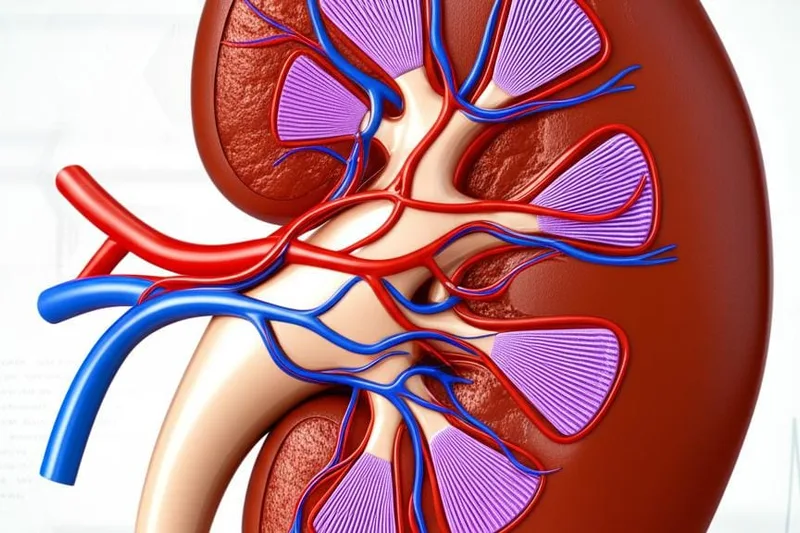
We all know that the kidneys are a very important organ in our body. The kidneys work like a filter that filters out the waste in our body. So, it is very important to provide these kidneys with proper blood supply. Today we are going to talk about a special blood channel system that helps in that work, which carries blood to the kidneys. These are what we call `(Renal Artery)` or the renal artery.
What is the Renal Artery? Simply put...
Okay, now let's see what these `(Renal Artery)` or kidney arteries are. These are the large blood vessels that carry clean blood from our heart to the kidneys. The English word ``Renal`` means ``pertaining to the kidneys.`` So when we say ``Renal Artery``, it is immediately understood that these are related to the kidneys.
There are two main renal arteries in our body. One supplies blood to the right kidney, which we call the `Right Renal Artery`. The other supplies blood to the left kidney, which is the `Left Renal Artery`. To be precise, there is one of these arteries for each kidney.
What is the function of these renal arteries? Why are they so important?
Now you might be wondering why the `(Renal Artery)` is so important. Well, the renal artery is a very important part of our circulatory system. It is through these that oxygen-rich blood from our heart is carried to the kidneys via our main artery, the `(Aorta).`
Imagine, about half a cup of blood goes to the kidneys through this renal artery every minute . That is how much blood goes through this in a day! So, our kidneys are part of the urinary system. These are the ones that filter the waste products and unnecessary water in the blood. Then these waste products are excreted from the body as urine. It is said that two healthy kidneys can filter about 140 liters of blood per day . Look at how big a job that is! So for this work to be done properly, the kidneys need to receive the right amount of blood. That is what this `(Renal Artery)` helps with.
Where is the renal artery located?
We have two kidneys in our body. These two kidneys are located behind our abdomen, slightly above the waist. So, the right renal artery is connected to the right kidney, and the left renal artery is connected to the left kidney.
Each renal artery is usually between 4 and 6 centimeters long . They originate from the abdominal aorta, the main blood vessel that carries blood from the heart to the abdomen.
Let's learn about the further division (branching) of the renal artery.
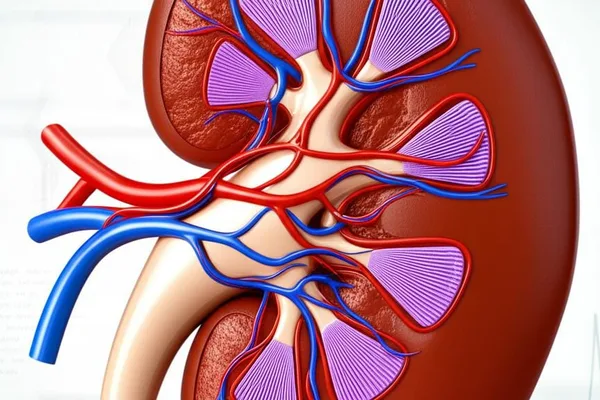
Each renal artery enters the kidney at a point called the ``Renal Hilum''. This is like the entrance to the kidney. Things like blood vessels and nerves enter and leave the kidney through this ``Renal Hilum''.
After entering the kidney, this `(Renal Artery)` divides into many smaller blood vessels. Just like branches branching off from the trunk of a tree. This division distributes blood throughout the entire kidney. Let's look at these main branches and their processes in simple terms.
Think of our kidneys as a super purification system.
1. Nephrons: Blood from the renal artery first goes to the smallest filtering units in the kidneys. These are called nephrons. There are about a million of these nephrons in one kidney!
2. Glomeruli: Inside these Nephrons are clusters of tiny blood vessels. We call them Glomeruli. Just like when you filter tea, the tea leaves get stuck on the filter, these Glomeruli filter out some of the waste products and water in the blood. However, the larger things like proteins and red blood cells in the blood do not pass through this filter, they remain in the blood.
3. Tubules: The waste products and water that are filtered from the Glomeruli then go into another system of small channels called Tubules. As they pass through these Tubules, the nutrients and minerals that the body needs are reabsorbed back into the blood. In other words, only the necessary things are retained and the unnecessary things are removed.
4. Renal Vein: Finally, the filtered blood leaves the kidneys through the renal vein. The blood then circulates throughout the body. The waste products and extra water that remain in the tubules are excreted as urine.
Look at how complex and amazing the process is that takes place inside our kidneys!
What diseases affect the renal arteries?
Just as a water pipe can become clogged with dirt and rust over time, fat and cholesterol can build up inside our arteries. We call this plaque. This plaque builds up and forms a layer on the walls of the arteries.
When `(Plaque)` accumulates in this way, the space inside the artery decreases, the artery becomes narrower, and it hardens. This condition is called `(Atherosclerosis)` (hardening of the arteries). Especially when the renal artery narrows in this way, it is called `(Renal Artery Stenosis)` (narrowing of the renal artery) .
So, what happens when these renal arteries narrow? When the blood flow becomes narrow, the blood flow slows down. The amount of blood that reaches the kidneys decreases. Then the kidneys cannot work properly. Also, the heart has to work harder to pump blood. This increases the pressure in the blood vessels throughout the body.
The main problems that can occur due to `(Renal Artery Stenosis)` are:
- High blood pressure : This is the most common and important condition. Sometimes, even with medication, high blood pressure can be difficult to control.
- Renal (Renovascular) Hypertension: This is high blood pressure caused directly by narrowing of the renal arteries.
- Heart failure : When the heart has to work too hard, it can weaken and fail.
- Kidney disease and kidney failure : When the kidneys do not receive enough blood, they gradually begin to fail.
- Stroke : High blood pressure can damage the blood vessels in the brain, causing conditions such as stroke.
Imagine, if the water pipe that supplies water to a water motor gets clogged, how much trouble would it cause for the motor? The same thing happens to the kidneys and heart when the renal artery becomes clogged.
How do we keep our renal arteries healthy?
Fortunately, if the blockage in these renal arteries is less than 60%, meaning the artery is not completely blocked, changes in our lifestyle and diet can greatly improve our condition. Here are some things we can do to keep our renal arteries and kidneys healthy:
- Eat a heart-healthy diet: Eat a diet low in cholesterol, fat, salt, and sugar. Eat more fruits, vegetables, whole grains, and fiber-rich foods.
- Exercise most days of the week: Do at least 30 minutes of exercise a day, such as walking, running, or swimming. This improves blood circulation and keeps arteries flexible.
- If you already have kidney disease, limit protein and potassium: You should talk to your doctor about this and get advice.
- Maintain a healthy weight: Maintaining a weight that is appropriate for your height helps protect you from many diseases.
- Control medical conditions like diabetes, high blood pressure, and high cholesterol: If you have these conditions, take your medications as directed by your doctor and control your diet.
- Avoid smoking and tobacco products completely: Smoking is very harmful to the arteries. It increases the buildup of `(plaque)`.
Doing these things is very good for the health of not only the kidneys, but also the entire body.
When should you see a doctor?
Sometimes, when something is wrong with our bodies, it shows itself in various symptoms. If you have one or more of the symptoms below, you should definitely see a doctor and get advice. These could be signs of a kidney problem.
- Blood in the urine: If the urine turns red or brown.
- Swelling (`Edema`): If areas such as the hands, feet, ankles, and face swell.
- Difficulty urinating or frequent urination: If you have difficulty urinating, feel like you have more urine after you go, or if you urinate frequently, passing small amounts of urine.
- Nausea, vomiting, and weight loss: If you have nausea and vomiting along with loss of appetite and weight loss as a result.
- Severe fatigue or headaches for no reason: If you feel lethargic and have persistent headaches, even after sleeping well and resting.
Don't ignore these symptoms. It's best to see a doctor as soon as possible to find the cause.
Final Take-Home Message
It's clear to you now that the renal arteries we talked about today are blood vessels that play a very important role in keeping our kidneys healthy. These are the blood vessels that supply the kidneys with the blood they need, and the blood is filtered and the harmful substances in the body are excreted as urine.
However, if fatty deposits form inside these arteries (Renal Artery Stenosis), it can not only affect kidney function, but also lead to serious problems such as high blood pressure and heart disease.
Therefore, adopting a healthy lifestyle is the best way to protect yourself from such problems. Good eating habits, regular exercise, avoiding smoking, and controlling conditions like diabetes and high blood pressure are very important.
If you have any doubts or questions, don't hesitate to talk to your family doctor. He or she can give you the advice you need and help you protect yourself from kidney disease. Stay healthy!
` Renal Artery, Renal Artery, Kidney Health, Blood Pressure, Kidney Disease, Blood Circulation, Artery Blockage




💬 Comments (0)
No comments yet. Be the first to share your thoughts here.
Add Your Comment