
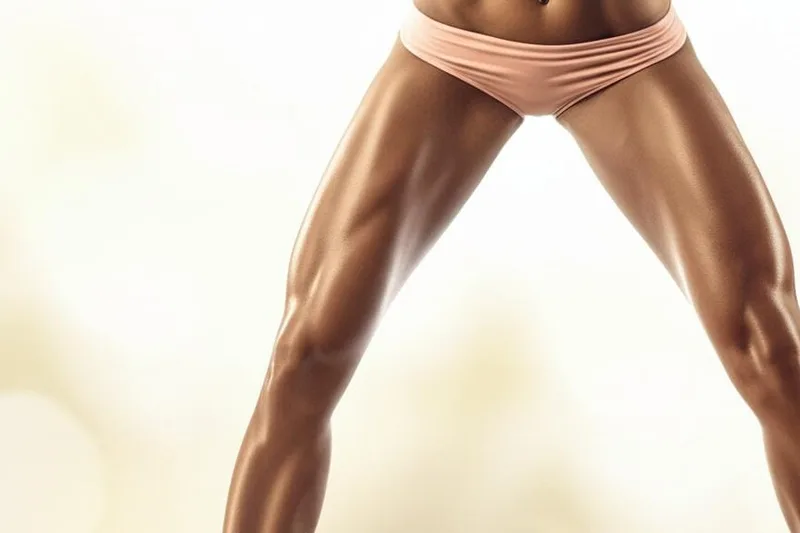
We all use our legs to run, jump, and walk. So, have you ever wondered how much the muscles in your thigh area help with these tasks? In fact, some of the largest and strongest muscles in our body are located in this thigh area. Today, we're going to talk about this in detail, as if we were talking to a friend.
What are the thigh muscles? What is their importance?
Simply put, your thigh is the upper part of your leg from the hip to the knee. These muscles are located on the front, back, and inside of this part. These muscles do a lot more work than you might think.
Think about it, when you walk, run, get up from a chair, sit on the floor, bend your legs, stretch them, rotate them around – these thigh muscles help with almost all of these things. Not only that, but these muscles also support a large part of your body's weight . They also help keep your hips and legs aligned and maintain your balance.
However, despite their importance, these thigh muscles are also prone to injury , especially in athletes. These muscles can become very tired when running, jumping, and changing directions suddenly. But don't worry, there are many things we can do to keep these muscles healthy.
What happens to each muscle group in the thighs?
Each muscle, or group of muscles, in the thighs has a specific job assigned to it. Let's take a look at what they are:
- Hamstrings: These are located at the back of your thigh. They help you pull your leg back (i.e., extend your hip) as you walk, and they help you bend your knee (for example, when you squat).
- Adductors: These muscles are located on the inside of your thighs. They help bring your thighs together (this is called ``adduction''). They also help you maintain balance, keep your legs and hips aligned, and rotate your hips and legs.
- Quadriceps: These are the main muscle group on the front of your thigh. They are activated when you bend your hip (for example, when you sit down) and when you extend your knee (for example, when you stand up and extend your leg to take a step forward).
- Pectineus: This muscle helps to flex and rotate your thigh at the hip joint. It also helps to stabilize your pelvis.
- Sartorius: This also helps to flex and rotate the thigh at the hip joint. Think about it, this muscle is why you cross-legged when you're sitting, or in a position like the lotus position.
- Iliopsoas: This muscle also helps to flex and rotate the thigh at the hip joint. However, unlike the other muscles in the front of the thigh, it does not help to extend the leg at the knee joint.
Where are these thigh muscles located?
We now know that there are many different muscles in the thigh area. These run from your hip all the way down to your knee. These muscles are attached to the bones of your pelvis, hip, and knee by strong tissues called tendons .
For convenience, these thigh muscles can be divided into three main groups based on where they are located: posterior, medial (inner side), and anterior.
Posterior thigh muscles
These are located on the back of your thigh, from the hip to just below the knee. This is where your hamstrings belong. That is, the three muscles called the semitendinosus, semimembranosus, and biceps femoris.
Medial thigh muscles
These are located on the inside of your thigh. They start at your pelvis and extend up to your thigh bone (the ``femur''). This is where your adductors belong. These are the muscles called the ``adductor longus'', ``adductor magnus'', ``gracilis'' and ``obturator externus''.
Anterior thigh muscles
These are located on the front of the thigh. They start at the pelvis and thigh bone (`(femur)`) and extend to the kneecap (`(patella)`) and shin bone (`(tibia)`). They include:
- Quadriceps: This muscle group, also known as your "quads," actually consists of five muscles: the vastus lateralis, the tensor of the vastus intermedius, the vastus intermedius, the vastus medialis, and the rectus femoris.
- Pectineus: This is a flat muscle that extends from the front of the pelvis to the top of the thigh bone.
- Sartorius: This is the longest muscle in the body. It is very thin and long. It starts at the hip, goes across the front of the thigh, and goes down to the knee.
- Iliopsoas: This is actually a combination of two muscles: the psoas major and the iliacus. These run through the thigh from the pelvis to the knee.
What are the thigh muscles made of?
The muscles in your thighs are skeletal muscles . This means they are attached to bones by tendons and help move parts of your body.
These are made up of bundles of muscle fibers . Inside these fibers are blood vessels and nerve fibers. All of this is held together by connective tissue .
What conditions can affect the thigh muscles?
The thigh muscles can be affected by a variety of disorders and conditions. Some of them include:
- Contusions: These can occur if you get a hard blow to the thigh area (especially the quadriceps and hamstrings). Sometimes, blood can collect under the skin, forming a condition called a hematoma (a large blood clot).
- Muscle strains: When a muscle is stretched beyond its limit, the muscle fibers can tear and rupture. This is called a muscle strain. These strains are common in your hamstrings and quadriceps.
- Muscle Tears: A tear is when a muscle, either partially or completely, separates from its tendon or bone. Examples include hamstring tears and quad tendon ruptures.
- Lacerations: If an accident or injury causes a cut in the skin of your thigh, creating an open wound (laceration), the underlying muscles can also be damaged.
What are the symptoms of thigh muscle problems?
If there is a problem with your thigh muscles, you may experience symptoms like these:
- Bruising or skin discoloration.
- A burning or stinging sensation.
- Muscle cramping.
- Muscle weakness.
- Hearing a "pop" sound or feeling like something exploded.
- Sudden, severe leg pain.
- Swelling.
- Tenderness when touched.
- Difficulty in keeping your feet on the ground and bearing weight.
Who is most at risk of injuring the thigh muscles?
Hamstring injuries are very common among athletes because of the way they use their bodies. These injuries are especially common among football, soccer, and basketball players .
In addition, you may also be at risk of injury in situations like these:
- If you stay in the same position for a long time, without moving.
- Do you warm up before physical activity or cool down after it?
- If you have muscle fatigue or stiffness.
- If you have a chronic medical condition (e.g. kidney failure , lupus) that can weaken your tendons.
- If you are using fluoroquinolones (a type of antibiotic).
- If you are using corticosteroids (also a type of medication).
How can I keep my thigh muscles healthy and safe?
There are several things you can do to keep your thigh muscles healthy and strong. Be sure to keep these in mind, especially when engaging in physical activity:
- Minimize sports that involve sudden changes of direction or tackling (especially if you have a previous injury).
- "Don't play with pain." If something hurts, stop and rest.
- Eat foods rich in protein .
- Engage in regular physical activity . The stronger your muscles are, the less likely they are to get injured.
- Maintain a healthy weight that suits you. This will reduce unnecessary stress on the muscles.
- Stay hydrated .
- Before engaging in physical activity , warm up , gradually increase the intensity of the activity, and then stretch well .
- Wear well-fitting shoes and use proper safety equipment for any sport you play.
Important: Remember, even a small wound, if not treated properly, can become a bigger problem later.
When should you see a doctor about a problem with your thigh muscles?
Damage to a hamstring muscle can increase your risk of further injury. Therefore, be sure to see a doctor if you have any of these symptoms:
- If you can't bend or straighten your hip or knee.
- If you have loss of sensation or persistent weakness in your thigh or hip.
- If the pain does not decrease or increases when you bend or extend your hip or knee.
- If you hear a "clicking" sound from your leg or feel something explode.
- If you get injured repeatedly .
- If there is swelling or bruising .
- If it is difficult to bear weight with your feet on the ground .
Finally (Take-Home Message)
These muscles in your thighs control the movements of your hips and legs. By now you probably understand how important they are. However, injuries like muscle strains and tears can occur in this area, especially in athletes.
So, if you have any of the above-mentioned pain, numbness, weakness, or difficulty putting your foot down, please seek medical advice . They can then diagnose your symptoms and recommend the right treatment to get you back on your feet. Taking care of your muscles is very important for your overall health!
` Thigh muscles, thigh muscles, hamstrings, hamstrings, quadriceps, quadriceps, thigh pain, muscle disorders, exercise


💬 Comments (0)
No comments yet. Be the first to share your thoughts here.
Add Your Comment