
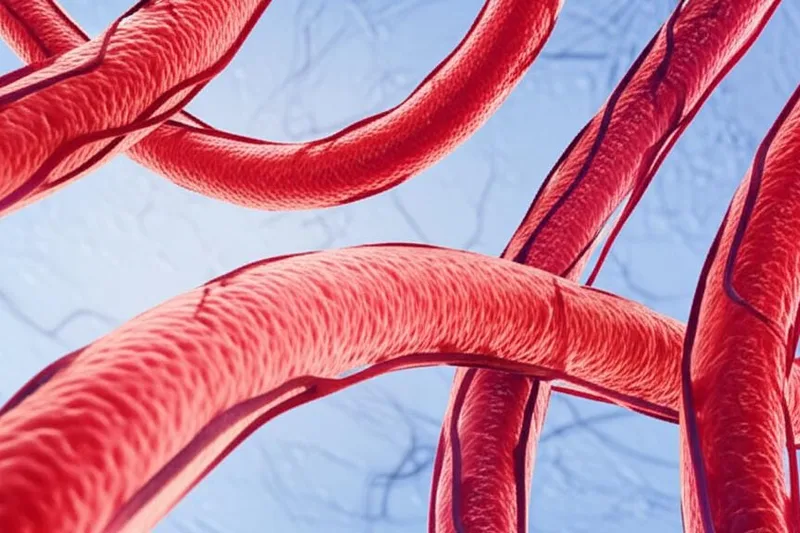
Have you ever wondered about the tiny blood vessels inside our bodies? That's what we call capillaries . They are like fine threads that run throughout our bodies. Their importance cannot be overstated. Today, we'll talk about what these capillaries are, what they do, what diseases they cause, and how to keep them healthy.
What are capillaries? Let's understand it simply!
Simply put, capillaries are the tiny blood vessels that run throughout your body. They are like tiny tubes through which blood flows. Their main function is to carry nutrients and oxygen to the cells in your organs and body systems. They also carry waste products, such as carbon dioxide , out of those cells.
Think of it this way. It's like someone bringing a bunch of stuff to your house and taking all the trash with them. This is happening all over your body, in different places. Isn't it amazing?
Are there types of capillaries?
Yes, capillaries also have several shapes depending on the functions they perform. We can identify three main types:
1. Continuous fenestrated capillaries: These have tiny openings (fenestrae) , or holes. This allows for rapid exchange of substances. You can see these types of capillaries in your kidneys, small intestine, and endocrine glands .
2. Continuous nonfenestrated capillaries: Only very small particles can pass through the walls of these types of capillaries. These are found in your nervous system, as well as in fat tissue and muscle tissue.
3. Sinusoidal capillaries: These also have small holes (fenestrae). Only certain substances can enter and leave through them. These types of capillaries are most common in your liver and spleen .
What happens to capillaries? What exactly is their job?
Capillaries are what complete our circulatory system. That is, the arteries and veins are connected to each other through these capillaries. You know, the arteries carry oxygen-rich blood from the heart to the organs. The veins carry deoxygenated blood and waste products from the organs back to the heart.
So the function of the capillaries is to act as a place where the things that come from the arteries and veins are exchanged . Although the arteries and veins carry gases and nutrients throughout the body, it is these capillaries that deliver them to their intended places, which are the cells. Very important, right?
Capillaries serve many different organs and systems in our body. For example:
- Bone marrow: Helps newly formed blood cells enter the bloodstream.
- Brain: While providing nourishment to the brain, it helps to form the blood-brain barrier, which prevents harmful substances from entering.
- Endocrine system: Helps transport hormones to the relevant organs.
- Kidneys: The peritubular capillaries here filter the blood, make urine, and reabsorb water and sodium back into the body.
- Liver: Helps remove defective red blood cells and bacteria.
- Lungs: They help to expel carbon dioxide and take in oxygen.
- Lymphatic system: Helps collect fluids from tissues and direct them to lymph nodes.
- Small intestine: Transports digested nutrients and provides nourishment to cells.
Where are the capillaries located?
In short, capillaries are everywhere in your body ! They can be found wherever arteries and veins connect. They serve your tissues and organs as a network of capillaries (`capillary beds`).
How do these look? They're tiny, aren't they?
Yes, capillaries are the smallest blood vessels in your circulatory system. Researchers have to use a microscope to see them. Think about it, they're smaller than your hair . A typical capillary is about 5 micrometers (a micrometer is one thousandth of a millimeter!). They're so small that red blood cells have to pass through them one by one. A capillary is less than a millimeter long, which is about the size of a pen tip.
Capillaries have very thin walls (about 1 micrometer thick), which is why nutrients, fluids, and gases can easily enter and exit.
What are the parts of capillaries?
Capillaries have two main cell layers:
- Endothelial cells: These are located inside the capillaries. They control the flow of fluids, nutrients, and gases.
- Epithelial cells: These form a protective layer around the endocrine cells.
What are the common conditions and diseases that affect capillaries?
Broken capillaries are very common. They can occur when you cough or vomit hard. When these capillaries burst, they bleed, causing small, pinpoint-like discolorations (petechiae) on the skin. Most of the time, these heal on their own.
Apart from that, here are some other conditions that can affect capillaries:
- Arteriovenous malformation (AVM): A condition in which arteries and veins in the brain or spinal cord become tangled, bypassing capillaries. They can also occur in the limbs, trunk, and other organs.
- Capillary angiosarcoma: A rare type of cancer that arises from endothelial cells and can affect capillaries.
- Capillary leak syndrome: A condition in which blood pressure drops suddenly. Sometimes this requires emergency treatment.
- Hereditary hemorrhagic telangiectasia: An inherited blood vessel disorder in which abnormal growths (telangiectases) develop and can rupture. Also called Osler-Weber-Rendu syndrome.
- Macular degeneration: Damage to the inside of the eye due to capillary leaks.
- Microcephaly-capillary malformation syndrome: Dilated capillaries in people with smaller than normal heads.
- Port wine stain: A birthmark caused by capillaries not forming properly.
- Spider angioma: Small blood vessels that branch out from a central point, usually on the face, neck, or chest. Also called a spider nevus or spider telangiectasia.
- Strawberry birthmark: A cluster of dark red blood vessels on the surface of the skin.
- Vasculitis: Inflammation of the blood vessels. This can also affect the capillaries. This can lead to complications such as rupture and blockage of the vessels.
What are the common symptoms of capillary diseases?
Conditions that affect the capillaries can cause symptoms such as:
- Nausea
- Dizziness (vertigo)
- Headache (headache)
- Swelling
- Seizures
- The calendar
- Fatigue
- Skin rash
- Weight loss
- Nosebleed
- Skin discoloration
- Anemia
- Vision problems
What tests are done to check the health of capillaries?
Tests like these can be done to see if there are conditions that affect the capillaries:
- Blood tests
- MRI scan
- CT scan
- Angiogram
- PET scan
- Eye exam
- `OCT` eye test
What are the common treatments for capillary diseases?
Conditions affecting the capillaries can be treated in the following ways:
- Medicines
- Surgery or minor surgeries
- Radiation therapy
- Chemotherapy
- Blood transfusion
How can I keep my capillaries healthy?
You need to take care of your capillaries just like you take care of your other blood vessels. That means:
- Exercising for at least 30 minutes a day, five days a week (150 minutes total).
- Limiting alcohol and caffeinated beverages.
- Maintaining a healthy weight that suits you.
- Avoid smoking and using other tobacco products.
- Regularly seeing an ophthalmologist for eye exams.
Also, work with your doctor to manage conditions like these that can affect the health of your blood vessels:
- Diabetes
- High cholesterol
- High blood pressure
- Stress
When should you see a doctor?
Sometimes your doctor can detect a capillary disease before you even have symptoms. This can help you start treatment before it gets worse. This is especially true if you keep up with things like annual checkups.
See a doctor if you have symptoms of a blood vessel disease:
- Capillary bursts
- If the blood vessels in the legs appear enlarged
- If one side of the body is numb or feels like you can't feel anything
- If your legs hurt after a little exercise
- If there are sudden changes in vision
What is the difference between a vein and a capillary?
It's very simple. What a vein does is that after your cells have taken what they need from the blood, they carry the remaining blood back to the heart. Veins carry blood that has waste products like carbon dioxide. But a capillary is like an exchange center . Your cells get what they need that way, and your cells get what they need that way.
When we think about the big channels that carry blood through our bodies, we tend to forget about these tiny capillaries. But they're the ones that carry things to the right places . Just like any other part of our body, they can also have problems. So, keeping your circulatory system healthy by exercising regularly and eating a nutritious diet can help your capillaries too.
Take-Home Message
Capillaries are a network of tiny, yet vital, blood vessels in our bodies. Without them, our cells would not receive nutrients or oxygen, and waste products would not be removed.
>
By following a healthy lifestyle, which means eating well, exercising, and avoiding smoking, you can keep your capillaries healthy.
>
If you experience any unusual symptoms, don't forget to seek medical advice immediately. Because many illnesses are easier to cure if they are recognized early!
So, I hope you now have a better understanding of these little heroes in your body. It's your responsibility to take good care of them!
` Capillaries, blood vessels, cells, nutrition, oxygen, blood circulation, health


💬 Comments (0)
No comments yet. Be the first to share your thoughts here.
Add Your Comment