
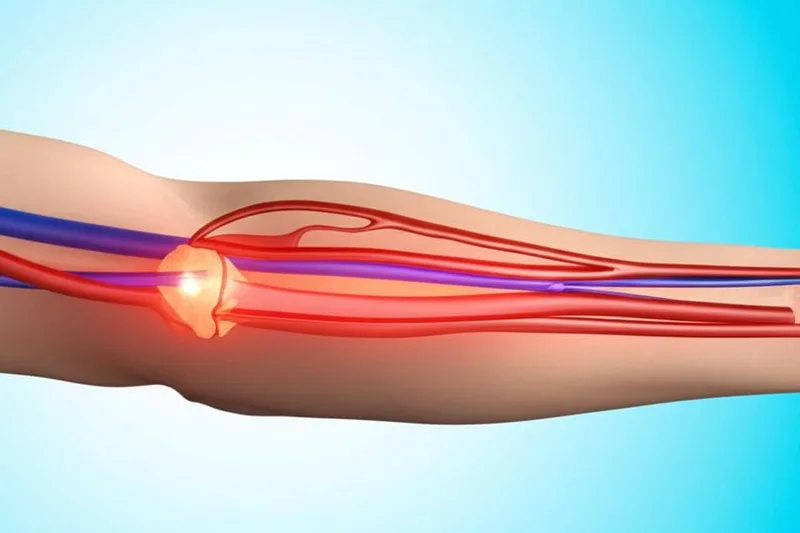
We all know that blood travels throughout our bodies. So, to carry this blood, we have a special system of tubes, a network of blood vessels. So, today we are going to talk about a very important, main blood vessel that runs from your upper arm, through your elbow, to your forearm and hand. We call this the Brachial Artery . You may have heard this name before.
What is the Brachial Artery? Let's understand it simply!
Imagine, this brachial artery is a large blood vessel that starts just below your shoulder, runs down your upper arm, passes through the crease in front of your elbow (we call it the cubital fossa), and ends at the beginning of your forearm. It's like the main pipe that carries water from a water pump to a garden. It's what supplies your upper arm, elbow, forearm, and hand with the oxygen-rich, clean blood they need.
Have you ever gone to the doctor and had your blood pressure checked? There's a cuff around your upper arm. That cuff is used to measure the blood pressure in your brachial artery. You may have seen a doctor sometimes take a pulse from your brachial artery.
What are the main functions of the brachial artery?
Now you're probably thinking, "Okay, so this is carrying blood, but what exactly is it carrying blood to?" The main job of this brachial artery, and the small veins that branch off of it, is to supply life to these parts of your upper arm, from your fingers down:
- Your biceps brachii muscles (this is what we often call the 'biceps').
- The brachialis muscles are located underneath the biceps.
- Your elbow joint .
- The triceps brachii muscles are located on the back of the upper arm.
Simply put, the bones, muscles, and nerves in your arm all need oxygen and nutrients to function and to repair themselves if they get damaged. The clean blood that contains those things is brought from the heart by arteries like this brachial artery. Arteries are the blood vessels that carry blood from the heart to the rest of the body.
How is the brachial artery important for medical tests and treatments?
This brachial artery is very useful for doctors to perform certain tests and perform special treatments.
- Interventional Radiology Treatment: Sometimes, a doctor can insert a thin, flexible tube, called a catheter , through the brachial artery and guide it through the blood vessels near the heart under X-ray guidance. This procedure is amazing because it can treat dangerous problems like blood clots, aneurysms , or narrowed arteries without having to do major open-heart surgery. This is a minimally invasive procedure, so the patient can recover quickly.
- Ankle-Brachial Index (ABI) test: This is also a very important test. It compares the blood pressure measured in your brachial artery with the blood pressure measured in an artery in your ankle. If there is a large difference between these two values, it can mean that your legs are not getting enough blood. This condition may be a sign of a condition called Peripheral Artery Disease (PAD) .
Where is the brachial artery located? How is it formed?
Now let's see where exactly this brachial artery is located in our arm, and how its branches branch out.
It's located along the front of your biceps muscle. It starts as an extension of the axillary artery, a blood vessel in your armpit and shoulder. It ends in the small hollow in front of your elbow, called the cubital fossa . From there, it divides into two main branches. The ulnar artery , which runs along the inside of your forearm, and the radial artery, which runs along the outside (towards your thumb). The brachial artery runs parallel to the median nerve, the main nerve that controls sensation and movement in your forearm.
Branching of the brachial artery
This brachial artery has several smaller branches. Looking from top to bottom, it looks like this:
1. Deep brachial artery (profunda brachii artery): This is the first and main branch of the brachial artery. It supplies blood to the humerus bone in your upper arm, the deltoid muscle, and the triceps muscle in the back of your upper arm. It travels with the radial nerve .
2. Superior ulnar collateral artery: This second branch can sometimes branch directly from the brachial artery or from the previously mentioned deep brachial artery. It supplies blood to the triceps muscle, some parts of the elbow, and the elbow joint. It passes close to the ulnar nerve at the elbow.
3. Inferior ulnar collateral artery: This third branch begins at the bottom of the upper arm bone (humerus). It helps supply blood to the biceps and brachialis muscles.
Finally, the branches that branch off at the end of the brachial artery are the aforementioned ulnar artery and radial artery. These two are what carry oxygenated blood to your forearm, wrist, hand, and fingertips.
Internal structure of an artery
Like every other artery in our body, the brachial artery is made up of three main layers:
- Tunica intima: This is the innermost layer. It is very thin. This is what helps the blood flow smoothly. It also helps control blood pressure, prevent blood clots, and stop toxins from accumulating in the blood.
- Media: This is the middle layer. It contains muscle fibers. This helps the blood vessels to dilate (expand) and contract as needed. This ensures that blood flows in one direction.
- Adventitia: This is the outer, protective layer. It provides strength and support to the blood vessels. This layer also contains tiny blood vessels, which supply oxygen and nutrients to the cells in the artery wall, and remove waste products.
What conditions can affect the brachial artery?
Now let's see what kind of health problems can occur in this important blood vessel.
- Accidents and Trauma: As I mentioned earlier, the brachial artery is very close to the skin, almost superficial. Therefore, this vein can be easily damaged by accidents such as arm fractures and deep lacerations. Such accidents can sometimes cause a dangerous condition called Acute Compartment Syndrome in the hand. Simply put, this is when the pressure inside the membrane surrounding the muscles inside the hand increases excessively, causing the muscles to swell so much that they lose blood supply. This can happen after surgery on the hand, due to internal bleeding, or even a severe bruise.
If compartment syndrome is not treated properly, it can lead to a condition called Volkmann ischemic contracture . This is when the forearm, hand, and fingers become stiff and lose function due to continued reduced blood flow and permanent damage to the muscles.
- Aneurysms: When the walls of blood vessels become weak or damaged, they can bulge out like a balloon. That's what an aneurysm is. Aneurysms in the brachial artery are relatively rare, but they can occur. Most often, they are caused by trauma, as mentioned earlier. However, sometimes, aneurysms in the brachial artery can also occur due to conditions such as atherosclerosis (a buildup of fatty deposits in the walls of the arteries), certain genetic diseases, infective endocarditis , an infection of the heart valves, or Kawasaki disease (a disease that affects young children and causes swelling of the blood vessels).
- Arm artery disease: You may have heard of a condition called peripheral artery disease (PAD) . It usually affects the blood vessels in the legs, but it can also affect the arms. The main cause of arm artery blockage is a blood clot that has formed elsewhere in the body, most often in the heart or the aorta, and has become lodged in the arteries in the arm. In addition, arm artery disease can occur due to atherosclerosis or because kidney patients receive dialysis treatment that uses the blood vessels in the arm.
How can I keep my brachial artery healthy?
Okay, now we know how important this brachial artery is and what problems it can cause. So, what can we do to keep it healthy? Actually, these things are very important not only for the brachial artery, but also for the health of other blood vessels throughout your body.
- Eat a healthy, balanced diet: Eat more fruits, vegetables, whole grains, and fiber. Reduce oil, salt, and sugar.
- Exercise regularly: Do something like walking, running, or swimming for at least 30 minutes a day.
- Keep your blood pressure and other chronic diseases (e.g. diabetes, cholesterol) well controlled: Follow your doctor's instructions exactly.
- Completely avoid smoking and using tobacco products: These are very harmful to blood vessels.
- Reduce your alcohol intake: It is best to limit it as much as possible.
When should you see a doctor?
Usually, we don't have anything to worry about with this brachial artery. However, if certain symptoms appear, it could be a problem with a blood vessel in the arm, perhaps a blood clot, so it's very important to seek medical advice immediately.
If you have any of these symptoms, be sure to see a doctor:
- If some parts of your hand feel hotter than others when you touch them.
- If the skin on your hand has changed color and looks very pale, red, or blue .
- If you experience frequent muscle cramps in your upper arm or forearm.
- If only one hand looks more swollen than the other .
- If the palms and fingers turn red or blue, and sometimes develop painful sores (ulcers) .
Don't ignore these symptoms. If you seek treatment early, you can resolve the problem before it causes more damage.
Finally, what to remember! (Take-Home Message)
So, you can see now that the brachial artery is a very important blood vessel that is essential for the function of our arms. It starts just below our shoulder, goes through our elbow, and branches out at the beginning of our forearm. Since this vein is located just below the skin, it can be easily damaged in accidents. It can also be affected by blood vessel conditions like aneurysms, blood clots, and peripheral artery disease (PAD), but this is usually a little less common.
The most important thing is that by following a healthy lifestyle , we can keep not only this brachial artery, but our entire cardiovascular system healthy. So, eat well, exercise, and stay away from bad habits. Then you can live a healthy, strong life!
` Brachial Artery, Brachial Artery, Blood Vessels in the Arm, Blood Pressure, Blood Circulation, Arm Health, Artery, Aneurysm, Blood Clot


💬 Comments (0)
No comments yet. Be the first to share your thoughts here.
Add Your Comment