

Have you ever had your eyes examined? Your eye doctor may have told you about a test called "gonioscopy." The name may sound a bit complicated, but it's actually a very simple, and very important, test. Today, we'll talk about it in detail, just like you would talk to a friend.
What is Gonioscopy? Why is it so important?
Simply put, gonioscopy is a painless procedure used to examine the very delicate structures inside your eye. Eye specialists, in particular, use this test to check whether the drainage system inside your eye is working properly. Think of it like the drainage system in our house. If it's not working properly, water can build up and cause problems, and if the fluid inside your eye isn't draining properly, problems can arise.
The main thing that can be detected with this test is a disease called glaucoma . Glaucoma is a dangerous condition that can damage the optic nerve due to increased intraocular pressure and gradually lead to vision loss. Since it often has no symptoms in the early stages, it can be detected early through tests like this.
What else can be found with a gonioscopy test?
In addition to glaucoma, this test can help diagnose or rule out other conditions. For example:
- Open-angle glaucoma: This is the most common type of glaucoma.
- Angle-closure glaucoma: This is a bit of an emergency and needs to be treated quickly.
- Pseudoexfoliation syndrome: In this condition, white powder-like substances build up inside the eye, which can obstruct the flow of fluid.
- Things like cancers or tumors that affect the iris or related parts of the eye.
Now you understand how important this test is, right? Keeping the pressure inside the eye at the right level is essential to protecting your vision.
How is this test done? What happens inside the eye?
Gonioscopy allows your eye doctor to look directly into the anterior chamber of your eye. The anterior chamber is the fluid-filled space behind your cornea and in front of your iris.
The doctor will look at the drainage angle . This is a circular area that looks like a ring. It is where your iris and the white part of your eye (sclera) meet. The aqueous humor, a fluid that forms inside the eye, drains out of the eye through this angle. This angle needs to be wide and open enough for the fluid to drain properly.
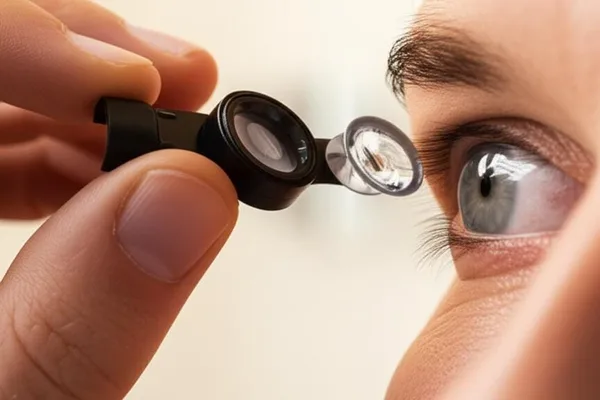
Imagine, you can't see something in a corner when you look straight ahead, right? But you can see it when you hold a mirror in that direction. That's how it is with this. The doctor can see that angle clearly only by using mirrors or magnifying lenses in a special lens used in gonioscopy.
Are there different types of gonioscopy lenses?
Yes, there are two main types of gonioscopy lenses:
1. Indirect lenses: These types of lenses use mirrors. The doctor sees the angle of the fluid flow only when light hits the mirrors and is reflected. That is why they are called "indirect". These types of lenses are most often used in regular eye clinics.
2. Direct lenses: These lenses do not have mirrors. These lenses directly magnify the angle and slightly bend (refract) the light. These are usually used more when performing things like surgery.
How should I prepare for a gonioscopy?
In most cases, you don't need to do anything special to prepare for this test. Your eye doctor can do it at any time.
However, if you wear contact lenses , it is a good idea to ask your doctor if you need to remove them for a certain period of time before the test.
Sometimes, if gonioscopy is being performed as part of another eye surgery, your doctor will give you specific instructions on how to prepare for it.
What to expect during the test?
The experience may vary slightly depending on the type of gonioscopy you have.
Direct Gonioscopy
This is usually done in a hospital. Most of the time, you will be given general anesthesia . This means that this test and related procedures are done while you are unconscious and asleep.
Indirect Gonioscopy
This is the type most often done in an eye doctor's office. It's done in much the same way as a slit lamp exam . You sit in a chair, and the doctor stands in front of you.
Before the test begins, the doctor will put numbing drops in your eye. The cornea of our eye is very sensitive, so if anything touches it, it feels uncomfortable and your eye closes. When this numbing drop is applied, you will not feel any discomfort or pain, and your eye will not close.
After the eye is numb, the doctor will also put something called wetting drops on the surface of the lens being examined. This will prevent air bubbles from getting trapped underneath the lens while it is in place. This will allow the doctor to see inside the eye clearly. It will also help to move the lens around on the eye more easily.
Then the doctor gently touches the lens to your eye, holding it with one hand and turning on the slit lamp with the other. The bright light from the slit lamp illuminates the inside of your eye and uses a magnifying glass to look inside. The doctor will tell you to look straight ahead or in a certain direction.
Sometimes a procedure called "dynamic gonioscopy" may be used. This means that the doctor will slowly press the surface of your eye with the lens. This will allow the doctor to see if your iris is stuck to the cornea or lens (synechiae).
Once your eye is completely examined, the doctor will remove the lens. He or she may also use something like wetting drops to rinse your eyes. It is normal for your eyes to be watery and teary during this time. The doctor will give you something like a tissue to wipe away your tears.
This test may or may not involve dilating your eyes. Sometimes, the doctor may need to look inside your eye before and after the dilation. The doctor will tell you about this.
Are there any risks or side effects from this test?
There are no side effects or risks with the gonioscopy itself. However, the medications used to numb and dilate the eye may cause some minor side effects (e.g., blurred vision, sensitivity to light). Your doctor will tell you more about these.
How does the test feel? Does it hurt?
Because your eye is numb during the test, you won't feel any pain or discomfort. Sometimes, you may just feel a slight stinging sensation, like when you rub your eyes. This is normal.
How do you get the test results? What do they mean?
- If Direct Gonioscopy was performed with surgery, the doctor will tell you about the results after you regain consciousness.
- If you have an indirect gonioscopy done in your doctor's office, your doctor will be able to tell you the results during or after the test. He or she will explain to you what they saw, what they mean, and what treatment is needed, if any.
If the results are abnormal, what do you do next?
If your eye doctor finds that you have a narrowed drainage angle or that the fluid is not draining properly, he or she will talk to you about treatment options.
Treating glaucoma is very important because if the pressure inside the eye is too high, it can cause permanent damage to the optic nerve at the back of the eye, which can lead to permanent vision loss.
If your doctor finds that the angle of your eye is completely closed, it is called angle-closure glaucoma . This is a medical emergency . This can cause sudden vision loss (which can be permanent). If this happens, your eye doctor will recommend emergency treatment and refer you to a facility that has the necessary facilities.
When should I see my ophthalmologist?
Glaucoma is a leading cause of vision loss worldwide. About 90% of glaucoma patients have the chronic form. This means that symptoms develop slowly. That's why it's recommended to have your eyes checked at least once a year or two (or at least once a year if you're over 40).
Additionally, it is important to have regular eye exams, such as gonioscopy, if you have any of the following conditions or risk factors:
- If you are 65 years of age or older.
- If you have type 2 diabetes .
- If someone in your family has glaucoma (family history of glaucoma).
- If you have high pressure inside the eye (ocular hypertension).
- If you have birth defects or inherited and genetic eye disorders.
- If you use medications such as corticosteroids for a long time.
- If the optic nerve is damaged or has a suspicious appearance.
- If you have severe nearsightedness or farsightedness.
- If you have sickle cell disease .
Also, be sure to see a doctor if you develop symptoms of glaucoma. Such symptoms include:
- Redness of the eyes.
- Headache.
- Nausea and vomiting.
- Feeling of pressure or pain in the eyes (this usually occurs when the pressure in the eye is too high).
- Seeing a rainbow-like halo when looking at lights.
- Decreased vision, for example , tunnel vision (seeing as if looking through a tube) or the development of new blind spots (scotomas).
When should you go for emergency treatment?
There are some symptoms of glaucoma that you should seek medical attention immediately if they appear. Such symptoms include:
- Sudden loss of vision.
- Sudden onset of severe eye pain, headache, nausea, and vomiting.
If something like this happens, don't delay.
Are there any disadvantages to gonioscopy?
Gonioscopy is a very valuable test. However, this test alone is not enough to tell for sure whether you have glaucoma or not. There are many other factors that go into diagnosing glaucoma. Gonioscopy is only one piece of the puzzle.
How long does a gonioscopy test take?
An indirect gonioscopy takes about five minutes. However, your appointment may take longer because other tests may also be needed.
The time it takes to undergo a Direct Gonioscopy can vary greatly depending on the procedure being performed. Your doctor can tell you more about this.
Finally, things to remember (Take-Home Message)
Gonioscopy may sound complicated, but the test itself is very simple. It is a non-invasive, painless procedure that does not harm the eye. It can help detect conditions that could cause permanent damage to your eyes. It can often be done in the doctor's office, and the results are available quickly.
If you have any concerns or questions about this test, talk to your eye doctor. He or she can explain the test to you, ease your fears, and help you understand what the test will show. Remember, a test like this can make a big difference in protecting your precious vision.
` Gonioscopy, eye exam, glaucoma, eye health, vision care, ophthalmologist, eye pressure




💬 Comments (0)
No comments yet. Be the first to share your thoughts here.
Add Your Comment