
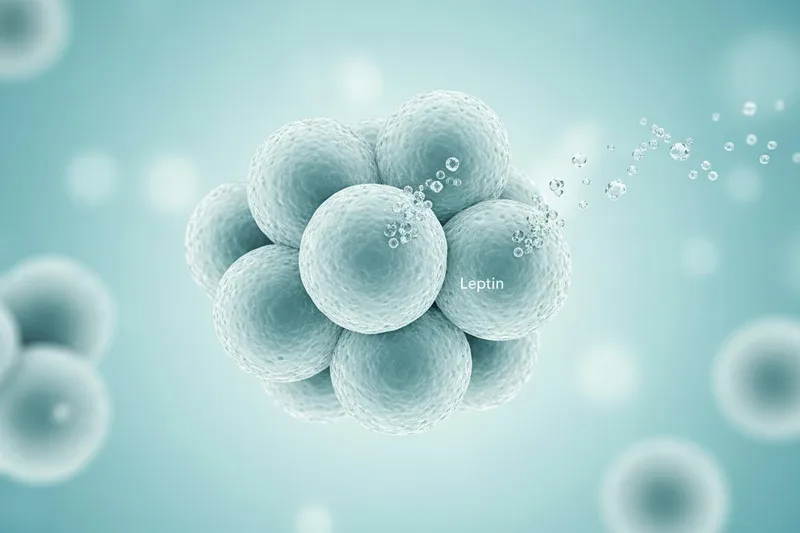
Have you ever wondered why we get hungry, how we feel full after eating, and why it's easy for some to gain weight while it's hard for others to lose weight? Today we're going to talk about a little chemical messenger produced inside our bodies that's connected to all of this. It's called Leptin. To be precise, leptin is a hormone released by our fat cells (adipose tissue) that helps us maintain our body weight in the long term.
What is Leptin? Let's take a simple look.
Imagine that your body fat produces a hormone called Leptin. So, the main function of Leptin is to control our hunger and give us the feeling of "enough, I'm full" (satiety) after eating. It's like a little manager that controls our body weight.
Scientists discovered the hormone leptin in 1994. That means there's still a lot to discover about it. They're already researching whether leptin can be used to treat weight control, Alzheimer's disease, reproductive health, and infertility.
"Ah... if leptin controls weight, shouldn't we be able to control leptin too?" you might think. But, the truth is, this hormone is not as easy to control as we want.
What does leptin do for our body?
Leptin's main job is to help keep our body weight stable. More specifically, it helps maintain a long-term balance between the amount of food we eat and the way our body uses energy. That is, it helps prevent us from feeling hungry when our body doesn't need energy (calories).
Leptin mainly acts on the hypothalamus, a part of our brain that controls our hunger and energy balance. However, leptin-sensitive receptors are also found in other parts of our body.
But here's something to understand. Leptin is not a hormone that makes us feel hungry after eating one meal. Instead, it helps us maintain our weight by changing the amount of food we eat over time , controlling how we use energy, and helping us control our weight.
Leptin's effects are especially felt when you're trying to lose weight. Think about it, when your body fat decreases, your leptin levels also decrease. Then the brain gets a signal saying, "Oh, the body doesn't have enough food, it's like we're fasting." This is why sometimes you feel very hungry and crave different foods. Then you're tempted to eat too much. This can make it even harder to lose weight.
Scientists are still researching Leptin. They believe that Leptin also affects our:
- Metabolism
- Endocrine system - that is, our hormonal system
- Immune system - the system that protects against disease
How are leptin levels controlled?
Leptin is produced and released by white adipose tissue in our bodies. This white adipose tissue is the main type of fat in our bodies. Simply put, it's the fat deposits on your body.
Because Leptin is produced by fat cells, the amount of Leptin in your blood is directly related to the amount of fat in your body. That means, if you have less body fat, you have less Leptin. If you have more body fat, you have more Leptin. It's simple, right?
If your body fat mass increases over time, your leptin levels will increase. Conversely, if your body fat mass decreases, your leptin levels will decrease.
What happens if leptin increases?
Leptin levels are often high in people with obesity. This is called hyperleptinemia. When leptin levels are consistently high, our brains may not respond to leptin properly. This is called leptin resistance .
There are several other conditions that may be associated with hyperleptinemia:
- Depression
- Food addiction
- Neurodegenerative disorders
- Nonalcoholic fatty liver disease
- Rabson-Mendenhall syndrome - This is a very rare genetic condition.
What is Leptin Resistance?
If you have Leptin Resistance, your brain doesn't respond to Leptin normally. Imagine, Leptin keeps sending signals to the brain saying "I've had enough food, I'm full," but the brain doesn't seem to care. So, you don't feel full. Because of this, you keep eating, even though you have plenty of fat stored in your body.
Not only that, but because Leptin is not working properly, the brain thinks that the body is starving and that it is starving. Then, to conserve energy, the brain reduces our energy levels, and also reduces the number of calories we use when we are at rest. Simply put, our Basal Metabolic Rate (BMR) is reduced.
So you see, leptin resistance causes you to feel hungry all the time, and it also lowers your BMR. When these two things come together, weight gain becomes even worse.
Scientists are currently researching drugs that can treat leptin resistance.
What are the symptoms of Leptin Resistance?
The main symptoms of leptin resistance are constant feeling of excessive hunger (hyperphagia) and overeating. These symptoms occur even when there is a lot of fat stored in the body.
However, there are other factors and conditions that can cause these symptoms. Leptin resistance is not the only one. As scientists are still learning about leptin, it is possible that more symptoms of leptin resistance will be discovered in the future.
What happens if leptin decreases?
Leptin deficiency is a very rare condition. The main disease associated with it is congenital leptin deficiency. This is a genetic condition that is present at birth. People with this condition do not produce leptin from their fat tissue.
When leptin is absent, the body thinks there is no fat in the body. This causes uncontrollable, excessive hunger and cravings to eat. For this reason, children with congenital leptin deficiency develop severe obesity (class III obesity) at a very young age, and puberty is delayed.
Other diseases that may be associated with this condition:
- Dyslipidemia - an imbalance of fats such as cholesterol and triglycerides
- Fatty liver disease
- Frequent bacterial infections
- Hyperinsulinemia - which means producing too much insulin
- Hypogonadotropic hypogonadism - that is, low sex hormone levels
What kind of test is done to check leptin levels?
Leptin levels can be measured with a blood test. However, doctors do not usually test everyone's leptin levels. They recommend a leptin test in the following cases:
- If your young child has class III obesity .
- If you are obese and constantly hungry .
What should normal leptin levels be like?
Leptin levels can normally range from:
- For women: 0.5 to 15.2 nanograms per milliliter (ng/mL)
- For men: 0.5 to 12.5 nanograms per milliliter (ng/mL)
But remember, these normal ranges can vary slightly between different laboratories. So, it's best to check the normal range on your report. Or, it's best to ask your doctor about it.
How can I increase my leptin levels?
To be honest, there's very little we can do to increase our leptin levels to reduce hunger and appetite. Because, as mentioned before, your leptin levels are directly related to the amount of fat tissue you have in your body.
One study found that people who get less sleep have higher levels of the hunger hormone ghrelin and lower levels of the hormone leptin. So, getting enough, quality sleep can help regulate your hormones.
Scientists are also investigating the relationship between leptin and a type of fat called triglycerides. Some research has shown that high triglyceride levels affect the way leptin works. But there are still different opinions on this. Some scientists think that an eating plan that lowers triglycerides can help improve leptin levels. But others disagree.
What foods are high in Leptin?
This is where many people make a mistake. Leptin is a hormone that is produced within our bodies, not a nutrient that we can get from food like vitamin C or protein. Therefore, there is no such thing as foods that contain leptin.
Finally, some of the most important things we need to remember
Leptin is actually a relatively new discovery, so scientists are still learning more about it, especially how it affects obesity and weight loss. As you can see, as your body loses fat, leptin levels drop, signaling that your body is "fasting," making it harder to lose weight.
If you're concerned about your weight or need guidance on how to lose weight healthily, it's best to talk to your doctor. You can also talk to an endocrinologist about weight management programs.
Remember, all of this is to help you stay healthy. It's important to be aware of your body.
` Leptin, weight control, hormones, hunger, obesity, fat, metabolism


💬 Comments (0)
No comments yet. Be the first to share your thoughts here.
Add Your Comment