
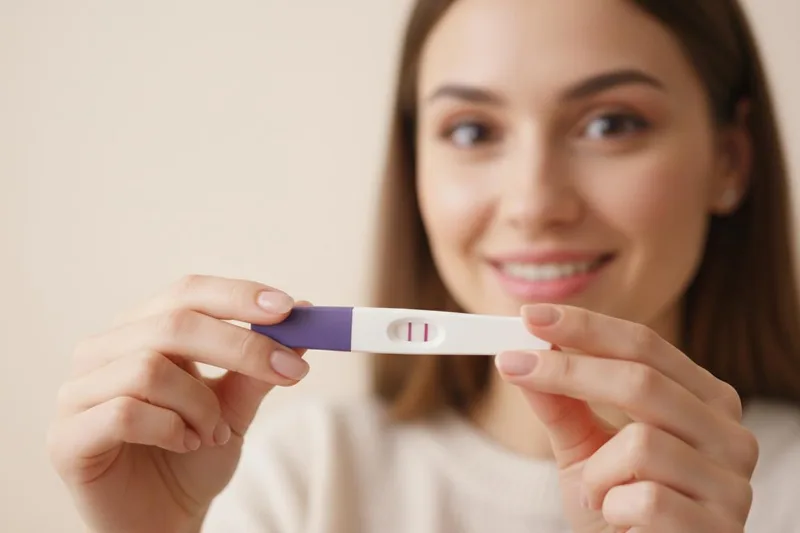
You know that feeling when you take a home pregnancy test and see two lines? Maybe it's something you've been waiting for. The test is looking for a special hormone in your body. We call it hCG, or Human Chorionic Gonadotropin . So, what is hCG? Why is it so important to you, especially during pregnancy? Let's talk about it today, like talking to a friend.
What is hCG? Simply put...
Simply put, hCG is a hormone produced by the placenta during pregnancy. Did you know, it is also called the "pregnancy hormone"? The reason for this is that this hormone plays a very special role during pregnancy, especially in the first three months (First Trimester). It is this hCG level that is checked by urine tests or blood tests to confirm whether you are pregnant or not.
Think about it, during the first 8 to 10 weeks of pregnancy, hCG levels increase very rapidly. In fact, they can double every three days. Sometimes, doctors will measure how quickly hCG levels increase to determine if the pregnancy is progressing properly.
Also, high levels of hCG in a non-pregnant person can sometimes be a sign of cancer. Very rarely, some types of cancer cells, such as germ cell tumors, can produce hCG. Therefore, doctors sometimes use this hCG test to diagnose cancer, see how treatment is going, or to check if the cancer has come back.
What actually happens with hCG?
hCG is the first pregnancy hormone produced by the placenta after conception. It plays a key role in "telling" the rest of your body that you are pregnant. That is, it signals your body to stop your monthly period and then to produce other important hormones, such as progesterone and estrogen .
Now look, these two hormones, progesterone and estrogen, are essential during pregnancy and for the development of the baby. Progesterone thickens the uterine lining, making the uterus lighter and facilitating pregnancy. Estrogen helps the baby's organs develop, increases blood flow to the placenta, and also helps prepare the body for labor.
You can think of it this way: hCG is the first hormone to help with early pregnancy. It then "talks" to other hormones to help.
When does hCG start being produced in our body?
In fact, everyone has very small amounts of hCG in their bodies (so low that it's undetectable). But when you become pregnant, hCG levels rise very quickly, to levels that are usually only seen during pregnancy. HCG levels peak around 10 weeks into pregnancy, and then gradually decline until the baby is born.
What is the hCG level required to be pregnant?
Generally, if your hCG level is above 25 milli-international units per milliliter (25 mIU/mL), it means you may be pregnant. But it's not 100% certain. Your doctor may want to check your hCG level again in a few days to see if it has increased. If it does, it's a sign that you're pregnant.
What are normal hCG levels by week of pregnancy?
The following diagram shows how hCG levels increase rapidly and steadily in the first trimester, then decline:
- Week 3: 5 – 50 mIU/mL
- Week 4: 5 – 426 mIU/mL
- Week 5: 18 – 7,340 mIU/mL
- Week 6: 1,080 – 56,500 mIU/mL
- Weeks 7 – 8: 7,650 – 229,000 mIU/mL
- Weeks 9 – 12: 25,700 – 288,000 mIU/mL
- Weeks 13 – 16: 13,300 – 254,000 mIU/mL
- Weeks 17 – 24: 4,060 – 165,400 mIU/mL
- Weeks 25 – 40: 3,640 – 117,000 mIU/mL
But remember, these numbers are just a guide. Your levels may vary. What's important is not the value, but how it changes. You should have your hCG levels checked, and your doctor will tell you what the test results mean for your pregnancy. Remember, even in healthy pregnancies, hCG levels can sometimes be lower than normal.
How often is this checked during pregnancy?
Usually, hCG levels are not checked regularly during pregnancy. Doctors may check hCG levels in the first trimester only if there is any doubt about whether the pregnancy is progressing properly. If your hCG level is lower than normal, your doctor will check it again in a few days to see if there has been any change. Some doctors also measure hCG as part of prenatal genetic testing.
How are hCG levels tested?
hCG can be measured either through a blood test or a urine test:
- Blood tests: Your doctor will take a small amount of blood from a vein in your arm and check the amount of hCG in it. A blood test can quickly detect hCG. It will show you the amount of hCG in a single number.
- Urine tests: This involves your urineA sample is taken and tested for hCG. However, this does not indicate how high or low the level is. It usually takes a long time before your period is due to be detected. This can be done at home or by a doctor.
If you have used an at-home pregnancy test, you have already taken an hCG test. The test will either be positive or negative if there is hCG in your urine .
But keep this in mind, a low hCG level alone does not diagnose a condition. It is just a way to help identify potential problems. If your doctor has any concerns about your hCG level, they will check your levels again in a couple of days. Or they may do an ultrasound scan to confirm the pregnancy and see how far along you are.
What can low hCG levels mean?
Low or declining hCG levels may be due to one of the following:
- Blighted Ovum: This means that a fertilized egg implants in the uterus but does not develop into an embryo.
- Miscarriage: The loss of a pregnancy.
- Ectopic Pregnancy: A pregnancy that occurs outside the uterus , such as in the fallopian tube. This is an emergency.
- Not knowing exactly when your last period was: The number of weeks you calculate may be wrong.
If your hCG levels are low for your pregnancy, your doctor will check your hCG levels again in two to three days, or perform an ultrasound to confirm the pregnancy.
What can high hCG levels mean?
High hCG levels can mean:
- You're further along in your pregnancy than you think: Your baby may be a few weeks older than you think.
- You are pregnant with twins, triplets, or more: hCG levels are higher when there is more than one baby.
- Molar Pregnancy or other Gestational Trophoblastic Diseases (GTD): These are abnormal developments that occur in the placenta.
- Very rarely, some types of cancer can also cause elevated hCG levels in the blood.
When should I see the doctor?
Most of the time, you don't know your hCG level until you see a test report in an online medical record. Doctors usually check hCG early in pregnancy, but they don't keep checking unless there's a specific reason. If you have any questions about your hCG test results, be sure to talk to your doctor.
How is hCG used in fertility treatments?
You adopt a child.If you are undergoing IVF (In-vitro Fertilization) or IUI (Intrauterine Insemination) , you may be given an hCG injection to help you ovulate. Also, after ovulation, you may need an hCG injection to help the embryo implant in the uterus. If you have had previous infertility problems, your doctor may want to check your hCG levels more often and more often.
What happens to men with hCG?
The hormone hCG can also help treat certain conditions in men. For example:
- For those with low testosterone levels (Low Testosterone)
- Male Infertility
- For those with undescended testicles
Finally, things to remember
Human chorionic gonadotropin, or hCG, is known as the "pregnancy hormone." This is the hormone that home pregnancy tests look for. Your body produces a lot of hCG during the first trimester to help your growing baby. Your hCG levels can provide valuable information about your pregnancy and can also give your obstetrician a clue about potential problems. However, if your pregnancy is going well, you may never even know about your hCG levels. If you have any questions about your hCG levels or what they mean, don't hesitate to ask your doctor. He or she will explain everything to you.
👩🏽⚕️ Additional questions (FAQs)
💬 What kind of hormone is HCG (Human Chorionic Gonadotropin)?
This is simply called 'The Pregnancy Hormone'! When a woman becomes pregnant, as the cells begin to divide and the embryo begins to develop (in a few days), the newly formed placenta releases a huge amount of this HCG hormone into the urine and blood. The Pregnancy Test Card from the pharmacy checks for the presence of this hormone.
💬 Why do an HCG blood test in addition to a pregnancy test?
A urine test only confirms that there is a baby in the womb (positive). However, doctors do a blood test (Beta hCG levels) to confirm whether the baby is growing properly, whether there is a dangerous condition where the baby is located outside the womb (in the tube) (Ectopic Pregnancy), and whether there are twins. Because in the early months, this hormone value should double every 2 days.
💬 Is it cancer if the HCG hormone is elevated in men or non-pregnant women?
Normally, a man should have zero levels of this HCG hormone. However, if it is abnormally present in the blood of a man or a non-pregnant woman, it is often a 'tumor marker'. Doctors check this HCG report, especially in cases of testicular cancer in men and ovarian cancer in women.
` hCG, pregnancy, hormones, pregnancy test, pregnancy health, women's health, placenta




💬 Comments (0)
No comments yet. Be the first to share your thoughts here.
Add Your Comment