
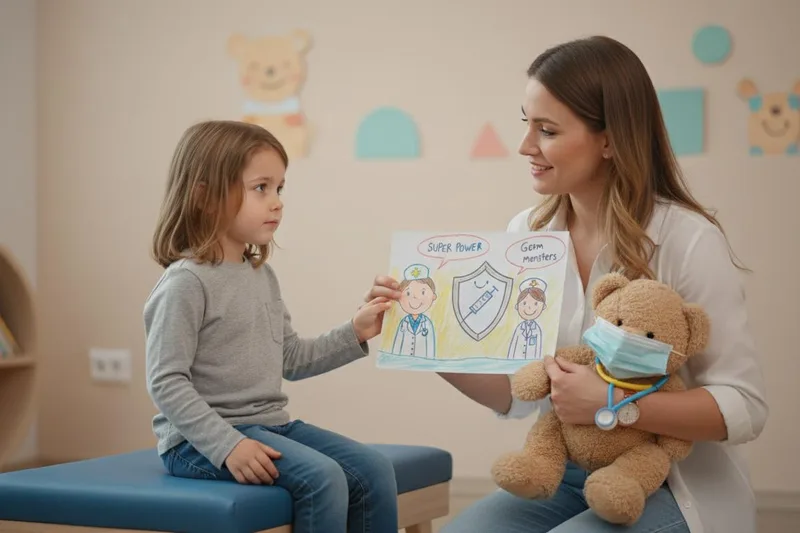
When your little one is in the hospital or is undergoing treatment for an illness, is he very scared, worried, and sad? Sometimes we can't even imagine how to comfort him at a time like this, how to make him understand these different things. Today we are going to talk about a special person who can be of great help to you and your child at such a time. That person is called `(Child Life Specialist)`.
Who is this `(Child Life Specialist)`? Simply put...
Simply put, a ``Child Life Specialist'' is a healthcare professional who helps your child cope with their illness, treatment, and hospitalizations. It's like a friend who comforts and encourages the child. While doctors and nurses treat the child's illness, this specialist works to reduce the child's fear, anxiety, and pain, and to give them the strength to endure this experience.
Imagine, a small child is about to be given an `(Injection)`. He is crying and struggling. At that moment, this specialist can come and explain it to the child with a game in a way that he can understand. Maybe he can divert his attention and help him give the `(Injection)` without him realizing it.
These people usually work in hospitals. They have good training in several of these areas:
- Child Development: This refers to how a child develops physically, mentally, and socially as they grow older.
- Education: Methods of teaching facts to children in a way that they understand.
- Psychology: Understanding children's thoughts, feelings, and emotions.
A ``Child Life Specialist`` will explain the health issues affecting your child and the treatments they can receive in a language they understand. They can also help distract your child during treatment so that they don't feel it.
They work with babies, toddlers, preschoolers, school-aged children, and even teenagers. Not only that, but their job is to support the entire family. They provide you and your family with the information you need and teach you how to cope with this challenging time. They do this by using things like:
- Play: Toys and games help children understand things and dispel their fears.
- Preparation: Before surgery or any treatment, the child is mentally prepared for it.
- Education: Teaches about the disease, medicine, and the hospital environment.
- Self-expression activities: Help the child express their feelings through activities such as drawing and telling stories.
Even in the midst of these difficult experiences, these people try to encourage the child's normal development without hindering it.
What kind of education is required to become a ``Child Life Specialist''?
To perform such a responsible service, one must receive good education and training.
1. First, you need to have a four-year bachelor's degree. Some people major in Child Life. Others major in Child Psychology or Human Development and take additional courses related to Child Life. In these degree programs, they learn the following:
- Child Development
- Communication skills
- Coping techniques
- Basic medical jargon
2. Some people even pursue a postgraduate degree (Master's Degree). Such postgraduate courses usually last about two years. They provide more in-depth knowledge and practical training. This also helps in facing the competition in the job market.
3. Then, you need to get a professional certification from the Association of Child Life Professionals. Many hospitals expect you to get this certification within a year of starting work. To get this certification, in addition to a bachelor's degree, you need to meet the following qualifications:
- Must have completed a ``Child Life`` study program approved by the ``Association of Child Life Professionals``. Otherwise,
- You must have completed at least 10 subjects related to the subject of ``Child Life`` at the university level. At least one of these subjects must have been taught by a ``Certified Child Life Specialist``.
- In addition, you must complete a 600-hour internship or fellowship. This must also be done under the direct supervision of a Certified Child Life Specialist.
- Finally, you must pass the exam conducted by the Association of Child Life Professionals.
You see, this is not an easy thing. Since you are working with children's mental health, you need to have the right qualifications for it.
What does a ``Child Life Specialist`` do at a children's hospital?
At a children's hospital, these specialists provide patient- and family-centered care. Their main goal is to reduce any discomfort, fear, or pain your child may experience before, during, and after medical treatment. They work to prepare you and your family for and educate you about your time in the hospital.
They teach helpful coping strategies to reduce the stress of being in the hospital. These strategies include play and activities that allow you to express your feelings. They provide emotional support to your family. They also help your child develop normally, even while dealing with health problems.
A ``Child Life Specialist`` tries to help the child understand his or her medical experience. They provide preparation and education that is appropriate for the child's age and development. When a child understands what is happening to him or her, it is easier for him or her to cope. It can also reduce the psychological trauma that he or she may experience.
You too can meet with this specialist to get guidance for your family. They will help you deal with the medical experience.
Some of the programs and services provided by a `(Child Life Specialist)` are:
- Behavioral modification plans: These plans help the child successfully adapt to a new medical treatment regimen (e.g., daily medication, special diet).
- Education: Educational programs that provide information about a newly diagnosed disease. These are tailored to the child's age and level of understanding. They are presented in a way that suits the child's needs, using toys, books, and technology.
- Pediatric medical preparation and pre-surgery teaching: Providing age-appropriate information to reduce a child's fears, anxieties, and misunderstandings. For example, before an operation, you can show a doll how to perform the operation, just like a game, and make the child understand it.
- Support during procedures: They help reduce the child's pain and fear during procedures such as injections, cannula insertion, and wound cleaning. They use techniques such as distraction, guided imagery, and relaxation exercises.
- Therapeutic play activities: These activities can help to make the hospital environment a normal place for the child and reduce stress. These can be done at the child's bedside, in playrooms, or in waiting rooms.
- Medical play: Letting your child play with medical equipment, such as a stethoscope and a syringe (without a needle), can help reduce their fear of them. As the child becomes familiar with these equipment, their discomfort will decrease.
- Support for brothers and sisters: Helping the siblings of the sick child understand the situation and deal with their emotions (such as sadness, fear, anger). Answering any questions they may have about their sibling's treatment.
Remember, a ``Child Life Specialist`` is someone who is very important not only for the child's physical well-being, but also for their mental well-being.
What does a ``Child Life Specialist`` do in an adult hospital?
These people are not limited to children's hospitals. A ``Child Life Specialist'' can also help children of patients in adult hospitals. Imagine, a mother or father is hospitalized for a serious illness. A small child does not understand what is happening. He may be scared, he may be sad. At such times, these specialists help those children understand what is happening to their parents.
These people work with any child who has an adult family member in the hospital. They provide preparation and education that is appropriate for the child's age and development. Preparing the child in this way is very helpful in helping him cope with stress and manage it in the long term.
A ``Child Life Specialist`` focuses on the special needs of children and provides services such as:
- Education: You can teach the child about the adult's new illness. Provide information about the adult's illness and treatment in a way that the child can understand.
- Adjustment: Helps the child adjust to changes in the adult's physical appearance (e.g., weight loss, hair loss) or abilities.
- Preparation: Prepare the child for the visit before going to see an adult at the hospital. (Example: "Daddy has been given saline now, don't be scared to see that, son").
- Guidance: Helps with difficult conversations (e.g., about the adult's hospitalization, the severity of the illness, and the prospects for recovery).
- Therapy: Therapeutic activities and interventions are used to deal with the feelings and problems the child is experiencing due to the adult's illness.
- Support: Support is provided for end-of-life issues and grief issues, using specialized services and bereavement care.
How do I find a `(Child Life Specialist)`?
If you need to talk to a Child Life Specialist, talk to your child's healthcare provider. They can help you find the resources you need. Doctors are also eager to help you and your child cope with this illness and hospitalization.
Finally, remember this (Take-Home Message)
A ``Child Life Specialist`` is a healthcare professional who helps and works with your child when they are sick, injured, or hospitalized. Their main goal is to help your child's life continue as normal as possible during this difficult time. They can help reduce the discomfort your child feels while in the hospital and help your child understand health issues.
These people provide emotional support not only to the child, but to you and your entire family. They are there to help you, to provide the best care possible for you and your child.
Therefore, if your child is afraid of going to the hospital or undergoing treatment, don't hesitate to talk to the doctor about it and seek help from a ``Child Life Specialist''. It will be a great boost to your child's recovery journey!
👩🏽⚕️ Additional questions (FAQs)
💬 Is a Child Life Specialist a doctor in a hospital?
No! These are not doctors who give medicine, but rather a group of 'chief angels' in a hospital! This is a specially trained assistant who helps young children and their families who are afraid of the hospital environment, operations, and needles, understand that the hospital is not a hell through toys, drawings, and stories, 'so that the fear and pain go away'.
💬 How do they mentally prepare the child before an operation?
When a child cries out in fear, "Will they cut me now? Will they stick needles in me?", this specialist comes and shows me the equipment in the operating room (by showing me a doll) like it's a game. He distracts the child while the cannula is inserted. He sits like a 'friend/hero' to the child inside the hospital, completely eliminating that innocent fear.
💬 What is the biggest benefit to the hospital and mothers of having a Child Life Specialist?
The main thing is that when the child who was screaming in fear of death calms down, the doctors can treat him without any obstacles. Also, if the child is calm, there is no need to give a lot of anesthesia/painkillers. Because of the wonderful peace that comes, the child recovers quickly and goes home, and a huge burden on the parents' heads is relieved.
` Child Life Specialist, Child Psychology, Hospitalized Children, Children and Hospitals, Psychological Support, Play Therapy, Preparing Children


💬 Comments (0)
No comments yet. Be the first to share your thoughts here.
Add Your Comment