

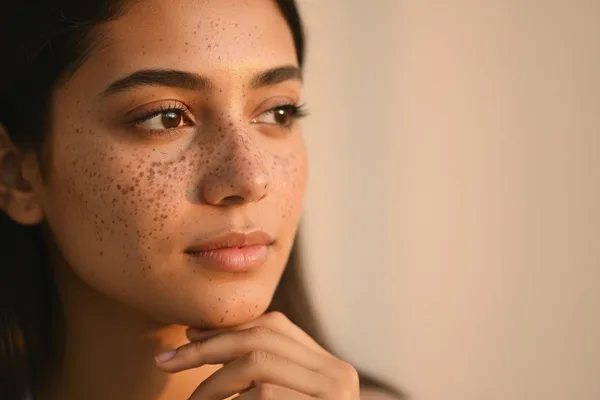
You may have noticed that when some people spend a little time in the sun, small brown spots appear on their faces and hands. Some people say, "Oh, this is so beautiful." But for others, this is a minor annoyance. We call these 'freckles.' So today, let's talk about what these freckles are, why they form, are they dangerous, can they be removed, and what to do to prevent them.
What exactly are freckles?
Simply put, freckles are small, flat spots that appear on your skin, especially in areas exposed to the sun (think face, neck, arms, upper chest). They can usually be light brown, dark brown, or reddish brown in color.
These spots are very common , and they do not pose any threat to your health . They are most often seen during the summer, which means during the hot summer months.
Generally, people with fair skin and light-colored (blonde or red) hair are more likely to develop freckles. However, that doesn't mean that people with darker skin don't get them. They can also get freckles, but they usually appear dark brown.
Okay, now let's see how these spots are formed?
Freckles are caused by the overproduction of a pigment called melanin in our skin. Melanin is a natural pigment that gives color to our skin, hair, and eyes. This melanin is produced by a special type of cell in our skin called melanocytes .
Think of it like melanin, a natural protection for our skin. One of the main functions of melanin is to protect our skin by absorbing and reflecting harmful ultraviolet light (UV rays) from the sun. If you have fair skin, when your skin is exposed to the sun, these melanocyte cells start producing more melanin. But instead of the skin becoming evenly brown (tanned), in some places the melanin accumulates and appears as small spots. That's what we call freckles.
Are there different types of freckles?
Yes, there are mainly two types of freckles.
1. Ephelides
2. Solar Lentigines
Now let's talk about these two types separately.
What are Ephelides?
This is the type we usually think of when we think of "sunspots." These are flat, reddish or light brown spots. They are mainly caused by sun exposure and sunburns .
- Where do you see it?: Sun-exposed areas like the face, hands, upper chest, neck, and back.
- Who is more likely to get it?: It is more common in people with light hair and skin, as well as in white and Asian people.
- When do they start?: These can start to appear first in young children who are exposed to the sun. For example, in the past, when we were children, we would play cricket all day long, or participate in school sports events, and we would get sunburned and develop these spots. These can continue to appear until adulthood.
- What happens as we age?: Often, these types of spots called ephelids gradually diminish as we age .
What are Solar Lentigines?
These are spots on the skin that vary in color from yellow, red, brown to dark brown. They are also called "age spots" or "liver spots."
- Who is most likely to get them?: These are usually seen in adults over 40 years of age .
- Why does it occur?: The main cause is repeated exposure to the sun over a long period of time.
- Where do they appear?: These also appear in sun-exposed areas. They can be seen on the face, upper arms, back of the hands, chest, back, shoulders, and lower legs.
The main difference between these two types is that Ephelides are light brown spots that can appear from childhood and increase with sun exposure, and sometimes decrease with age. Solar Lentigines are slightly darker, sometimes larger spots that appear after the age of 40, due to prolonged exposure to the sun.
Are there other causes of freckles?
Although the main cause is exposure to UV rays from the sun, there can be several other causes:
- Genetics: Yes, some genes play a role in the development of freckles. In some families, these are hereditary.
- Xeroderma Pigmentosum: This is a very rare condition. People with this disease have an extreme sensitivity to ultraviolet rays, that is, sunlight.
Do I need to treat freckles?
In fact, freckles are mostly harmless , so there's no need to treat them. However, as with other skin blemishes, it's best to avoid the sun as much as possible and use sunscreen daily. This is especially important if you're prone to freckles or don't want to get more.
Is there any way to remove my freckles?
It is difficult to completely remove freckles, but there are treatments that can reduce their color and make them fade a little. They are:
- Acid and chemical peels: These methods use products containing chemicals such as alpha hydroxy acid , trichloroacetic acid , glycolic acid , or phenol . These work by removing the top layer of dead skin cells, helping to reveal new, healthy skin.
- Retinoids, retinols: These chemicals also speed up the process of skin cell turnover and the production of new cells. They also stimulate the production of collagen in the skin.
- Laser treatment: This is a method that uses laser beams to remove the top layer of skin.
- Cryotherapy: This uses a very cold substance called liquid nitrogen to remove non-cancerous age spots and actinic keratosis . The treated area darkens after a few days, and the top layer of skin peels off.
However, before undergoing any of these treatments, it is important to consult a dermatologist to find out what treatment is best for your skin condition.
Can you prevent the formation of freckles?
Yes, you can! Since sun exposure is the main cause of freckles, the best thing to do is to protect our skin from the sun . You can do the following:
- Before going out, always apply a broad-spectrum (UVA and UVB) sunscreen with an SPF (Sun Protection Factor) of 30 or higher , and a water-resistant sunscreen. Remember to apply sunscreen every day , even on cloudy days and in the winter. Reapply every two hours if you sweat or swim.
- When going outside, wear a wide-brimmed hat , sunglasses with UV protection , and light, long-sleeved clothing and long pants. If possible, choose clothing with a UPF (Ultraviolet Protection Factor) label , which provides even more protection.
- UV rays are usually strongest between 10 am and 4 pm . Minimize sun exposure during these hours as much as possible.
- Avoid tanning, that is, artificially tanning your skin. If you want a tanned look, there are spray-on tanning products you can try.
So what are moles? Are they different from freckles?
Yes, moles are another thing like freckles. They can appear anywhere on the body.
- Birthmarks can come in different shapes and sizes. They are usually larger than freckles.
- The color can also be different shades like pink, light brown, dark brown, blue, black, etc. Sometimes it can be the same color as the skin or even have no color at all.
- Birthmarks can be flat or slightly raised above the skin.
- Most birthmarks are not cancerous (benign) . However, some can grow larger, change color, or change shape over time. Some can even become cancerous.
- Birthmarks usually appear most often between the ages of childhood and about 20. Some can appear later in life. Most people have at least a few birthmarks.
Moles to watch out for are those that look different from other moles, or those that appear new after the age of 20. Most moles don't need treatment. But if you notice a change in the color, height, size, or shape of one of your moles, be sure to see a dermatologist.
What is Melanoma?
Melanoma is the most dangerous type of skin cancer. It can grow very quickly and spread to any organ in the body.
Most melanomas are black or brown. But some can be pink, red, purple, or even skin-colored. About 30% of melanomas start in an existing mole. But the rest develop on normal skin. That's why it's important to be aware of changes in your skin.
How to check yourself for moles on your skin? - ABCDE rule
According to the American Cancer Society and the American Academy of Dermatology, this ABCDE rule is very useful for assessing the spots on your skin.
- A - Asymmetry: This means that if you mentally draw a line through the middle of the spot, the two sides are not the same.
- B - Border: The edge of the mole is unclear, blurred, jagged, or irregular.
- C - Color: The color of the mole is not uniform throughout. There may be a mixture of colors such as black, brown, and light brown, and there may even be patches of red, white, blue, or pink.
- D - Diameter: The diameter of the spot is about a quarter of an inch (1/4 inch) or larger (about the size of a regular pencil eraser).
- E - Evolving: The size, shape, or color of the mole has changed over time.
If you notice any of these symptoms, see a doctor or dermatologist immediately. And remember, some dangerous spots may not follow this rule.
Other risk factors:
- Changes in a new spot, or spots that look different from other spots.
- A wound that does not heal.
- Redness or swelling beyond the edge of the spot.
- The color of the mole spreads beyond the edge of the mole to the surrounding skin.
- The spot is now itchy, sore, or painful when pressed.
- The surface of the spot has changed - it is oozing pus, bleeding, becoming crusty, or a lump has appeared.
What if I get a spot on my lip? Is it dangerous?
Freckles can appear anywhere on the body, even on the lips . Our lips are part of the epidermis, the top layer of our skin. Most of the time, having freckles on the lips is not harmful. But you should always pay attention to your freckles, and if you notice any changes, see a dermatologist.
Sometimes, spots on the lips can resemble birthmarks or spots associated with a condition called Peutz-Jeghers syndrome . This is a genetic condition, one of the symptoms of which is the appearance of dark spots on various parts of the body, including the lips.
I have white spots on my skin. What are they?
Sometimes you may notice small white spots on your skin. This is called idiopathic guttate hypomelanosis . Isn't that a long name? It's thought to be caused by prolonged exposure to the sun.
Like other types of freckles, these are more common in people with fair skin. However, they can also occur in older, darker-skinned people. They are most commonly found on the legs, arms, upper back, and face.
These white spots are caused by a decrease in the melanin pigment in your skin. Idiopathic guttate hypomelanosis is not a harmful condition. If you need treatment, there are treatments available such as topical steroids , tretinoin , pimecrolimus, and dermabrasion .
When should you see a dermatologist?
If you notice any of these changes in your freckles or other skin spots, see a doctor or dermatologist immediately:
- If the size, shape or color changes.
- If the edge is not clear, if it looks like it is cut.
- If the shape is asymmetrical (if divided into two, the two sides are not equal).
- If it hurts, itches, or bleeds.
- If it comes out of the skin.
- If there are dark spots or if there are several colors in one spot.
Moles are a common skin discoloration. They are usually harmless . However, just like any other skin spot or discoloration, be aware of every spot on your skin. If possible, take pictures of all your skin areas at least once a year. This will make it easier to see changes over time. If you notice any changes in a birthmark, freckle, or other spot, see a doctor or dermatologist right away for a checkup. Even if you don't see any changes, it's a good idea to get your skin checked regularly by a doctor.
Finally, a few things to remember
Okay, we've talked a lot about freckles, haven't we? Finally, here are the most important things you need to remember:
- Freckles are usually harmless and do not cause any serious health problems. If they do not bother you, they do not require special treatment.
- Sun protection is the best way to prevent freckles. Make it a habit to use sunscreen daily, wear a hat, and wear sunglasses.
- If you notice a change in any spot or birthmark on your skin (such as size, shape, color, itching, or pain), don't ignore it.
- Whenever you have any doubts, seeing a dermatologist for advice is the best thing you can do.
So, I hope you've got the answers to your questions about freckles. May you too have healthy, beautiful skin!
` Freckles, skin spots, sunburn, melanin, skin diseases, skin cancer, sunscreen




💬 Comments (0)
No comments yet. Be the first to share your thoughts here.
Add Your Comment