
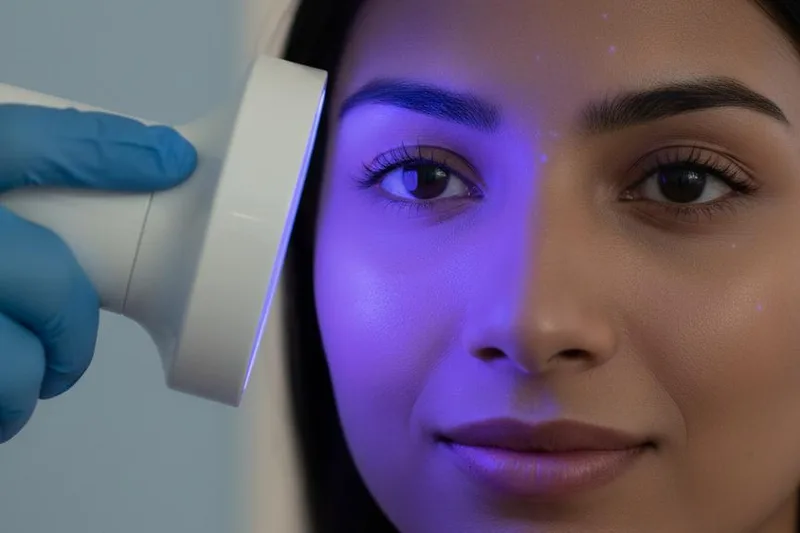
Have you ever gone to a dermatologist and seen them turn off the lights in the room and shine a strange blue-purple light on your skin? You might have thought, 'What is this doing?' At that moment, you might feel a little curious and a little scared. But there's nothing to be afraid of. That's what we're going to talk about today, a very simple but very important test called the 'Wood's Lamp' test. It can easily detect some diseases of your skin, scalp, and hair.
Simply put, what is this Wood's Lamp test?
Imagine this is a special torch-like device. But what comes out of this is not normal light, but ultraviolet or UV light that our eyes cannot see directly. This is also called 'black light'. It was first introduced by an American physicist named Robert Wood. That is why it is called 'Wood's Lamp'.
When the UV rays from this lamp hit the skin, some of the cells, germs, and fungi in the skin start to glow in different colors. Just like some toys that glow in the dark. While healthy skin looks one way, areas with a certain disease glow in a different color. It is by looking at those colors that the doctor can identify if there is a problem with your skin.
What diseases can be identified with this test?
Although this is a really small device, the number of diseases it can detect is very large. Dermatologists use it all the time. Let's see what are the main things it can detect.
| Disease category | Examples and descriptions |
|---|---|
| Abnormal pigmentation of the skin | Some people develop brown spots on their faces ( Melasma) . Others develop white, scaly patches on their skin ( Vitiligo) . This light helps you see exactly what these spots look like and how far they have spread. |
| Bacterial Infections | Some types of bacteria, such as Pseudomonas and Corynebacterium, glow a special color under this light. This can give you an idea of whether a wound is infected and what bacteria is causing it. |
| Fungal Infections | It is often used to identify fungal infections such as ringworm ( Tinea Versicolor ), tinea capitis , and ringworm. The areas of fungus appear to glow a greenish-blue color. |
| Parasites | This lamp can also be used to detect scabies, head lice, and lice eggs, which are associated with itchy skin. |
| Other skin problems | It can also help check for things like acne, age spots, and milia (small white spots around the eyes). It can also be used to diagnose a rare condition called porphyria . |
Is this only used by doctors?
No, that's the amazing thing! The technology in this Wood's Lamp is used for many things outside of the medical field. You've probably heard of these.
- In banks: Identify counterfeit money. The security features on some banknotes glow in this light.
- At Night Clubs: Check the hand stamp to identify people entering and returning.
- Immigration officers: Check documents like passports for forgeries.
- Law enforcement officers: Find evidence at crime scenes that is not visible to the naked eye, such as urine and semen.
- Museums and jewelers: Check the authenticity of things like old paintings and gemstones.
So do you understand? This is not just a torch, it's an amazing device that can do a lot of things.
Do I need to do anything before the test?
There is no need for much preparation, but the most important thing to remember is to not apply anything to the skin being tested before the test .
That means,
- Make-up
- Deodorant
- Moisturizers or other creams
- Any other medicine applied to the skin
If you have applied these things, the chemicals in them can also shine through the light. Then the doctor may see the result incorrectly. Therefore, it is best to wash the area with just water and dry it well before the test. Do not apply new soap and wash it, because the residue from some soaps can also affect the results.
What happens during the test? Does it hurt?
Absolutely not! This is a 100% painless test. There is no heat from this lamp, and you won't feel anything. It's like holding a torch to your skin.
The steps for the test are usually as follows:
1. Make the room completely dark: The doctor will turn off the lights in the room, close the curtains, and make it very dark. Sometimes, a black cloth may also be placed over your skin. This is because only when it is completely dark can the skin's colors be clearly seen.
2. Turning on the lamp: Then turn on the Wood's Lamp. You will see a small purple light coming from it.
3. Wait a while: Wait about a minute for the lamp to warm up a bit and for the doctor's eyes to adjust to the dark.
4. Eye protection: Since continuous exposure to these UV rays is not good for your eyes, your doctor will tell you to close your eyes or give you goggles.
5. Skin examination: The lamp is then held about 5 inches away from your skin and examined for a few seconds.
6. Relight: When the test is over, the lamp is turned off and the room lights are turned on.
7. Discussing the results: The entire test only takes a few minutes. The results are available immediately, so the doctor will explain them to you right away.
What do the colors in this light mean?
This is the most important part. Different colors mean different things. Let's see what these colors mean.
| Visible color | What does it usually mean? |
|---|---|
| Healthy skin appearance | |
| Light blue | This is what healthy, normal skin looks like. There's no problem. |
| White spots | Areas where the skin is thickened. It could also be pieces of thread from clothing. |
| Yellow color | Oily skin. |
| Purple | The skin is dry and dehydrated. |
| A color that may indicate a medical condition | |
| Bright blue-white | Skin pigmentation is reduced (hypopigmentation) or completely lost (depigmentation). This color is seen in vitiligo. |
| Brown | Hyperpigmentation is an increase in skin pigmentation. This discoloration can be seen in conditions such as melasma (spots on the face). |
| Blue-green | There may be some severe fungal infections. |
| Coral pink | A symptom of some bacterial infections. |
| Pink-red | This color can be seen in urine in a condition called porphyria. |
| White or gray spots on the skull | There may be lice eggs (nits). |
| Yellow or orange | It is seen in yeast infections such as tinea versicolor. |
Important: These colors cannot be used to tell you 100% whether you have the disease. This is only a tool to help diagnose the disease. Your doctor will consider the results of this test, your symptoms, and the results of other tests, if necessary, to make a final diagnosis.
Take-Home Message
- The Wood's Lamp test is a simple, painless, and safe UV light test used to diagnose diseases of the skin, hair, and scalp.
- This can quickly detect fungal, bacterial infections, changes in skin pigmentation, and more.
- Do not apply any cosmetics (such as creams or makeup) to the skin before the test, as this may cause incorrect results.
- The test only takes a few minutes, and the results are available immediately.
- This test is virtually risk-free, but it is essential to protect your eyes during the test.
- Whatever the test results, only discuss them and future treatment with your doctor .


💬 Comments (0)
No comments yet. Be the first to share your thoughts here.
Add Your Comment