
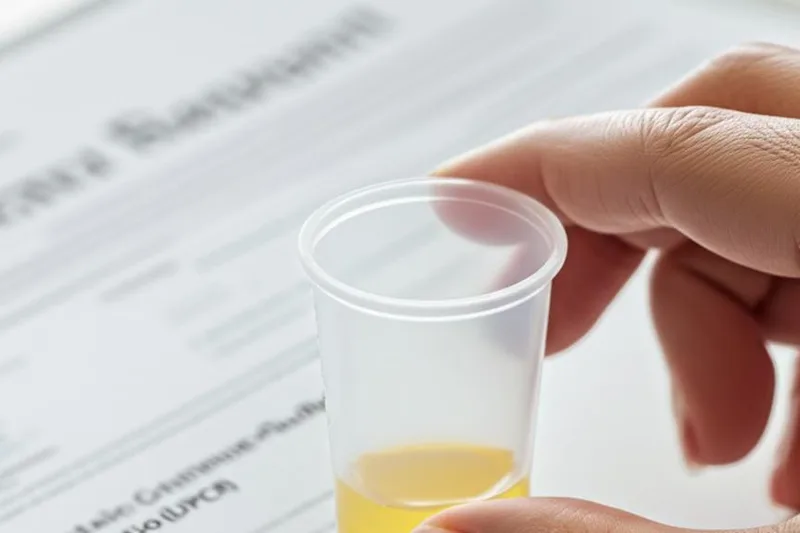
Hello! Have you ever thought that there is a very simple urine test that can tell you if your kidneys are working properly? That is one of the tests we are going to talk about today , the Urine Protein Creatinine Ratio (UPCR) test. It can tell us a lot of important things about the health of our kidneys.
What is this (UPCR) test?
Simply put, this (UPCR) test is a test done on a sample of your urine. It mainly looks at how much protein and creatinine are in your urine. Now you are probably wondering what this creatinine is, right? Creatinine is a waste product that is produced when our muscle cells use something called creatine (a natural chemical that gives muscles energy). It is like the garbage that accumulates in our homes.
When your kidneys are healthy and working properly, they filter waste products like creatinine from your blood and remove them from your body in your urine. So this (UPCR) test gives your doctor a lot of important information about how your kidneys are working. The results of this test can help identify conditions that can damage your kidneys and see how effective any treatment you are already taking is.
What time is the (UPCR) test done?
Now let's see in what cases doctors recommend this (UPCR) test.
This test is usually done to see if your urine protein level is higher than normal, meaning that you may have proteinuria ( protein in the urine), which can be a major symptom of kidney disease.
So, the situations that may cause you to do this (UPCR) test are:
- During your regular annual medical check-up, you can basically do a screening test to see if you have proteinuria.
- During pregnancy, if you develop symptoms of a condition called preeclampsia (a serious condition associated with high blood pressure during pregnancy).
- If you have symptoms of kidney disease (for example, swelling, decreased urination, fatigue), or if your blood creatinine level, also known as serum creatinine, is abnormally high, this (UPCR) test is used to detect kidney damage or to see if you have pre-existing kidney disease/chronic kidney disease (CKD) and how well your treatment is working.
How does this (UPCR) test work?
Okay, now let's take a closer look at how this (UPCR) test provides so much information about our kidneys.
As you know, our kidneys are a very important and indispensable organ of the urinary system. The main function of healthy kidneys is to filter waste products and extra fluids from our blood and excrete them from the body as urine. Among these waste products is creatinine. Also, proteins, which are essential building blocks for our body, also pass through the delicate filters of the kidneys.
However, a special feature of healthy kidneys is that they reabsorb these filtered proteins back into the blood. Because these proteins perform many very important functions, such as balancing the amount of fluid in our blood, fighting infections, and producing hormones and enzymes.
So, imagine, if there is any weakness or damage in the kidneys, it becomes difficult for these proteins to be filtered and properly absorbed back into the blood. Then, instead of being absorbed into the blood, these valuable proteins are excreted in the urine. That is what this (UPCR) test measures.
The UPCR test is a type of kidney function test. It measures the levels of both protein and creatinine in the urine to determine whether the kidneys are damaged or at risk of damage. The UPCR test is considered very accurate because it measures the ratio of both substances in the same urine sample, minimizing the effects of changes in urine concentration at different times of the day.
How to prepare for a (UPCR) test?
This is another great thing about this test. You don't have to prepare for this (UPCR) test in advance. When you go to see the doctor, they will ask you to give some urine in a clean bottle. Usually, the first urine sample in the morning is the best, as it is more concentrated. However, it can be done with a sample taken at any time of the day.
However, in some special cases, since the protein level in urine changes throughout the day, doctors sometimes measure this protein level from urine collected over a 24-hour period to reduce that effect. However, for (UPCR), one sample is usually sufficient.
What happens after the (UPCR) test?
After you give your urine sample, there are places that have small instruments that can test it right in the doctor's office. Or, it will be sent to a specialized laboratory, called a ``lab''. The lab will accurately measure the levels of protein and creatinine in your urine.
Once the results are in, your doctor will call you to discuss them and discuss what to do next. If the sample is sent to a lab, it may take a day or two to get the results back, or it may take up to a week. This depends on the lab's workload.
What are the benefits of a (UPCR) test?
The main advantages of this (UPCR) test are that it is a ``noninvasive'' , quick, painless, and very simple test. With a small amount of urine, your doctor can get important clues about diseases and various health conditions that affect your kidney function. It can also be used to monitor the effectiveness of treatments for conditions that damage the kidneys (e.g., diabetes, high blood pressure, and kidney damage).
Consider, for example, some other urine tests, such as the creatinine clearance test . These only measure creatinine levels (not protein levels). For such a test, you have to give the entire amount of urine collected over a certain period of time (usually 24 hours). That is when the lab can measure the volume of urine produced over a certain period of time. There are other tests, such as the urine protein test , which only measure the protein in your urine over a longer period of time, usually 24 hours.
However, since this (UPCR) test measures the ratio of both creatinine and protein levels, you only need to provide one urine sample. So, because it avoids the inconvenience of collecting urine for 24 hours, the (UPCR) test is a reliable alternative that is convenient for the patient and provides quick information for the doctor .
Are there any risks with this test?
This is something you can be happy about. There are no health risks associated with this (UPCR) test. This is because it is not something that is injected into the body. Very rarely, if the urine sample was not collected properly or for some other reason, the test results can be ``inconclusive or unclear``. If that happens, you will have to give another urine sample. That is the worst that can happen.
How long does it take to get the results of the (UPCR) test?
The results of this test may come back to you as quickly as you would expect, within minutes (especially if you get the test done at the clinic). Or, if you send it to a lab, it may take a few days. However, your doctor will call you as soon as the results are in and explain what they mean.
What does elevated protein levels in urine mean?
This is a very important fact that we all need to know. If your kidneys are healthy and working properly, the amount of protein excreted in your urine per day should be less than 150 milligrams. The (UPCR) value should generally be less than 0.2 mg/mg (or 20 mg/mmol).
However, sometimes protein levels in the urine can temporarily increase. Common causes include:
- Dehydration (lack of water in the body ).
- An infection , especially a urinary tract infection.
- Pregnancy (some pregnant women may experience a little proteinuria, but it is not as severe as in preeclampsia).
- Immediately after strenuous physical exercise .
- Severe mental stress or physical stress (e.g. fever).
However, if protein levels are higher than normal for a long time, without these temporary reasons, it could be a sign of severe kidney damage or a gradual progression to kidney failure . Therefore, it is not a good idea to ignore this.
Also, elevated protein levels in the urine can help your doctor identify and manage conditions such as diabetes and high blood pressure , two major diseases that damage the kidneys.
When should I talk to my doctor about the (UPCR) test?
If you have any questions, doubts, or difficulties understanding the results of your (UPCR) urine test , do not hesitate to contact your doctor . Your doctor will be the one who will explain your results to you and advise you on what tests to do next, what treatments to take, and whether you need to make any lifestyle changes.
The most important things to remember
So, you probably now understand that the Urine Protein Creatinine Ratio (UPCR) test we talked about is a test that provides your doctor with very valuable and important information about how your kidneys are working. It is also a great relief that this urine test is quick, painless, and does not cause any harm to the body . The results of a (UPCR) test can help your doctor identify conditions that can damage your kidneys and affect your overall health, monitor existing conditions, and measure the success of treatments.
Therefore, never forget to talk openly and honestly with your doctor about the results of this test and their impact on your health. The care of your kidneys is in your hands!
` Kidney, urine test, UPCR, protein, creatinine, kidney disease, proteinuria, health, kidney function, urine protein


💬 Comments (0)
No comments yet. Be the first to share your thoughts here.
Add Your Comment