
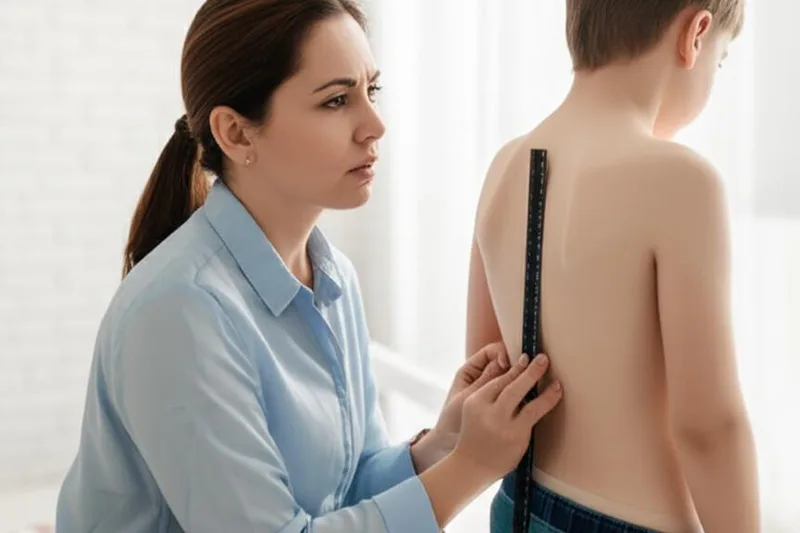
Sometimes when we look at our children's posture, especially the way they stand and walk, we get a little suspicious, don't we? We think things like, "Oh, my child's shoulders don't look level," "The spine looks a little bent to one side." So, today we're going to talk about a simple device that doctors use in times like these, which helps them detect whether they have a curvature of the spine, a condition we call scoliosis.
What is a scoliometer? Simply put...
Think of it like a small, specialized device that doctors have. To be precise, a scoliometer is a tool that healthcare providers, that is, doctors and nurses, use to diagnose a condition called scoliosis , and to monitor its severity and whether it is increasing or decreasing. It is used to detect this type of curvature in young children, young adults, and adults.
Now you might be wondering what this is. When you see a scoliometer, you think of it as a combination of a ruler and a spirit level. It's a flat instrument with a small, round notch on the bottom edge. A doctor places this scoliometer on your spine to measure the amount of curvature, or how many degrees, your spine is curved.
But one thing to remember is that a doctor doesn't just use a reading from a scoliometer to tell you if you have scoliosis. They will also do a physical exam, which involves carefully palpating your spine, and may even take X-rays .
The most important thing is that only a doctor can accurately diagnose a condition like scoliosis and recommend the right treatment. You may be able to buy a scoliometer online or find an app for your phone. However, even with such an app, talk to a doctor about how to use it properly. Never try to diagnose yourself at home. If you notice any changes in your child's spine, be sure to see a doctor.
If you have any questions about your back or spinal health, don't be afraid to talk to a doctor.
When is a scoliometer used?
When a doctor physically examines you or your child, they use this scoliometer to check for scoliosis.
Your child's doctor may regularly check for scoliosis during routine checkups, and health officials at your child's school may also screen children for this condition.
Now, let's see how a doctor does this. If he suspects that you have an abnormal curve in your spine, he will ask you to bend forward from the waist. This is called the Adams forward bend test . When you bend like this, your spine is clearly visible, and the curve in it is also clearly visible. If the doctor sees or feels something in your spine that could be scoliosis, then he will take a scoliometer and measure how many degrees your spine is curved.
Who uses this scoliometer?
In fact, any healthcare provider, whether a doctor or a nurse, can use a scoliometer to check the curve of your spine.
Your child's school health worker may use a scoliometer to check your child's spine during a routine checkup. However, most school-based tests only include the aforementioned forward bend test. This can help identify early signs of scoliosis. Sometimes they may also take a scoliometer reading. If the school finds anything, they will let you know and then schedule an appointment with your regular doctor or pediatrician .
How does this scoliometer work? It's amazing, isn't it?
When you look at a scoliometer, it looks like a combination of a ruler and a spirit level, which is what we use to hang a poster straight at home.
Like levels, scoliometers have an air bubble inside a liquid-filled chamber. However, scoliometers don't measure distance like a ruler. They measure how far your spine is from 0 degrees. If your spine is more to the left or right than it should be, the scoliometer will show you that in degrees.
A scoliosis test is something a doctor can do in their office:
Here's how to do the test:
- First, the doctor will ask you or your child to take off their shirt. Then they will ask you to bend forward from the waist.
- The doctor will then look at your spine and feel it. If you have moderate to severe scoliosis, the doctor will often be able to see and feel the abnormal curve in your spine.
- Next, the doctor places the scoliometer on your back. The groove-like part on the bottom of it fits snugly against your back.
- With the scoliometer on your back, the doctor can see any curvature or twist in your spine. The air bubble in the scoliometer moves left or right to match the curvature of your spine, if there is one. It's like the bubble on a level moving back and forth to show if a surface is level.
- The doctor may place a scoliometer at several points along the spine to see if the amount of curvature is different in different parts of the spine.
Do I need to prepare anything before this test?
No, there is no special preparation required. Your doctor can perform this test during a regular medical appointment. So there is no reason to worry.
What happens after the test? What's next?
After your doctor examines your spine with a scoliometer, you may be asked to take an X-ray of your spine. This will confirm the alignment of your spine and give your doctor a complete picture of any changes in your spine or vertebrae – the bones that make up your spine.
The doctor can also check for spinal fractures or other conditions that can change the shape of the spine with an X-ray .
The doctor will also tell you how often you should see him to monitor changes in your spine.
What are the results of a scoliometer reading? How do I understand them?
A scoliometer measures the curve of your spine in degrees. A reading of 0 degrees is a natural curve, meaning there are no signs of scoliosis.
However, a curve of more than 10 degrees means you have scoliosis. If so, you will need to continue taking scoliometer readings to see if it gets worse over time.
Are scoliometer readings and ``Cobb angle'' two different things? Or are they the same thing?
Scoliometer measurement is sometimes called Cobb angle . This is the measurement that doctors use to diagnose and monitor scoliosis. These are not separate tests or measurements, and doctors may use the two names interchangeably.
The Cobb angle is measured in degrees. It indicates how far your spine is curved from its natural position. People with scoliosis have a Cobb angle greater than 10 degrees.
The higher your Cobb angle , the more likely you are to need treatment for scoliosis (such as a back brace). Your doctor will tell you whether you need treatment and, if so, what to expect.
When should I see a doctor? What symptoms should I have?
If you notice any changes in your posture, or if your child's posture has changed to the point where you feel it is different from his normal posture, definitely see a doctor.
If you have been diagnosed with scoliosis, talk to your doctor about how often you should have checkups. Most people with scoliosis need to have their spine checked every four to six months.
Sure, we all get a little nervous when we hear about a back problem. But not everyone with scoliosis needs treatment. Even if your doctor uses a scoliometer to measure your spine and find a curve, you'll probably just have to go back for checkups every few months to see if it gets worse over time. If your child has scoliosis, it may get better on its own as they get older.
If you notice any changes in your back or spine, or if your child's hips or shoulders seem out of alignment, don't hesitate to talk to a doctor.
What is the most important thing we want to take home from this story?
Okay, so there are a few things to remember from what we talked about today.
- A scoliometer is a simple, painless device used to detect spinal curvature, or scoliosis .
- This measures the curvature of the spine in degrees. Anything over 10 degrees is called scoliosis.
- This test is often performed in conjunction with the Adams forward bend test .
- It is very important to recognize this type of situation at the earliest stage. Therefore, be careful about the posture of the children.
- Don't panic if you find a lump in your back. Not everyone needs treatment. Get tested as your doctor recommends.
- If you have any concerns about your or your child's spine, be sure to seek medical advice. Do not make decisions on your own at home.
Remember, the most important thing is to take care of your health and the health of your child.
` Scoliometer, scoliosis, scoliosis, spine, medical examination, children's health, Cobb angle


💬 Comments (0)
No comments yet. Be the first to share your thoughts here.
Add Your Comment