
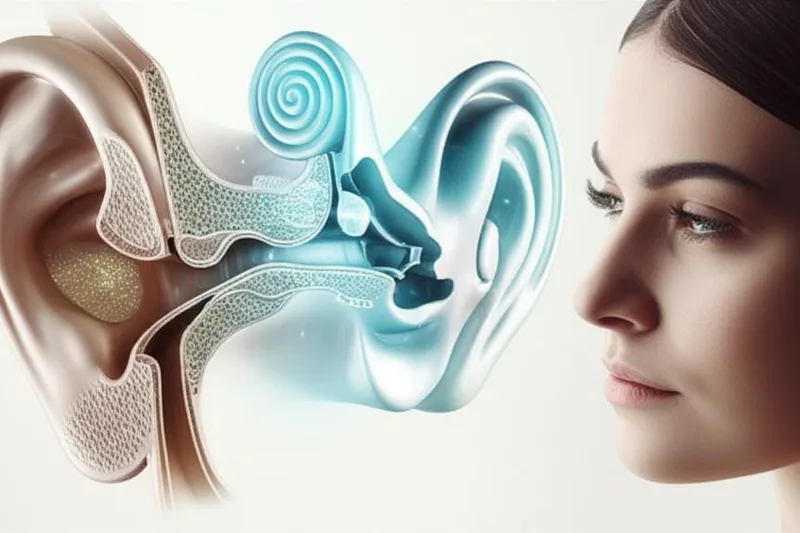
When we say "ear," we usually think of the part that's visible and touchable. But did you know that there's another part inside our head that's very small, but does a lot of very important work? That's the inner ear . This is truly an amazing creation of our body. Just like in a detective story, big things happen in this small space!
What is the inner ear? Where exactly is it located?
Think about it, even though we say "eat", it's actually a system made up of three parts.
1. Outer Ear: This is the earlobe you see and the canal that goes into the ear, that is, the ear canal.
2. Middle Ear: A small box-like part of your eardrum. Surprisingly, the three smallest bones in our body are also located in the middle ear.
3. Inner Ear: That's where our protagonist comes in. The inner ear is located beyond the middle ear, inside a small hole in the temporal bones that make up the sides of our skull.
Look, no matter how small or how deeply embedded they are in the inner ear, they have a huge impact on how we experience the world. This means that this little organ is responsible for the sounds you hear and your sense of balance.
What are the functions of the inner ear? What big jobs does this small organ do?
The inner ear has two main functions. Both are essential to our lives.
1. Making you hear sounds.
2. Helping you maintain balance in your body.
Okay, let's talk about these two in a little more detail.
Hearing Aids - How do we hear sound?
Think of it this way, a sound is like a person on a journey. This journey starts in your outer ear. From there, it goes through your middle ear, and finally ends in your inner ear. It's like a train going from station to station.
Once in your inner ear, special structures there convert these sound waves into electrical energy. Then, your auditory nerve carries this electrical energy to your brain. That's when your brain interprets this as "sound" and makes you hear it. Isn't that amazing?
Helping to maintain balance - Body Balance!
Similarly, when you move around, the inner ear is constantly monitoring your movements. When your posture changes, whether it's when you nod your head, when you walk, when you run, the inner ear knows all of this. It informs the brain about all of these changes. Then the brain tells the body, "Okay, now you need to do this to keep your balance." Imagine, if you suddenly spin around, you feel like you're spinning, and the inner ear is also activated at that time.
What are the parts of the inner ear? Who is inside this little world?
The inner ear consists of two main parts:
1. Cochlea: This is what helps you hear.
2. Vestibular system organs: These are what help with your balance.
Parts of the ear for hearing - Cochlea
The cochlea is a snail-shaped organ in your inner ear. It is a key player in the hearing process. It is filled with fluid. This fluid moves when sound waves arrive. Inside the cochlea, there are three tubes separated by two thin membranes. One of these membranes is called the basilar membrane . It is like a flexible wall. On top of this basilar membrane is the organ of Corti .
Inside the organ of Corti are very fine hair cells . On the tips of these hair cells are tiny, hair-like projections called stereocilia . When the fluid in the cochlea moves, these stereocilia also move, just as seagrasses move in response to the waves.
Here's a look at the amazing process by which the cochlea converts sound waves into sound:
1. Sound enters your outer ear and hits the eardrum. This causes the three small bones in the middle ear – the malleus, incus, and stapes – to move.
2. This bone, called the stapes, is attached to a small hole in the cochlea called the oval window . When the stapes moves, it creates ripples in the fluid in the cochlea.
3. These waves cause the stereocilia at the ends of the hair cells to move.
4. The movement of these stereocilia creates an electrical signal. This signal is what travels to your brain via your auditory nerve.
5. Finally, the brain interprets this electrical signal as "sound."
Although it may seem very complicated, this all happens in the blink of an eye! This is such a fast, efficient system.
Parts of the body for balance - Vestibular System
The structures in your inner ear that help with balance belong to the vestibular system . It mainly includes two parts:
- Three fluid-filled semicircular canals .
- There are two otolith organs : the saccule and the utricle .
Let's see what these parts are and what happens from them:
- Semicircular canals: These are coiled tubes in your inner ear. Like the cochlea, these tubes also contain hair cells. But they don't respond to sound waves, but to body movements. In particular, they help detect rotary motion , which is movement that isn't in a straight line, like when you turn or tilt your head. Think about it, when you're dancing or spinning, these tubes send signals to your brain to help you keep your balance.
- Otolith organs in the vestibule: Your saccule and utricle contain tiny hair cells and crystal-like structures called otoconia . They detect body movements as the fluid in your inner ear moves. In particular, the saccule and utricle help detect when your body is moving forward, backward, up, or down . For example, they are activated when you are in an elevator or when a car is moving at high speed.
The electrical impulses generated by the movement of these hair cells travel to your brain via your vestibulocochlear nerve , the eighth cranial nerve. The brain interprets these electrical signals as information about your balance.
What are the common diseases and disorders that affect the inner ear?
A healthy inner ear is essential for your hearing and your sense of balance. Here are some of the most common inner ear conditions and disorders that can interfere with this:
- Acoustic neuroma: A noncancerous tumor that can develop on an important nerve involved in balance.
- Benign Paroxysmal Positional Vertigo (BPPV): This is a vestibular (balance) disorder. It occurs when small pieces of otoconia in the inner ear become stuck in the semicircular canals. This can cause you to feel like you are moving, even though you are not actually moving. It can feel like your head is spinning.
- Hearing loss: This is a very common condition. There can be many causes. There are different types, such as age-related hearing loss (presbycusis) , noise-induced hearing loss (NIHL) , and sudden sensorineural hearing loss (SSNHL) .
- Inner ear infection (Otitis interna / Inner ear infection): Any condition that causes inflammation of the inner ear. Labyrinthitis and vestibular neuritis are the most common types. These infections can cause severe hearing loss and long-lasting vertigo.
- Ménière's disease: This is a chronic (long-term) condition that affects the inner ear. It affects both hearing and balance, and symptoms can vary from time to time.
- Ototoxicity: Damage to the inner ear as a side effect of taking certain medications.
- Tinnitus: A persistent sound in the ears (e.g., ringing, buzzing). This is often associated with hearing loss.
In addition to this, there are several other conditions that can cause inner ear problems:
- Autoimmune inner ear disease
- Earwax blockage - Although this is primarily a problem of the outer ear, it can sometimes indirectly affect the inner ear.
- Hyperacusis - Hearing even normal sounds so loud that they are unbearable.
- Otosclerosis - Abnormal growth of the bones in the middle ear.
- Perilymphatic fistula
- Superior canal dehiscence syndrome
- Susac syndrome
What are the common signs or symptoms of an inner ear problem?
If there is something wrong with your inner ear, you may experience one or more of these symptoms:
- Difficulty understanding what others are saying.
- Unpleasant sensations in the ear, for example pain, ringing, or pressure .
- Headache .
- Dizziness.
- Vertigo - This is the feeling that you or things around you are spinning.
- Oscillopsia - seeing things moving that are not actually moving.
Depending on the specific condition of your inner ear, you may experience other symptoms as well. Therefore, if you experience any of these symptoms, you should definitely see a doctor.
How do doctors diagnose inner ear problems?
Doctors use several tests to examine the inner ear and diagnose inner ear problems. The main ones are:
- Hearing tests: These tests are done to see how the auditory system in your inner ear is working.
- Otoacoustic emissions (OAE) test: This tests how the sensory hair cells in your inner ear are working.
- Auditory brainstem response (ABR) test: This tests how well your main auditory nerve is working.
- Vestibular tests: A vestibular test battery includes several tests. These check how well the vestibular (balance) part of your inner ear is working.
What are the common treatments for inner ear problems?
Depending on your diagnosis, treatments can manage or cure your condition. Here are some commonly used treatments:
- Medications:
- Treat infections with antibiotics or antivirals .
- Diuretics (water pills) help regulate fluid in the inner ear.
- Steroids reduce inflammation.
- Medications given to manage symptoms.
- Hearing-assistive devices:
- Hearing aids .
- Cochlear implants .
- Rehabilitation:
- Vestibular rehabilitation therapy (VRT): This works by improving how all parts of your vestibular system work together to maintain balance.
- Surgery:
- Surgery to repair damaged parts of the inner ear or remove tumors.
How do I protect my inner ear? This is very important!
There are several ways to protect your inner ear from hearing loss. Here are some of the most important ones:
- Turn down the volume: When watching TV, watching videos, listening to music – especially when using earphones (earbuds) – turn down the volume and listen. This is something that many people ignore, but it is very important.
- Avoid loud places: An example of this is staying away from speakers, such as at a music concert.
- Use hearing protection devices: When loud noises cannot be avoided, use earplugs , earmuffs, or noise-canceling headphones .
- Get treatment for inner ear problems early: If you seek treatment as soon as you notice something is wrong, you are more likely to prevent serious long-term damage.
Remember, don't just sit there thinking, "I can't hear you a little." Even a small thing can be the beginning of a big problem.
Finally, things to remember (Take-Home Message)
Your inner ear is a very complex, delicate, and essential part of your body. Every second, every day, your inner ear converts sound waves into sounds that protect you, add value to your life, and help you stay balanced.
Hearing loss and balance problems can sometimes come on without warning . They can interfere with your ability to use sensory information from your inner ear. If left untreated, inner ear problems can get worse over time.
Therefore, if you have the slightest suspicion that something is wrong with your inner ear, the best thing to do is not to ignore the feeling, but to see a doctor as soon as possible and seek advice. Take care of your ears!
` Inner ear, hearing, hearing loss, balance, cochlea, vestibular system, ear diseases, vertigo, tinnitus, Inner Ear


💬 Comments (0)
No comments yet. Be the first to share your thoughts here.
Add Your Comment