
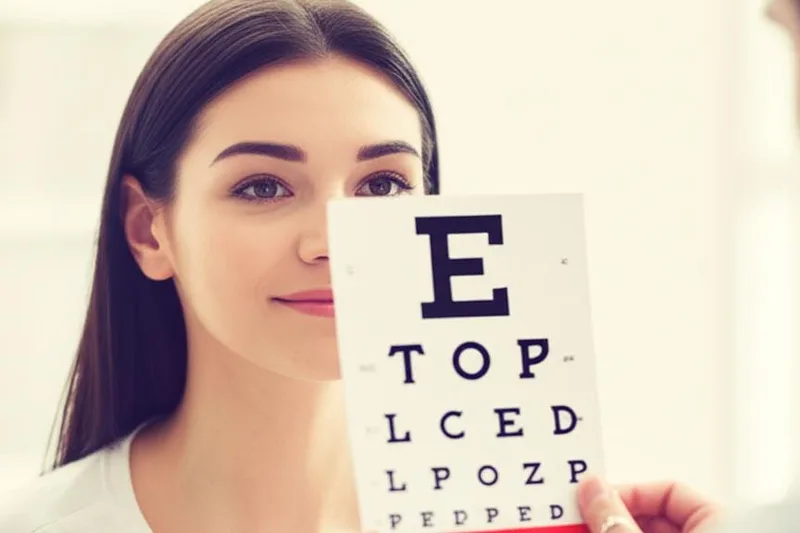
Have you ever had to look at a board with lines of text on the wall when you go to see an eye doctor? That's what we often call a (Visual Acuity Test). Simply put, it's a test to see how well your eyesight is. "Visual acuity" is what doctors call the sharpness of your vision.
Why is this (Visual Acuity Test) so important?
Imagine, you feel like you can't see things that are a little far away, or the letters in the newspaper look blurry. Here is a quick way to find out if there has been a change in your eyesight. After this test, an eye specialist will decide whether you need to wear eyeglasses or contact lenses, or if you already use them, whether you need to change the power.
The most important thing is to see an eye specialist immediately if you notice any changes in your vision. It could be that your glasses need a slight adjustment. However, sometimes blurred vision can be the first sign of another condition affecting the eyes.
When is a visual acuity test done? What can it detect?
Usually, when you go for an eye exam, this (Visual Acuity Test) is definitely done. Doctors do this to detect any changes in your vision over time.
There are several vision problems that can most commonly be detected with this test:
- Myopia : The inability to see distant objects clearly.
- Nearsightedness (Hyperopia): The inability to see things that are close, especially when reading.
- Astigmatism : Blurred vision caused by the eye not focusing light properly.
- Presbyopia : The loss of near vision as we age. It usually begins after the age of 40.
- Color blindness : The inability to distinguish certain colors.
How often should you have your eyes checked?
By regularly checking your eyes and vision, your eye doctor can identify any problems early . The frequency of your eye exams will usually vary depending on your age:
- Young children: You should have your child's eyes checked by a pediatrician at every well-child visit until they start school, and then every year or two after that.
- Adults under 40 years of age: Every five to ten years.
- Adults between 40 and 54 years old: Every two to four years.
- Adults over 55 years of age: Once every one to three years.
However, if you wear glasses or contact lenses, or have a medical condition such as diabetes, you may need to have your eyes checked more frequently . It is best to ask your eye doctor how often you should have your eyes checked.
Who performs this (Visual Acuity Test)?
Most of the time, this test is performed by your eye specialist , which could be an optometrist or an ophthalmologist.
Sometimes, even your general practitioner may perform this (Visual Acuity Test), especially if you go to see him with any eye symptoms.
What types of Visual Acuity Test are there?
There are various ways to test your vision. Here are some of the most commonly used types of visual acuity tests:
- Snellen eye chart: This is the board with rows of letters on the wall that you remember when you hear about an eye test. The letters are large at the top, and the letters get smaller as you go down. The doctor will tell you to read them until you can read them clearly. In some places, this is either projected onto the wall or shown on a screen.
- Random E chart: This is similar to the Snellen chart. But instead of different letters, it only has the letter "E". The letter E is smaller and smaller, rotated, upside down, and turned in different directions. You have to read it until you can't tell which way the letter E is.
- Dynamic visual acuity test: In this test, the doctor holds your head and slowly shakes it from side to side to check your vision. This test checks whether you can keep your eyes steady while your head is moving (this is called the vestibulo-ocular reflex).
- Pinhole visual acuity test: This is a test specifically designed to detect nearsightedness, or myopia. Like a regular test, you are given a device called a paddle that covers one eye. However, it has one or more small holes (pinholes) in it. Instead of looking through the other eye, you read the Snellen or Random E chart through these holes.
- Visual acuity tests for children: There are several ways to test vision for children of different ages. You may have heard of the Cardiff visual acuity test. Some of these tests use pictures or diagrams instead of letters. You may also be given the letters on a separate sheet of paper and asked to match the letters on the wall chart.
How to do a Visual Acuity Test?
Most visual acuity tests are done this way:
1. You will be placed or made to stand about 20 feet away from the sign with the letters.
2. Then the doctor will tell you to close one eye (often with your hand, or with that little board).
3. Next, they are told to read slowly from the top row of largest letters down .
4. You should keep reading until you can no longer see the letters or symbols clearly .
5. When you are finished with one eye, close the other eye and repeat the test from the beginning.
It's okay to try to guess if you're having trouble reading the letters as they go down. However, if you start to see the letters blurry or have difficulty reading, tell your doctor. Don't squint or strain your eyes. The purpose of this test is to get an accurate assessment of your vision. So don't worry about "failing" or "passing" anyway.
If you already wear glasses or contact lenses, your doctor may do this (Visual Acuity Test) several times. This means that your vision will be checked both without your glasses (this is called uncorrected vision) and with your glasses (this is called corrected vision).
Is there anything I need to prepare before this (Visual Acuity Test)?
No, there is no special preparation required. If you wear glasses or contact lenses, be sure to bring them with you when you come for your eye exam. The doctor will likely remove them and test your uncorrected vision.
What happens after the Visual Acuity Test?
After the Visual Acuity Test is complete, your eye doctor will complete the rest of the eye exam. You may also need to do other tests, such as a Slit Lamp Exam. These will check for other conditions that may be affecting your eyes, such as:
- Cataracts
- Glaucoma (Glaucoma)
- Macular degeneration
Is there any risk in this (Visual Acuity Test)?
There is no risk. You may feel a little uncomfortable without your glasses or contact lenses, but this is temporary. You can wear them again as soon as the doctor has finished examining your eyes.
What are the results of the Visual Acuity Test?
Your Visual Acuity Test result comes as a fraction. This tells you how good your uncorrected vision is.
You may remember that 20/20 vision is called correct vision. Having 20/20 vision means that you can clearly see something that is 20 feet away. Some people think that 20/20 vision means "perfect" vision. But it actually means having normal or healthy vision .
Many people do not have 20/20 vision without glasses or contact lenses. In fact, only 35% of adults in the United States have 20/20 vision naturally.
After the Visual Acuity Test, your eye doctor will tell you what you need to do to correct your vision. The most common methods are to wear glasses or contact lenses. If you already wear them, they can also be adjusted to match the changes found in the test.
When should I see a doctor?
If you notice any changes in your vision, see your eye specialist immediately .
If your vision suddenly becomes very bad, or you lose vision in one or both eyes, go to a hospital emergency room immediately.
The most important things to remember
Even if you don't know what a visual acuity test is, chances are you've done it before. Reading from top to bottom on that wall board is an essential part of a routine eye exam. Regardless of what type of visual acuity test your doctor uses, be honest about how far you can and cannot see. Although some movies make fun of people with low vision taking this test, it's not a "fail" or "bad" test.
Almost everyone feels relieved, comfortable, and safe after getting a visual acuity test and getting the help they need to correct their vision. If you have any concerns or notice any changes in your vision or eyes, talk to your eye specialist.
` Eyesight, vision test, visual acuity test, eye chart, myopia, eyeglasses, ophthalmologist, eye exam, Snellen chart


💬 Comments (0)
No comments yet. Be the first to share your thoughts here.
Add Your Comment