
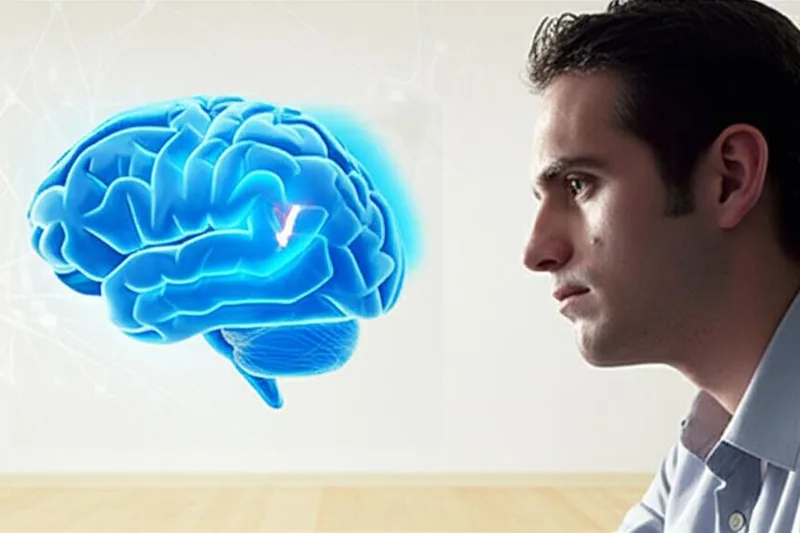
Our brain is a very amazing organ, isn't it? It is responsible for almost everything we think, feel, and do. So, today we are going to talk about one special, very important part of the various parts of the brain. That is the front part of the brain, or as doctors call it, the ``Frontal Lobe``.
What is the frontal lobe of the brain? Where is it located?
Simply put, the ``Frontal Lobe`` is one of the five main parts of your brain. As the name suggests, it is located at the very front of your head. To be precise, this important part is located behind your forehead. Think of it like the "control room" inside your head.
This `(Frontal Lobe)` works in cooperation with other parts of the brain. Anything we do consciously, that is, thinking and calculating, making decisions, this part helps in all these. In terms of size, experts say that between 25% and 40% of the `(Cerebral Cortex)`, the corrugated surface on top of our brain, is made up of this `(Frontal Lobe).` That is a bit big, isn't it?
So, what happens with this (Frontal Lobe)? What does it help our body with?
Actually, there are many functions performed by this ``Frontal Lobe''. Let's look at some of the main ones:
- Reasoning: This includes everything from simply thinking about something to analyzing information in a very complex way. Thinking logically, coming to judgments, making decisions, and creating new things (creativity) all fall under this category.
- Social understanding: This ``(Frontal Lobe)`` helps us understand things like what are the accepted norms in society, how we should behave, what is good to say, and what is bad to say. It's like our "social compass."
- Executive functions: This may seem a bit complicated, but simply put, it includes things like self-control, inhibitions, attention span, and working memory, which is the ability to remember information related to something while doing it.
- Voluntary muscle movements: All of your voluntary muscle movements, such as raising your hand, picking up something, or getting up and walking, are controlled here. Also, the part of the brain that controls the muscles we use to speak is also located in this ``Frontal Lobe``.
- Learning and recalling information: This section helps you learn something new, remember it for later use, and also recall old things.
Just think, this ``Frontal Lobe'' helps you from the moment you wake up in the morning and plan your day, to going to work and solving a problem, to talking to a friend.
What is this (Frontal Lobe) made of?
Like the rest of our brain, the ``Frontal Lobe`` is made up of specialized cell types. There are two main types of cells:
1. Neurons: These are the main communication cells in the brain and nervous system. They can send signals to other nerve cells. These signals travel inside the nerve cells like electrical messages (impulses). Then, these electrical signals are converted into chemicals and released from the nerve cell. The next nerve cell recognizes those chemicals and creates another electrical signal. That's how messages travel very quickly inside the brain.
2. Glial cells: These are the "helper cells" of the nervous system. They don't transmit signals, but they do many important jobs, such as maintaining nerve cells, removing waste, providing nutrition, and keeping the structure strong.
What are the common diseases and disorders that affect the frontal lobe?
Virtually any disease that can damage brain tissue can affect the frontal lobe. Also, there are some neurodevelopmental conditions that affect brain development that can cause symptoms specifically related to the frontal lobe. Let's look at some of the conditions that can affect it:
- Alzheimer's disease
- Speech difficulties, especially `(Expressive aphasia)` or `(Broca's aphasia)` (in which you know what you want to say, but have difficulty putting the words together)
- Attention-deficit hyperactivity disorder (ADHD)
- Autism spectrum disorder
- Brain injuries or damage (Brain lesions) (these can be caused by diseases or things like surgery)
- Brain tumors (both cancerous and non-cancerous tumors)
- Carbon monoxide poisoning
- Head injuries, especially concussions and other serious traumatic brain injuries
- Corticobasal degeneration
- Frontotemporal dementia (for example, Pick's disease)
- Genetic conditions (e.g. Huntington's disease, Wilson's disease)
- Headaches and Migraines
- Heavy metal poisoning or ingestion of other toxic substances
- Infections (especially infections that cause brain fever, such as encephalitis)
- Mental health conditions, for example mood disorders, anxiety disorders, and personality disorders
- Lewy body dementia
- Seizures (especially frontal lobe seizures) and seizure-related disorders such as epilepsy
- Stroke and Transient Ischemic Attack (TIA)
What are the common symptoms of a problem with the Frontal Lobe?
In fact, there are many symptoms that can be caused by a problem in the ``Frontal Lobe''. There are two reasons why these symptoms differ from each other:
1. Because your ``Frontal Lobe'' performs a wide variety of functions.
2. Because a large number of different medical conditions can affect this ``Frontal Lobe''.
However, there are several symptoms that are commonly seen with problems in the ``Frontal Lobe'':
- Personality changes: Things like becoming more stubborn than before, getting angry quickly, and behaving in an antisocial manner.
- Difficulty seeing cause and effect, focusing, organizing things, planning, or switching attention from one task to another.
- Executive dysfunction: As mentioned earlier, difficulty making decisions, planning, and maintaining self-control.
- Difficulty controlling one's emotions and actions, especially losing control over what one says and does.
- Some types of memory loss (Amnesia).
- Difficulty moving certain muscles, including the muscles used for speaking.
What are the common tests performed to check the health of the frontal lobe?
Doctors have a variety of ways to check the health of your frontal lobe. These include diagnostic tests, lab tests, and imaging scans. Some examples include:
- Blood tests: These can detect a variety of things, from immune system problems to toxins in the body (especially metals like copper, mercury, and lead).
- CT scan (Computed Tomography - CT scan)
- EEG (Electroencephalogram - EEG) test (see electrical activity of the brain)
- EMG test (Electromyogram - nerve conduction test) (sees the speed of messages traveling through the nerves)
- Evoked potentials - sensory tests (see how sensations travel to the brain)
- MRI Scan (Magnetic Resonance Imaging - MRI)
- Neuropsychological testing (tests things like thinking, memory, attention, etc.)
- PET scan (Positron Emission Tomography - PET scan)
What are the common treatments for conditions affecting the frontal lobe?
Treatments for Frontal Lobe-related conditions can be as varied as the conditions themselves. Your doctor can best advise you on the best treatment options for your condition and what your doctor recommends. Therefore, it is important to seek medical advice if you have any symptoms.
What can I do to keep my (Frontal Lobe) healthy?
There are many things you can do to keep your entire brain, including your frontal lobe, healthy. Some brain conditions can be prevented. While some can't be prevented, you can reduce your risk of developing them. Here are some things you can do to keep your brain healthy:
- Eat a balanced diet: The food you eat affects the health of your circulatory system. Healthy blood circulation is essential for the brain to function properly (for example, a stroke is when problems with the circulatory system affect the brain). Also, too much or too little of certain vitamins can affect the brain.
- Find ways to maintain a healthy weight and be physically active: Your weight and activity level can help prevent or delay conditions that affect the brain, especially cardiovascular problems like high blood pressure. You can ask your family doctor for advice on what a healthy weight range is for you and what you can do to maintain it. Physical activity directly affects brain health. It helps with good blood circulation, and it also helps the brain produce chemical messengers called ``neurotransmitters''.
- Wear protective gear when necessary: Since your frontal lobe is located at the front of your head, you are more susceptible to concussions and traumatic brain injuries. Therefore, it is very important to use protective gear like helmets and seat belts when riding in vehicles.
- Manage your chronic conditions: Many conditions that affect the brain get worse over time. However, with proper treatment, you can sometimes stop them or delay their worsening. For example, conditions like Type 2 Diabetes and Epilepsy.
An interesting story about the Frontal Lobe!
Your ``Frontal Lobe`` is where the parts of your brain that control who you are, especially your personality and how you behave, are located. The way you think, your ability to solve problems, your ability to form social relationships, your morality, and your ability to understand right from wrong all depend on the parts of your ``Frontal Lobe``.
Experts learned this because of a railroad foreman named Phineas Gage. In 1848, an iron rod went through Gage's head during an explosion at a railroad construction site, damaging the left side of his frontal lobe. Before the accident, Gage was a calm, well-respected leader among his fellow workers. Miraculously, Gage survived the accident. But after the accident, his personality changed completely. He became irritable, disrespectful, and often used foul language.
However, Gage's personality changes were not permanent. Four years after the accident, Gage went to Chile, South America, and worked as a horse-drawn carriage driver. A doctor who examined Gage in late 1858 or early 1859 reported that he was physically healthy and had "no impairment of mental faculties."
Although Gage largely recovered from the accident, he died in San Francisco in 1860 of seizures. The seizures were likely a result of the damage he sustained in the accident. However, his case contributed greatly to modern medicine's understanding of what happens in the frontal lobe, especially how it affects personality.
Finally, things to remember (Take-Home Message)
When you think about your ``Frontal Lobe``, you are actually telling a part of your brain to think about it. Your ``Frontal Lobe`` is one of the most important parts of your brain. It controls and manages many of the skills you use in your daily life. It is also where you control things like your personality, emotions, and judgment.
So, taking good care of your ``Frontal Lobe'', and getting treatment for conditions that affect it, can make a big difference in the way it contributes to your life. The brain is a precious resource, and it is our responsibility to protect it.
` Frontal lobe, brain function, personality, decision making, brain health, neuroscience


💬 Comments (0)
No comments yet. Be the first to share your thoughts here.
Add Your Comment