
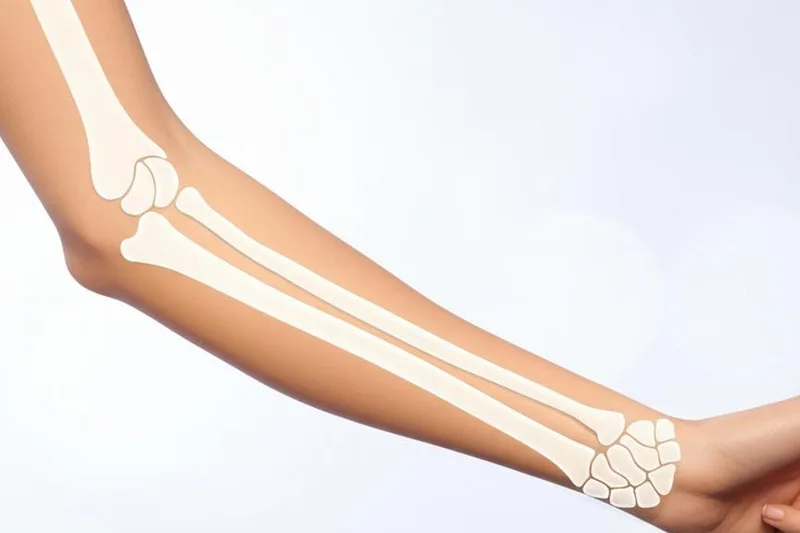
We all know how important it is to use our hands, right? We do so much work with our hands throughout the day. But have you ever thought about the bones in your hands, especially the long bone in your forearm? That bone is called the radius . Although it may seem like a small thing, it is essential for the movement and strength of our hands. Let's talk about this in more detail today.
What is Radius? What does it do?
Simply put, the radius is one of the two bones in your forearm, from your elbow to your wrist. It's not just a piece of bone. Just think, the radius helps you turn, bend, and extend your arm and wrist. Not only that, but it also has about seven important muscles attached to it.
There are several other important functions of Radius:
- Helping you move, bend, and rotate your forearms and wrists.
- Holding it in place involves about seven muscles.
- It helps to keep the other parts of your hand, wrist, and forearm stable.
Also, tendons (which connect muscles to bones), ligaments (which help hold bones together), and blood vessels are all associated with the radius. So, if there is any damage to the radius, you may have difficulty using your hand. If the bone is fractured, you may need surgery to heal it, and then physical therapy to regain strength in your hand.
Like all other bones, the radius can be affected by conditions like osteoporosis . This means that the bones become weak and easily broken. Because the radius is so closely connected to the muscles and nerves around it, damage to one can affect the other.
Where is the radius located? What is its relationship to the ulna?
One of the two bones in your forearm is the radius. The other bone is the ulna . The radius is located on the opposite side of the ulna, that is, on the lateral side of your forearm. When you extend your arm forward and turn your palm downward, the radius rotates over the ulna. But when you extend your arm forward and turn your palm upward, these two bones are almost parallel. Isn't it amazing how they are designed?
What does the radius look like? What are its parts?
Now let's look at what the radius looks like. Strictly speaking, it's one long bone, but it has several parts. The big bone in your upper arm, the humerus , is a little bit smaller at the top. The shaft is the longest, and it's a little bit curved. When you get to the wrist, the bottom end is a little bit wider. That's because it connects to the scaphoid and lunate bones (also called carpal bones ) in your wrist.
That's what doctors use for parts of this. These are a bit of medical terms, but it's good to know.
Proximal aspect
The upper end of the radius, that is, the part that connects to the humerus. This also has parts called the 'head', 'neck', and 'radial tuberosity' .
Radius shaft
This is what helps support the weight of the forehead, and it is also this part that gives the forehead its shape.
Distal aspect
The lower end of the radius forms the upper part of the wrist joint. It also has special areas called the 'styloid process' and the 'ulnar notch' .
All of these are often important for your doctor to tell you exactly where you are having pain or a problem. If you ever break your radius (radial fracture), the doctor will use these words to describe where the bone is damaged.
How big is the radius?
Your radius is the third longest bone in your hand. It's also one of the longest bones in your body. An adult's radius is usually about 10 inches long.
What are the common diseases and conditions that affect the radius?
This important bone can also have various problems. Let's see what they are.
Radius fractures
A fracture is simply a break in a bone. There are several main reasons why the radius can break:
- Sports injuries.
- Car accidents.
- Falls.
When a bone breaks, symptoms such as:
- Severe pain.
- Swelling.
- Tenderness when touched.
- Inability to shake hands normally.
- Bruising or skin discoloration.
- A lump or deformity that is not normally present is visible at the site of the injury.
There are several specific types of fractures that affect the radius. Examples include Colles fractures , Smith fractures , Greenstick fractures (these are more common in young children), and growth plate fractures (these also affect growing bones in children).
If you have had an accident and think you have a broken bone, you should go to a hospital immediately.
Osteoporosis
Osteoporosis is a disease in which bones become weak and easily break. It often has no symptoms. That's why many people don't know they have it until they break a bone. Women and people over the age of 65 are at higher risk of developing osteoporosis. It's a good idea to talk to your doctor about getting a bone density test. This can help detect the condition before a bone breaks.
Nursemaid elbow - an elbow problem that affects young children
This is something that parents of young children have probably heard of many times. It is sometimes called a 'pulled elbow' . This is actually when the radius bone of a young child is pulled slightly out of the elbow joint. Strictly speaking, the bone is not completely detached, but the ligaments are pulled a little. This happens because the ligaments of a young child are looser than those of an adult. Imagine, you suddenly pull a small child by the hand while crossing the road, or you pick up the child with both hands for play. This can happen at times like these. Most of the time, this happens by accident.
What tests are performed to check the health status of Radius?
The most important test to check the health of your radius is a bone density test . This is also called a DEXA scan or DXA scan . This uses low-level X-rays to measure how strong your bones are. Doctors use it to see if your bones are getting weaker as you age.
If you have a fracture of the radius, your doctor may also need to do tests like:
- X-rays
- Magnetic Resonance Imaging (MRI)
- Computerized tomography scan (CT scan)
What are the common treatments for Radius?
Unless you have a fracture, injury, or condition like osteoporosis, your radius does not require special treatment.
Treatment for a fracture
The treatment for a broken bone depends on the type of fracture and how it happened. You may need to wear a splint or cast to keep your arm from moving. You may also need surgery to set the broken bone. This will help it heal properly.
Treatment for Osteoporosis
Osteoporosis can be treated with exercise, vitamin and mineral supplements, and medications. Your doctor will develop a treatment plan that is right for you and your bone health.
How do you keep your radius healthy?
Following a good diet and exercise plan, as well as getting regular medical checkups, can help keep your bones (and your entire body) healthy. If you're over 50, or if someone in your family has osteoporosis, be sure to talk to your doctor about getting a bone density test.
Follow these simple tips to protect yourself from accidents:
- Always wear a seatbelt when riding in vehicles.
- Wear appropriate protective equipment when playing sports and other activities.
- Don't clutter your home or workplace with things that could fall.
- Always use the appropriate equipment when reaching for something high up. Never climb on chairs or tables.
- Follow a diet and exercise plan that helps maintain good bone health.
- If you have difficulty walking, or are at high risk of falling, use your cane or walker.
Finally, the most important thing
I hope you now have a good idea about the radius bone. This is a bone that is essential for the movement of our hand and the function of the wrist. Most people think about this radius only when there is a problem with it. But before that happens, especially if you are at risk for osteoporosis, it is very important to talk to a doctor about it and take the necessary steps. Remember, everything you do to keep your overall health in good shape also helps keep your bones strong! So, take good care of your body, be careful!
` Radius bone, hand bones, forearm bones, bone fracture, ulna bone, osteoporosis, bone health


💬 Comments (0)
No comments yet. Be the first to share your thoughts here.
Add Your Comment