

Have you ever wondered how we hear all these sounds? This is helped by a very small, but very important part of our ear. That is the eardrum. Today we will talk about this eardrum, or as doctors call it, the ``Tympanic Membrane``. It is like a protector in our ear, and it is the main one that helps us hear the different sounds in the world.
What is an eardrum? Let's understand exactly!
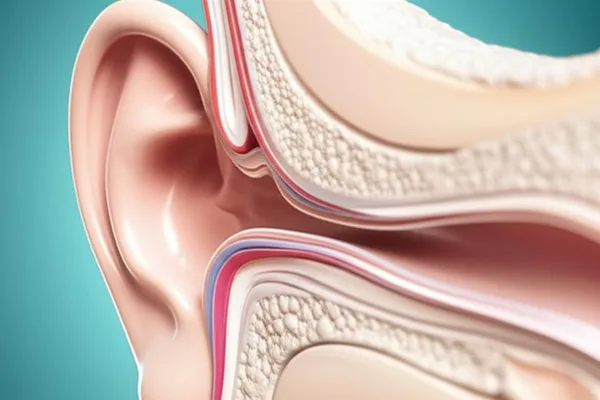
Simply put, the "eardrum" is a very thin, round membrane in our ear, called by doctors the `(Tympanic Membrane)`. It is like the skin of a drum. It is what separates the outer ear from the middle ear.
Imagine, when you go all the way inside your ear canal, the last place you'll find it is the eardrum. It's like a door, to be precise. On the other side of that door are three tiny bones (`(Ossicles)`) that help us hear.
Now you're probably wondering what the eardrum looks like, how big it is. It's actually very flat and round . It's about a centimeter in diameter, to be exact. That's about a third of the size of a nickel. A healthy eardrum is usually a pearly white to gray color. But the strange thing is, you can barely see through it. It looks like a fogged-up window, or a sheet of transparent plastic that's been stretched and tightened.
What is the eardrum made of?
Do you know what the eardrum is made of? It is mainly made up of three layers of connective tissue. Let's take a look at what those layers are:
- Outer layer : This is made up of a type of tissue called epithelial tissue. This is like the outer skin of our body.
- Middle layer : This is made up of a slightly flexible, fibrous tissue. This layer is what gives the eardrum its strength and flexibility. Most importantly, this layer contains nerves and blood vessels.
- Inner layer : This is made up of tissue called the mucosa. It is like a thin membrane that lines the inside of some organs, like our intestines.
How does the eardrum help us hear?
Okay, now let's look at how this little eardrum helps us hear sound. It's a very amazing and complex process.
Imagine, you hear a beautiful song. The sound waves of that song travel through the air and hit your eardrum. What happens then? The eardrum starts to vibrate . It's like the skin of a drum vibrating when you hit it. This vibration varies depending on the nature of the sound.
Next, these vibrations travel through three tiny bones (Ossicles) in your middle ear. These three bones are connected to each other, acting like a chain. So the vibrations that occur in the eardrum travel through these bones further inward, towards the inner ear.
Then, these vibrations are picked up by tiny hair cells in the fluid-filled, snail-shaped part of your inner ear called the cochlea. Isn't it amazing? These hair cells are what convert the vibrational energy into electrical signals .
Finally, your auditory nerve carries these electrical signals to your brain. The brain interprets these signals and tells you, "Oh, that's a song" or "That's your mother's voice."
Simply put, the process by which we hear sound is as follows:
- Sound waves reach the eardrum and cause it to vibrate.
- Those vibrations go to the small bones (`(Ossicles)`) in the middle ear.
- Next, hair cells in the inner ear (cochlea) capture these vibrations and convert them into electrical signals.
- Finally, the auditory nerve carries these signals to the brain, which interprets them as sound and informs us.
What are the common problems that can occur to the eardrum?
Because the eardrum is so delicate, it can sometimes have minor problems. Let's take a look at some of the most common things you might encounter. Don't worry, there are good treatments for most of these things.
- Eardrum rupture.
- A condition called ``Tympanosclerosis'' means scarring of the eardrum.
- Fluid accumulation behind the eardrum is also called ``Otitis Media with Effusion''.
- Eardrum infection `(Infected Eardrum)`.
Let's learn about Eardrum Rupture
A ruptured eardrum is a hole in the eardrum. This can happen due to ear injuries or if ear infections become severe. For example, if you get a hard blow to the ear or if the pressure in the middle ear increases due to an ear infection, the eardrum can burst. Sometimes, you can accidentally put something like a cotton bud in your ear and damage it.
When the eardrum ruptures, there may be hearing loss , fluid-like discharge from the ear (sometimes with a little blood), or ringing in the ear (`(Tinnitus)`) . Some people may experience severe pain.
But there is good news! Most of the time, a ruptured eardrum can heal on its own . Our bodies have the ability to do that. However, in some severe cases, or if the hole is large, surgery, such as a Tympanoplasty, may be required to fix it.
Tympanosclerosis, or scarring of the eardrum
Tympanosclerosis is a condition where your eardrum becomes scarred. It's similar to a scar that forms when our skin is injured. This can happen after an ear injury or after ear surgeries. Tympanosclerosis can also be caused by long-term, recurring ear infections.
People with tympanosclerosis may have a chalky white appearance due to scarring of the eardrum. This scarring reduces the flexibility of the eardrum, making it difficult for sound to vibrate properly and enter the ear canal. This can cause some hearing loss.
The main treatment for this is a surgery called ``Tympanoplasty.`` In this surgery, the surgeon removes the scar tissue and repairs any damage to the bones (``Ossicles``) of the middle ear.
Fluid accumulation behind the eardrum (Otitis Media with Effusion) or Glue Ear
Doctors call this the accumulation of fluid behind the eardrum, or middle ear, called ``Otitis Media with Effusion.'' Some people also call it ``Glue Ear.'' Because the fluid is a bit thick, like gum. This happens when your ``Eustachian tubes'' – the tubes that connect the inside of your ear to the back of your throat and equalize air pressure – become blocked or swollen.
After an ear infection, a cold, or things like allergies and cigarette smoke, these Eustachian tubes can become blocked, causing fluid to build up in the middle ear. This condition is quite common among young children.
Most of the time, this fluid behind the eardrum will go away on its own . If it doesn't, you may need to take antibiotics , especially if there is an infection. If the problem persists for several months, your doctor may recommend inserting small tubes (grommets or ear tubes) into your ear. These tubes help to ventilate the middle ear and stop the fluid from building up.
Eardrum Infection (Infected Eardrum)
Your eardrum can become infected after a middle ear infection (`middle ear infection` - `Otitis Media`) or if your eardrum ruptures. When your eardrum becomes infected, a condition called ``Myringitis``, you may experience symptoms such as severe ear pain , hearing loss, dizziness (``Vertigo``) and ringing in the ears (``Tinnitus``). Sometimes, small blisters may develop on the eardrum.
Most ear infections go away on their own . However, if your symptoms last more than two weeks, or if the pain is severe, see a doctor. They may prescribe oral antibiotics, antibiotic ear drops, or painkillers.
How do we take care of our eardrums?
If we take good care of our ears, we can keep our eardrums healthy. They are just as valuable as our eyes. Here are some things you can do for them:
- When going to places like concerts or workplaces with loud noises, use ear protection or earplugs. Continuous exposure to loud noises is not good for the eardrum and the delicate parts of the inner ear .
- When listening to music with headphones or earbuds, don't turn the volume up too high . Keep the volume to a level that only you can hear. If someone near you can hear what you're listening to, it's too loud.
- Keep the volume of the TV and even the radio at a normal, moderate level .
- Do not use cotton swabs to clean your ears . These can damage your eardrum and push earwax deeper into your ear. Your ear has a natural mechanism to clean itself. Earwax is a protective substance that protects your ear.
- If you have concerns about your hearing, or if you have frequent ear problems, see an audiologist and have regular hearing tests.
- Get proper treatment for colds and flu, as these can lead to ear infections.
Answers to other questions you may have about the eardrum
Okay, so now let's talk a little bit more about the eardrum. Maybe you've had these problems too.
Where is the eardrum located in the ear?
As we mentioned earlier, the eardrum is located in your middle ear . It's located at the very end of the ear canal, just before the three little bones (ossicles) we talked about earlier. It's like a bridge between the outer ear and the middle ear.
What happens to the eardrum when a sound comes in?
When sound waves hit the eardrum, it vibrates . This vibration then travels to the bones (ossicles) in the middle ear, and from there to the inner ear, where it is transmitted to the brain via the auditory nerve. That's when we hear the sound.
What happens if the eardrum is damaged?
Most of the time, a ruptured or damaged eardrum will heal on its own within a few weeks . However, if your symptoms become severe, such as persistent ear discharge, severe pain, or significant hearing loss, you should definitely see a doctor.
Can the eardrum heal on its own?
Yes, most of the time it can . It's an amazing ability of our body. Usually, within a few weeks, if there is a small rupture, the eardrum can heal on its own. But major damage can take longer to heal, or it may require medical attention.
Can we see someone's eardrum?
We can't see someone's eardrum with the naked eye because it's inside the ear canal. However, your doctor can use an instrument called an otoscope to look at your eardrum. An otoscope is a handheld instrument with a light and a magnifying lens that can be used to look inside your ear. It magnifies your ear canal and eardrum to show you clearly.
Can you hear without an eardrum?
Without an eardrum , everything sounds muffled . It's like hearing sounds underwater. People who have a ruptured eardrum usually have some hearing loss until it heals. So the eardrum is essential for us to hear clearly. Without it, sound waves don't travel properly to the middle ear.
Things to remember in summary
So, we've talked a lot about the eardrum, or `(Tympanic Membrane)`. I hope you have a good understanding of this now.
Your eardrum is a very delicate and valuable part of your body, essential for you to hear properly.
Ear infections and injuries can damage the eardrum, causing ear pain, ringing in the ears (tinnitus), fluid in the ear, and hearing loss.
The best part is that most of the time, the eardrum can heal on its own – and the damage is usually temporary.
However, if you have bothersome symptoms, if they persist, or if they get worse, be sure to see a doctor and tell them about it . They will help you and work to correct the problem.
So, it's very important to take care of your ears. Remember, stay away from loud noises, don't poke your ears, and be careful not to get water in your ears . Then your eardrums will stay healthy, and you will always be able to hear the beautiful sounds in this world!
` Eardrum, Tympanic membrane, Hearing, Ear infections, Rupture of eardrum, Tympanosclerosis, Eardrum care, Otitis Media with Effusion




💬 Comments (0)
No comments yet. Be the first to share your thoughts here.
Add Your Comment