

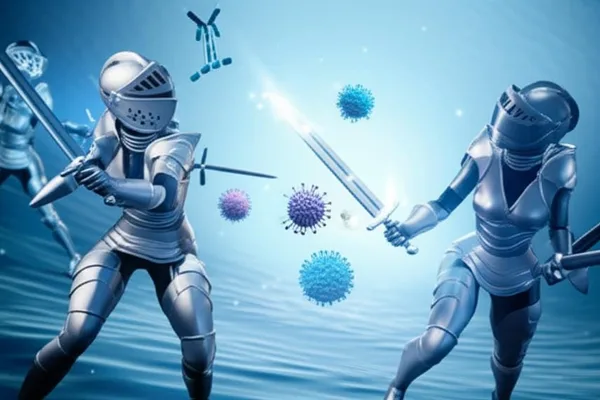
Have you ever wondered if there is an invisible war going on inside our bodies all the time? Yes, it is true. The little guards inside our bodies fight the germs that cause diseases coming from outside. A very important group among those guards are these B cells. Today we are going to talk about these B cells and how they protect us from diseases.
What exactly are B cells?
B cells, as mentioned earlier, are a type of white blood cell in our blood. We also call them `(B lymphocytes)`. These B cells are a key part of your immune system, the body's defense system that protects you from disease. Their main job is to produce special proteins called `(antibodies)` to fight harmful `(pathogens)` – things like viruses, bacteria, and parasites – that enter the body.
B cells and T cells are two types of cells that belong to a special type of white blood cell called lymphocytes. These lymphocytes fight invaders and abnormal cells like cancer cells. T cells destroy pathogens and coordinate the immune system by sending signals to other parts of the body. B cells, on the other hand, make antibodies in response to antigens. Antigens are like ID cards. These antibodies help our immune system recognize things in our body, especially harmful things like viruses and bacteria.
What are the main types of B cells?
Okay, now you know what B cells are. There are two main types of B cells. They are plasma cells and memory cells. Both of these types help protect us from disease. Let's see how.
Plasma cells
These plasma cells are the ones that release antibodies in response to the antigens mentioned earlier. Think of it like shooting at an enemy on sight. Once a B cell has transformed into a plasma cell, it can release about 2,000 antibodies per second! Isn't that amazing? These plasma cells are also called plasmacytes and effector cells. However, their lifespan is a little shorter than that of memory cells.
Memory cells
The name suggests it, right? These memory cells remember specific antigens. Then, if that antigen comes back to our body in the future, our immune system can quickly, as if in preparation, take defensive measures. Just as we would quickly respond to a known enemy. When plasma cells make antibodies and fight off invaders at that time, memory cells help us fight future battles. For example, this is how many vaccines we get work. What a vaccine does is introduce our immune system to a certain antigen. Then our memory cells remember it. If that pathogen actually comes back later, our body can quickly launch an attack against it.
Why are B cells important to us?
B cells are a very important part of our adaptive immune system. Now you might be wondering what the adaptive immune system is. There are two main parts of our immune system. One is the innate immune system, and the other is the adaptive immune system. The innate immune system is like the first line of defense, responding to any threat. But the adaptive immune system is more specialized. It recognizes a specific threat – that is, a specific virus, bacteria, etc. – and fights against it.
So, what B cells do is produce antibodies that destroy that antigen or the pathogen that has bound to that antigen. Also, B cells can remember specific antigens. Then, if that pathogen ever comes back into the body, our immune system can mount a very effective defense against it. Simply put, without B cells, our body would not be able to recognize specific enemies, make specific weapons (antibodies) to fight them, and remember those enemies and act quickly if they come back.
How do B cells work in the immune system?
Although it is a very complex process, let's try to understand it simply. B cells, along with other cells in the immune system, fight harmful invaders that make us sick, as well as abnormal cells like cancer cells. Once a B cell is 'activated', it either becomes a plasma cell, which makes antibodies in response to an antigen, or it becomes a memory cell, which remembers that antigen. That way, if it comes back in the future, it can quickly recognize and fight it.
Normally, when the immune system needs B cells to fight an invader, these are some of the steps that happen:
- First, a special cell called an antigen-presenting cell (APC) attaches to the invader's antigen and breaks it into small pieces. The APC then attaches the antigen pieces to a molecule called the Major Histocompatibility-II complex (MHC-II).
- Next, helper T cells (also a type of T cell) come in and bind to that MHC-II complex. This binding is what activates the helper T cells. These helper T cells are very important because they are the ones who signal the B cells to 'get to work'.
- An activated T cell attaches to a B cell. That B cell then begins to make copies of itself, or ``clones.'' Some of these B cells become plasma cells, which can make antibodies. Other B cells become memory cells and are stored in the body.
- Over the next few days, the plasma cells produce millions of antibodies. Each of these antibodies is made to destroy only the specific pathogen that produced that antigen. This means that a single antibody can only target one type of enemy.
- These antibodies attach to either the antigen or the part of the pathogen that has the antigenic marker. Once attached, the pathogen can no longer harm the body.
Think of it like a police operation. First, a signal comes in (antigen recognition by an APC). Then a special team (helper T cells) comes into play, informing another team (B cells). Part of that team goes into battle right away (plasma cells), while another part prepares for future threats (memory cells).
Where are B cells located?
The location of B cells varies depending on their stage of development. Think about it, when you're a fetus, that is, in your mother's womb, B cells are made in the liver. But after we're born, B cells develop in a soft, spongy tissue inside our bones. That's what we call the bone marrow. They start out as hematopoietic stem cells. Then, through a process called hematopoiesis, they become B cells. Once fully mature, your B cells travel to important parts of your lymphatic system. For example, the spleen and lymph nodes.
What are the common diseases that can occur related to B cells?
If something abnormal happens to our B cells, it can lead to autoimmune diseases and various types of cancer. Let's take a look at that.
Autoimmune diseases
Sometimes, this is what happens. Our B cells make antibodies in response to antigens on our own healthy cells. Then, those antibodies attack our own healthy cells as if they were attacking a dangerous pathogen. It's like attacking our own family. That's what we call autoimmune diseases. Here are a few examples:
- Lupus
- Multiple sclerosis
- Rheumatoid arthritis
- Type 1 diabetes
Cancers
There are several types of cancer that are associated with abnormal growth of B cells. This means that B cells start to multiply uncontrollably. Some of them are:
- Acute lymphocytic leukemia
- Chronic lymphocytic leukemia
- Hodgkin lymphoma
- Non-Hodgkin lymphoma
- B-cell lymphoma `(B-cell lymphoma)`
- Multiple myeloma
- Waldenström's macroglobulinemia
What is the normal range for B cells?
An average adult has between 1,000 and 4,800 lymphocytes per microliter of blood. B cells make up about 10% to 20% of your total lymphocytes.
But remember, if your B cell count is consistently too high or too low, it could mean you have a medical condition. A doctor will need to do tests to find out for sure.
What are the common tests to check the health of my B cells?
Your doctor can tell how many lymphocytes you have in your body with a simple test called a Complete Blood Count (CBC). However, it does not provide information about specific types of lymphocytes, such as B cells and T cells.
If your doctor suspects that you have a disease associated with an abnormality in your B cells, he or she may order other tests that provide information about specific types of lymphocytes, such as a lymphocyte profile (T and B cell counts), or a B-cell leukemia/lymphoma panel.
What can we do to keep our B cells healthy?
There are no widely accepted natural ways to 'boost' B cells. However, there are things you can do to keep your immune system healthy and protect the B cells you already have. Many of these things may seem like common sense, but they actually prevent your body's B cells, and other valuable immune system resources, from being wasted. Just as our cars last longer if they are well maintained.
You can do these things to keep your immune system healthy:
- Get all recommended vaccines.
- Eat a good, balanced diet.
- Manage your stress well.
- Avoid alcohol consumption, or use it in moderation.
- Avoid smoking (cigarettes, vaping). If you do, quit.
- Get at least seven to eight hours of sleep every night.
- Engage in at least 150 minutes of moderate exercise per week.
- Wash your hands regularly with soap or use hand sanitizer.
What is the difference between T cells and B cells?
T cells, B cells, and B cells both protect us from pathogens that cause disease. But they perform different roles in the immune system. T cells either send signals that control the immune response (these are called helper T cells) or directly destroy pathogens or infected cells (these are called cytotoxic T cells).
But B cells make proteins called antibodies in response to antigens, which are signals that tell the body that an invader has entered the body. The important thing is that the invader is not stopped directly by the B cell, but by the antibodies that the B cell makes.
Finally, things to remember
So, without B cells, our bodies wouldn't be able to make antibodies. These antibodies are very important proteins that help fight off harmful pathogens. Along with other lymphocytes and white blood cells, your B cells are what keep you free from disease and protect you from abnormal cells.
So, take care of your B cells. Do things every day that help keep your entire immune system healthy. As mentioned earlier, eat well, sleep well, exercise, reduce stress, and get your shots on time. These simple things will give these little guards in your body a big boost.
` B cells, B lymphocytes, antibodies, immune system, lymphocytes, pathogens, plasma cells, memory cells




💬 Comments (0)
No comments yet. Be the first to share your thoughts here.
Add Your Comment