

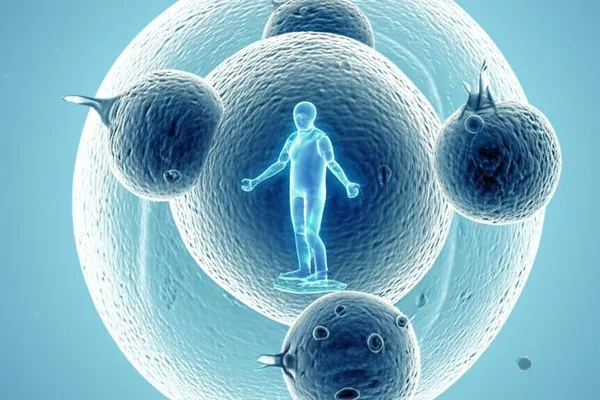
Have you ever thought that there are little guards inside our bodies that help stop cancer from forming? Yes, it's true. Today we're going to talk about a very important type of gene that controls cancer cells in our bodies. These are like 'guardians' in our bodies.
What are these 'tumor suppressor genes'?
Simply put, these ``Tumor Suppressor Genes`` are a major group of genes that protect our body from cancer. These genes work like the brakes on a car. These genes make a special type of protein. These proteins stop cells from growing too quickly, which can lead to cancer, and put a "brake" on it.
Imagine what happens if this cancer-suppressing gene undergoes some kind of mutation , that is, a change. Then it's like taking the brakes off a car and stepping on the accelerator. Cell growth suddenly accelerates out of control. That's when the risk of developing cancer increases.
How exactly do these genes work in our bodies?
To understand how these ``Tumor Suppressor Genes'' work, we first need to know a little about the relationship between ``DNA'', genes, and cells.
Every one of the trillions of cells in our body contains ``DNA''. Inside this ``DNA'' are genes. These genes tell cells what to do, when to divide, and when to stop dividing.
Now imagine that if one or more genes in a cell mutate , that is, change, those mutated genes stop making proteins, or they start making abnormal proteins. When that happens, those abnormal proteins can stop giving instructions to cells, or they can give incorrect instructions. In cancer, these new instructions cause cells to divide and multiply uncontrollably, eventually forming tumors .
So, what these cancer-suppressing genes do is precisely control the complex process called the cell cycle. That is:
- It prevents cells from dividing and multiplying rapidly, leading to the formation of tumors. This is very important.
- Cells normally live for a certain amount of time and then die. We call this "programmed cell death / apoptosis." That is, it helps old, damaged cells die naturally.
- Repairs damage to DNA that may occur when cells divide faster than normal.
- It helps prevent cancerous tumors from spreading throughout the body, that is, from becoming ``metastatic.''
Simply put, these genes are what make sure that the cells in our body are working in an orderly and controlled manner. Like a traffic police officer.
Why do these genes mutate? What are the reasons?
There are two main reasons why these cancer-suppressing genes mutate.
1. Inherited mutations:
Some people inherit these genetic mutations from their parents. This means that the mutated gene was present in the egg or sperm cell that gave rise to you. For example, a condition called Li-Fraumeni syndrome is caused by inheriting a mutated cancer-suppressing gene from a parent.
Sometimes, someone who is born with one mutated gene can develop another mutated gene later in life. Having two such mutated genes increases the risk of developing certain types of cancer, such as breast cancer. However, it is important to remember that inheriting these genes does not necessarily mean that you will develop cancer .
2. Acquired mutations:
Often, as we age, these cancer-fighting genes become mutated. Our bodies are like a fast-paced production line. When new genes are made, mistakes can sometimes happen. Over time, if this process isn't repaired properly, these mistakes can accumulate. It's these kinds of mistakes that cause cancer-fighting genes to stop working.
What are the types of mutated tumor suppressor genes? Let's look at some examples.
Medical researchers have now identified more than 1,000 mutated cancer-suppressing genes that can cause cancer. Here are some of the main examples we hear about most often:
- (p53) Gene: Changes, or mutations, in this gene have been found to be associated with more than 50% of all cancers . This means that this is a very important gene.
- (RB1) gene: This is the first example of a mutation in a cancer suppressor gene causing cancer. Research has shown that this ``(RB1)`` gene is mutated in people with common cancers such as breast cancer and prostate cancer.
- (CDKN2a) gene: This gene is mutated in people with hereditary melanoma (a type of skin cancer) and pancreatic carcinoma. It is also found in 25% to 30% of all cancers that people develop during their lifetime. For example, it can be found in breast cancer, lung cancer, bladder cancer, and pancreatic cancer.
- (BRCA1) and (BRCA2) genes: You may have heard of these genes. People with hereditary breast cancer and ovarian cancer, as well as those who develop ovarian cancer later in life, have mutations in the gene ``BRCA1''. People with hereditary breast cancer may also have mutations in the gene ``BRCA2''. These mutations increase the risk of developing breast, ovarian, and other cancers. Sometimes, doctors recommend genetic testing if someone in your family has had breast or ovarian cancer.
- (APC) gene: People born with hereditary conditions such as Gardner syndrome or Turcot syndrome have a mutated version of this ``APC'' gene. Researchers have linked this mutated ``APC'' gene to colorectal cancer and liver cancer.
- (PTEN) gene: This (PTEN) gene is mutated in people with various types of cancer, such as breast cancer, prostate cancer, head and neck squamous carcinoma, and follicular thyroid cancer.
These are just a few examples. There are many more genes like this.
Is there genetic testing to find out if these genes are mutated?
Yes, there are genetic tests that can detect certain genetic mutations, that is, certain mutations in these cancer-suppressing genes. However, not everyone needs to have these tests.
Who is suitable for genetic testing?
According to the National Cancer Institute, there are several reasons why you might consider getting genetic testing for cancer:
- If you developed cancer before the age of 50.
- If you have had several different types of cancer.
- If you have cancer in both of your organ systems (for example, cancer in both kidneys, or cancer in both breasts).
- If several first-degree relatives in your family have had the same type of cancer. First-degree relatives are your parents, siblings, and children. Some researchers recommend that second- and third-degree relatives also be tested.
- If several members of your family have had cancer or currently have it.
- If you have a specific type of cancer that doesn't usually occur in people your age or gender. For example, male breast cancer.
- If you have physical changes associated with certain inherited cancer syndromes. For example, Neurofibromatosis Type 1 is an inherited cancer that is accompanied by other symptoms, such as noncancerous tumors called neurofibromas.
- If you belong to a certain race or ethnic group, you know that they have a higher risk of developing certain hereditary cancer syndromes, and you have one or more of the above factors. For example, studies have shown that the `(BRCA1/2)` gene mutation is more common in `(Ashkenazi Jewish)` (people of Central and Eastern European Jewish descent).
Can we know everything accurately from these tests?
This is also very important. Even if you get a genetic test for cancer, you may not get a clear answer. Also, having a genetic mutation does not mean that you will get cancer. It just means that you may be at increased risk of developing cancer.
If you are concerned about your risk of developing cancer, it is best to see your doctor and talk about your overall health, lifestyle habits, and family medical history. Your doctor can then recommend cancer screening tests that are right for you. These tests are not always genetic tests.
So, what are the most important things we need to remember? (Take-Home Message)
Okay, so here are the main things to remember about the ``Tumor Suppressor Genes'' that we talked about:
- These genes act as the main shield that protects you from cancer .
- They control the rate at which your cells divide, kill old or damaged cells, and repair DNA damage.
- If these genes mutate , cells can divide and multiply uncontrollably, leading to the formation of cancerous tumors.
- Medical researchers have discovered more than 1,000 such cancer-suppressing genes.
- There are genetic tests to identify these genetic mutations, but they are not suitable for everyone.
- If you are worried or have any concerns about your risk of developing cancer, it is best to see a doctor for advice. Your doctor will then tell you what you can do to reduce your risk of cancer and what tests you may need.
So, I hope you found this information useful. See you again with another important health tip like this!
` Tumor Suppressor Genes, cancer, genetic mutations, DNA, cells, genetic testing, cancer risk




💬 Comments (0)
No comments yet. Be the first to share your thoughts here.
Add Your Comment