
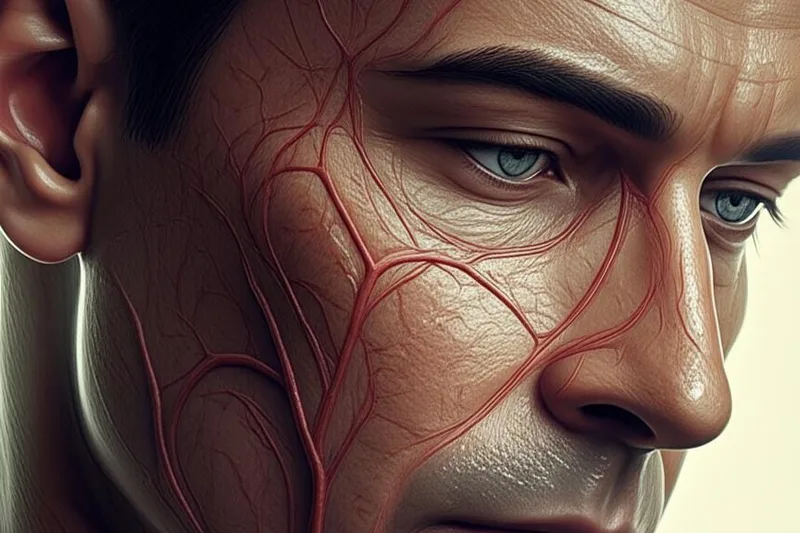
We all have a very important blood vessel located deep inside our face. Some people also call it the `(Internal Maxillary Artery)`. This is on both sides of our face. Just think, this is what supplies blood to most parts of our face. Today, let's talk about this `(Maxillary Artery)` simply, in a way that you can understand.
What is the Maxillary Artery?
Simply put, this ``(Maxillary Artery)`` is a major blood vessel located on the inside of your face, a little deeper. To be precise, it branches off into many smaller blood vessels that spread all over your face – up, down, to the sides, everywhere. It's like branches branching off from the trunk of a tree.
What happens to the maxillary artery? How is this important to us?
Like every other artery in our body, the main function of this ``Maxillary Artery`` is to carry oxygen and nutrients to certain parts of your face. Without these, our tissues and cells cannot function, right? So, this blood vessel fulfills exactly that responsibility.
But, its importance does not stop there. This ``(Maxillary Artery)`` is also very useful for our doctors to find solutions to some medical problems. Just think about things like this:
- Sometimes, when performing surgery for brain aneurysms or tumors under the skull, if it is necessary to supply blood through another route, the Maxillary Artery is used as an alternative blood supply (Bypass Route) .
- This is also important in some endovascular procedures.
- Sometimes, if nosebleeds cannot be stopped, or if the blood supply to noncancerous growths is too high, the Maxillary Artery can be used to control that blood supply, that is, to block or occlude it.
So you understand, right? This is not just a blood vessel, it is important for many things.
What areas are supplied with blood by the Maxillary Artery?
This ``(Maxillary Artery)`` supplies blood to many important parts of your face. Check out this list:
- Your jawbone
- For teeth
- For the lips
- For the chin area
- The muscles we use when chewing food
- Roof of your mouth
- Inner and middle ear
- To the nose
- The area around your cheekbones
All these places receive the necessary nutrition and oxygen from the branches of these small blood vessels.
Where is the Maxillary Artery located?
This `(Maxillary Artery)` starts as a branch from the `(External Carotid Artery)`, a major blood vessel that runs up your neck. Imagine that your `(External Carotid Artery)` goes north, then this `(Maxillary Artery)` splits to the east (or west if the other side is), and then goes up again. It starts inside the `(Parotid Gland)`, a salivary gland in front of your ear.
Could there be any differences in the location of this blood vessel?
Yes, it really is possible. In some people, this ``Maxillary Artery'' may be a little closer to the muscle in front of the ear, while in others it may be a little further away. The amazing thing is, even in the same person, this position may be slightly different on the right and left sides of the face.
Also, there are small branches that branch off from this `(Maxillary Artery)`, sometimes several of those branches can join together and branch off as one branch, instead of dividing separately. At other times, a branch that should normally branch off from the `(Maxillary Artery)` can start directly from the `(External Carotid Artery)` without dividing like that. It is normal to see small anatomical variations like this in our bodies.
What are the three main parts of the Maxillary Artery?
This ``(Maxillary Artery)`` can be divided into three main parts. They are:
1. Mandibular section: This mainly supplies blood to your jawbone, lips and chin area, and middle ear.
2. Pterygoid section: This section supplies blood to the muscles you use when chewing food.
3. Pterygopalatine section: This supplies blood to the roof of your mouth, jaw, teeth, lips, eyelids, and inner ear.
What are the branches of the Maxillary Artery?
As we have already said, this `(Maxillary Artery)` gives off many small branches. Each of these branches helps to supply blood to different parts of the face. For example, the `(Middle Meningeal Artery)` branch carries blood to the meninges, the `(Inferior Alveolar Artery)` one supplies blood to the teeth of the lower jaw, and the `(Sphenopalatine Artery)` one supplies blood to the nasal cavity. There are many more branches like this. Each of these supplies blood to its respective area.
How big is this Maxillary Artery?
The size of this blood vessel varies slightly from one part to another. It's hard to say exactly how many millimeters, because it can vary slightly from person to person and depending on the depth of the blood vessel. But in general, this is a blood vessel of considerable size.
What are the common diseases and disorders that can affect the Maxillary Artery?
Like other blood vessels, there are some medical conditions that can affect the ``Maxillary Artery''. The main ones are:
- Temporal Arteritis (also called Giant Cell Arteritis): This is a condition in which the arteries become swollen.
- Aneurysm (this is a bit rare): A condition where the wall of the artery becomes stretched, weakened, and bulges like a balloon.
- Pseudoaneurysm (also rare): A condition in which blood leaks out of a damaged artery wall and forms a blood clot around it.
If such situations arise, it is very important to seek medical advice immediately.
What are the common signs or symptoms of Maxillary Artery disease?
If there is a problem with your ``Maxillary Artery'', you may experience symptoms like these:
- A swelling is visible in front of the ear .
- It feels like a pulsating lump in front of the ear.
- Fever .
- Headache , especially in the forehead area.
- Double Vision .
- Pain in the cheek area or jaw .
- Feeling pain when chewing food .
If you have something like this, you should see a doctor without ignoring it.
What are the common tests performed to check the health of the Maxillary Artery?
A doctor has various testing methods to check the condition of this ``(Maxillary Artery)``. Some of them are:
- Ultrasound test: This uses sound waves to take an image of the blood vessels.
- CT scan: This test uses X-rays and a computer to produce detailed images.
- MRA scan: This is a special method of taking pictures of blood vessels using an MRI machine.
- Angiogram: This test uses X-rays and a special dye called a contrast dye to look inside the blood vessels.
In addition to these tests, a doctor can perform a physical examination and assess whether there is a problem with this blood vessel based on your symptoms.
What are the common treatments for Maxillary Artery problems?
Treatment options depend on your condition. Common treatments include:
- If you have an aneurysm or pseudoaneurysm, you can have a minimally invasive surgery . This means that the surgery is performed without a large incision, using instruments inserted through a small hole.
- For conditions like `Temporal Arteritis`, corticosteroid medications can be given. These reduce swelling.
How do we keep this Maxillary Artery healthy?
These things will help keep every blood vessel in your body healthy, not just your ``Maxillary Artery'':
- Exercise regularly. Walking for at least 30 minutes a day is also good.
- Avoid tobacco products completely. Smoking is very harmful to blood vessels.
- Eat nutritious foods. Include vegetables, fruits, legumes, and whole grains in your diet.
- Limit the amount of alcohol you drink.
- Reduce the amount of salt added to food.
- See your doctor regularly. If you have any symptoms related to the ``Maxillary Artery'', tell your doctor about it.
Final Take-Home Message
This ``Maxillary Artery``, located deep under your skin, inside your face, does a very silent job – it feeds the muscles and tissues of your face with the blood that flows through it. By following a healthy lifestyle , you can keep all your blood vessels, that is, your entire cardiovascular system, in good shape.
By getting regular medical checkups, you can identify problems in your body at an early stage and treat them before they become serious. Therefore, take care of your health. Because health is the greatest wealth!
` Maxillary sinus, facial blood vessels, blood circulation, headache, jaw pain, sinus health, anatomy


💬 Comments (0)
No comments yet. Be the first to share your thoughts here.
Add Your Comment