

Hello! How are you? Today we are going to talk about something very important inside our mouth, especially related to the tongue. Today's story is about a small but very powerful blood vessel that supplies blood to our tongue and other parts of the mouth, which helps us when we talk, eat, and taste. This is what we call the lingual artery in medicine. Although the name may sound a little strange, the service it provides is very great.
What is the lingual artery? What does it do?
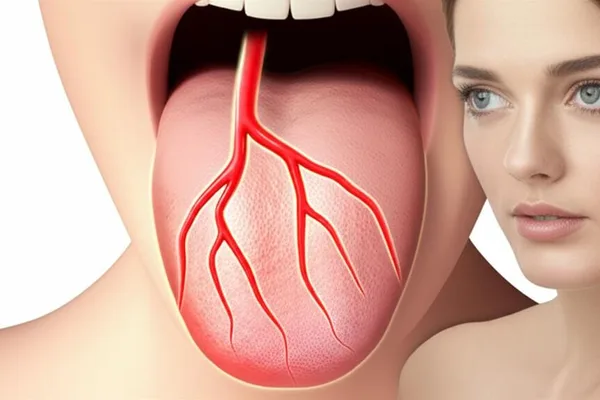
Simply put, your lingual artery is a blood vessel, or vein . It carries clean blood, which is oxygen and nutrients, from your neck to various parts of your mouth. There are lingual arteries on both sides of your jaw. This blood supply is essential for the muscles and tissues we use when we eat and speak.
So, what areas does the lingual artery supply blood to? Take a look:
- For your tongue: This is essential for the functioning of the tongue.
- Muscles inside the mouth: These muscles help you speak and chew food.
- Floor of your mouth: The part under your tongue.
- Palate: Sometimes this part also has a blood supply.
- Tonsils: Tonsils on either side of the throat.
- Epiglottis: The small flap-like part that closes the windpipe when we swallow.
- Salivary glands: One of the saliva-producing glands in our mouth.
- Jaw: Some parts of the jaw.
Look how much work he does, even though he's so small!
Where is the lingual artery located?
Your lingual artery starts from the external carotid artery, a large blood vessel that runs up and down your neck. Starting in your neck, it travels forward, under your jaw, and then under your tongue. Finally, the lingual artery ends at the tip of your tongue.
What's really amazing is that some branches of the lingual arteries on the left and right sides of your mouth are connected to each other. This means that even if there is a slight blockage on one side, the other side still gets some help in maintaining blood supply.
What are the parts of the lingual artery?
The lingual artery can be divided into three main parts:
1. First part: This is where the lingual artery begins, that is, the part closest to the previously mentioned carotid artery.
2. Part Two: This is located under your chin, a little inward. This is the part that moves forward.
3. The third part: This is the part that goes up from under the tongue.
These three parts work together to provide the necessary blood supply to the tongue and other parts of the mouth.
What are the branches of the lingual artery?
Just like the branches of a tree, the lingual artery also branches off into smaller blood vessels, or branches. Each of them supplies blood to a specific area. Let's see what they are:
- Suprahyoid Artery: This supplies blood to some muscles in the front of the neck.
- Dorsal Lingual Artery: This supplies blood to your epiglottis, the roof of your mouth, and other surrounding areas.
- Sublingual Artery: This supplies blood to the muscles of the tongue, one salivary gland, and other surrounding parts.
- Deep Lingual Artery or Ranine Artery: This is the artery that carries blood to the tip of the tongue.
All these activities in our mouth happen properly because each of these branches does its job precisely.
What does the lingual artery look like? Are there any differences?
Now you might be wondering what the lingual artery looks like and how big it is. It's actually a very small blood vessel. To be precise, it's only about 2 to 5 millimeters in diameter . That's less than half a centimeter! But it can be as long as your tongue.
Also, the location, or anatomy, of the lingual artery is not exactly the same for everyone. In some people, it branches directly from a large blood vessel in the neck, the external carotid artery. In others, it branches off with one or two smaller blood vessels. Also, researchers have found that the way this artery travels through the surrounding muscles can vary slightly from person to person. This is why doctors are so careful about the lingual artery when performing head and neck surgery.
What are the common diseases and disorders that affect the lingual artery?
Unfortunately, this important blood vessel can sometimes be damaged. Especially if you have surgery for an abnormal growth, difficulty swallowing (dysphagia) , or sleep apnea , the surgeon will work in the area where the lingual artery is located. He will be very careful not to damage this artery. If it is damaged, it can lead to loss of tissue in the tongue or life-threatening loss of blood .
Other things that can damage the lingual artery include:
- Radiation therapy for head or neck cancer.
- A pseudoaneurysm is caused by damage to the vein wall. In this case, the vein wall can weaken and bulge like a balloon.
- Temporal arteritis or giant cell arteritis is an inflammation of the arteries. This causes the blood vessels to swell.
- Tongue cancer.
- Facial injury.
Things like this can cause problems with the lingual artery.
What are the common signs or symptoms of a problem with the lingual artery?
If there is a problem with your lingual artery, you may experience symptoms like:
- After radiation therapy , the lingual artery can become narrowed, reducing blood flow.
- Sometimes, even though it may seem like a nosebleed, it could be a sign of a pseudoaneurysm . Bleeding can also occur from inside the mouth.
- Pain and swelling can be symptoms of a condition called Temporal Arteritis.
- If you have tongue cancer, the lingual artery can bleed heavily .
- Bleeding can also occur after a facial injury.
If you see a sign like this, it's best to see a doctor as soon as possible.
Common tests that check the health of the lingual artery
Doctors use various tests to check the condition of the lingual artery. Some of them are:
- Ultrasound test: This uses sound waves to look inside blood vessels.
- Computed Tomography (CT) Angiogram: This test uses X-rays and a computer to take detailed images of the blood vessels.
- MRA (Magnetic Resonance Angiogram (MRA)) test: This uses an MRI machine to look at the blood vessels.
These tests allow the doctor to determine exactly if there is a blockage, damage, or other problem somewhere in the blood vessel.
Common treatments for the Lingual Artery
Fortunately, there are treatments for many problems with the lingual artery. Treatment depends on the type of problem.
- Statin- type medications may be given to stop blood vessels from narrowing after radiation treatment.
- A minor surgery can be performed for a pseudoaneurysm.
- Corticosteroid medications are used to treat temporal arteritis.
- Surgery may be required for tongue cancer or a facial injury.
The most important thing is to seek medical advice as soon as symptoms appear. That way, treatment can be started quickly and a bigger problem can be prevented.
Simple lifestyle changes and tips to keep the lingual artery healthy
So how do we keep not only the lingual artery, but all the other blood vessels in the body healthy? There are a few very simple things to do, but they need to be done with discipline.
- Exercise more days a week: Do something like walking, running, or swimming for at least 30 minutes a day.
- Avoid all tobacco products: Smoking is very harmful to blood vessels.
- Eat foods low in saturated fats: Reduce foods high in oil and fat. Eat more vegetables, fruits, legumes, and foods high in fiber.
- Reduce the amount of salt you eat: Eating too much salt is not good for blood pressure.
- Limit alcohol consumption: Stay away from alcohol as much as possible.
Following these habits will go a long way in keeping your entire body's circulatory system healthy.
What happens if the lingual artery is damaged?
As we discussed earlier, if the lingual artery is damaged, it can cause severe bleeding . It can also cause the tongue tissue to die , as this is the blood vessel that supplies the tongue with oxygen and nutrients.
Every part of your mouth, especially your tongue, needs blood and oxygen from the lingual artery to function properly. Therefore, it is important to eat a healthy diet and maintain good lifestyle habits to keep all your blood vessels functioning properly. Also, by regularly seeing a doctor and getting medical checkups , you can identify any problems early and treat them easily.
Finally, things to remember
The lingual artery is a very important blood vessel that is essential to the health of our mouth, especially our tongue. It is what gives life to our tongue, which helps us speak, eat, and taste.
- This blood vessel starts in the neck, goes under the chin, under the tongue, and extends to the tip of the tongue.
- It supplies blood to the tongue, mouth muscles, tonsils, and salivary glands.
- This can be damaged by certain medical conditions, radiation treatments, and injuries.
- By following a healthy lifestyle and getting regular medical checkups, you can keep this blood vessel, as well as other blood vessels in the body, healthy.
So, I hope you now have a better understanding of this small, but mighty "hero" inside your mouth. Take care of your health!
` Lingual Artery, Lingual Artery, Blood Vessels of the Tongue, Oral Health, Blood Supply, External Carotid Artery, Tongue Diseases




💬 Comments (0)
No comments yet. Be the first to share your thoughts here.
Add Your Comment