
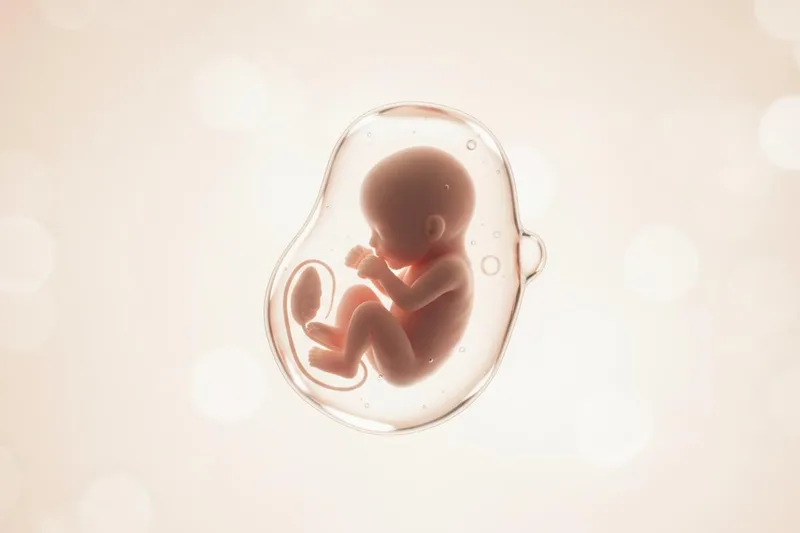
If you are a mother-to-be or someone who is curious about this amazing journey, this article will be very important for you. Just think about it, how amazing it is to start with a tiny cell and then grow into a fully-fledged baby in a few months? It's just like magic, isn't it? So, today we will talk about this amazing journey, that is, how a baby grows in the womb.
What are the three main stages of embryonic development?
Simply put, a baby's development in the womb can be divided into three main stages. It's like three parts to a story. You may not have heard many of these names, but it's good to know.
1. Germinal Stage
This is the shortest stage of embryonic development. It begins when a sperm and an egg meet and are fertilized in your Fallopian tube. The tiny cell that forms is called a zygote. This zygote travels for about a week toward the uterus. During this journey, the zygote divides very rapidly, eventually forming two separate structures. One becomes the embryo (later the fetus), and the other becomes the placenta. Cell division continues at a very rapid rate. Eventually, this zygote becomes a blastocyst. This blastocyst reaches the uterus and implants itself in the uterine wall (implantation). If this implantation is successful, your body begins to produce hormones to help you get pregnant. This is when your monthly period stops.
2. Embryonic Stage
This stage begins from the third week after conception until the end of the eighth week. The blastocyst is now starting to take on human characteristics. It is now called an embryo. The neural tube (which later becomes the brain and spinal cord), head, eyes, mouth, and limbs begin to form. A cluster of cells that will form the heart can join together and begin to beat by about five to six weeks. The first buds of the arms and legs also form by about the sixth week. By the end of the eighth week, most of the organs and systems of the embryo have formed. This is also when many people experience morning sickness.
3. Fetal Stage
This stage begins in the ninth week and lasts until the baby is born. This is when the embryo officially becomes a fetus. Although the baby's sex is determined by about nine weeks, the doctor cannot yet see it with an ultrasound. The baby's major organs and body systems continue to develop and mature. Things like nails, eyelashes, and hair are also forming. Although the fetus can move its limbs, you may not start to feel it until about 20 weeks. Most of the weight and length gain occurs during this fetal stage.
How and when does pregnancy begin?
Pregnancy actually begins on the first day of your last menstrual period (LMP). This is called the gestational age of the fetus. This is about two weeks before fertilization actually occurs. It may seem strange, but the first day of your last menstrual period is a very important date in determining your due date. Your doctor will ask you about this date and use it to calculate how far along you are.
How does conception happen? Every month, your body goes through a reproductive cycle. It can end in two ways: either you have your period, or you get pregnant. This cycle continues throughout your reproductive years – from the time you start menstruating until you reach menopause, around the age of 50.
There are several steps in a cycle that ends with pregnancy.
1. First, a group of eggs (`Oocytes`) prepare to be released from the ovary (`Ovulation`). These eggs develop inside small, fluid-filled sacs called `Follicles`.
2. From this group of eggs, one egg undergoes maturation and progresses through the cycle.
3. The mature follicle now opens and releases the egg from the ovary. This is called `Ovulation`.
4. After ovulation, the ruptured follicle becomes a structure called the corpus luteum. It releases the hormones progesterone and estrogen. Progesterone helps prepare the lining of the uterus for pregnancy. If you don't get pregnant during your cycle, this lining is shed during menstruation. If a sperm fertilizes the egg, fertilization has occurred, and the fertilized egg begins its journey to the uterus, where it implants.
How long does a pregnancy last?
We usually think of pregnancy as a nine-month process. But, that's not always the case. A full-term pregnancy is 40 weeks, or 280 days. Depending on the months you're pregnant (some are short, some are long) and the week you deliver your baby, you could be pregnant for nine or ten months. This is completely normal and healthy.
How a baby develops month by month
During a normal pregnancy, the fetus changes a lot. This period is divided into three parts, called `Trimesters`. Each trimester is about three months long. Your doctor will probably talk to you about fetal development in weekly terms. So, if you are three months pregnant, you are about 12 weeks pregnant.
During each trimester of pregnancy, you will see clear changes in the fetus and your body.
First Trimester
The first trimester lasts from fertilization to 12 weeks. This is usually the first three months of pregnancy. During this trimester, the fertilized egg changes from a small ball of cells into a fetus with human characteristics. The first trimester is very exciting, and it is also the time when many people experience unpleasant symptoms such as ``morning sickness`` and fatigue.
1 month (1 to 4 weeks)
It may seem strange, but the first two weeks of pregnancy are a "preparation period." Your body releases more hormones, and your uterus prepares for a pregnancy. At the end of the second week, an egg is released from your ovary (ovulation). If a sperm fertilizes an egg right after ovulation, pregnancy will proceed.
- Week 3: Fertilization occurs in the third week. A sperm and an egg unite to form a `zygote`.
- Week 4: The little ball of cells becomes a blastocyst and implants itself in the wall of your uterus. The placenta begins to form. A water-tight sac forms around the blastocyst. This is called the amniotic sac. This protects the fetus during pregnancy.
By the end of the fourth week, the blastocyst is about 2 millimeters long – about the size of a whip!
Month 2 (weeks 5 to 8)
Most people realize they are pregnant during the second month of pregnancy. Pregnancy hormones are at their peak, and a home pregnancy test will show a positive result around five weeks. Many people also start to experience pregnancy symptoms at this time.
- Week 5: The neural tube (the brain, spinal cord, and other nervous tissue of the central nervous system) is forming. The tiny "heart tube" is beating 110 times per minute by the end of the fifth week.
- Week 6: Tiny buds that will become arms and legs are developing. Blood cells are forming, and blood circulation is beginning. Structures that will become ears, eyes, and mouth are forming. Your doctor can detect the beating of the heart's developing cells with a vaginal ultrasound.
- Week 7: Bone begins to replace soft cartilage, and the sex organs begin to develop. The fetus's head is large in relation to the rest of the body. Some people think that the fetus looks like a tadpole or a seahorse , due to its prominent tail (which later disappears) and large head.
- Week 8: All major organs and body systems are developing. The fetus has webbed hands and feet. Eyes are beginning to appear, and ears are beginning to form. The umbilical cord is fully developed, helping to carry oxygen and blood to the fetus.
After the eighth week, doctors call the embryo a ``fetus.'' It remains a fetus until birth.
By the end of the second month, the fetus is 0.5 to 1 inch (1.3 - 2.5 cm) long – about the size of a black pea!
Month 3 (weeks 9 to 12)
It is during the third month of pregnancy that the embryo becomes a fetus. This is a time of rapid growth and development. The fetus develops distinct facial features, limbs, organs, bones, and muscles. By the end of the twelfth week, the fetus has a determined sex, but this cannot be seen on an ultrasound for several weeks.
- Week 9: The roots of the teeth and taste buds are forming. Muscles are developing, and the body is taking on a human-like shape. However, the head is still only about 50% of the length. Your doctor will be able to hear the heartbeat with a Doppler ultrasound.
- Week 10: Hands, palms, fingers, feet, and toes are fully formed (no webbed fingers anymore). Fingernails are starting to form, external ears are forming. External genitalia are also starting to form, but it's too early to see them with an ultrasound.
- Week 11: The fetus begins to explore a little, doing things like wiggling its hands and opening and closing its mouth. The knees, elbows, and ankles are working, but it's too early to feel any kicks. The bones are getting stronger, but the skin is still translucent. Facial features are becoming more distinct.
- Week 12: All organs, limbs, bones, and muscles are formed and continue to develop to become fully functional. The circulatory, digestive, and urinary systems are also functioning, and the liver is producing bile. The fetus is drinking amniotic fluid and urinating.
The most critical development has occurred, so the risk of miscarriage decreases significantly after 12 weeks (the end of the first trimester). Many people also begin to experience morning sickness by this time.
By the end of the third month, the fetus is 2.5 to 3 inches (6.4 - 7.6 cm) long – about the size of a small plum!
Second Trimester
The second trimester of pregnancy is often considered the best part of the experience. By now, the morning sickness has gone, and the discomfort of early pregnancy has faded. You may even start to feel the baby move as it rolls and squirms inside the uterus. This is when most people find out the sex of their baby. This is usually done during an anatomy scan (an ultrasound that checks physical development) at around 20 weeks.
Month 4 (weeks 13 to 16)
Many people start to notice signs of pregnancy around this time, especially if you've been pregnant before. Your doctor can clearly hear the fetal heartbeat with a Doppler ultrasound. The fetus may suck its thumb, twitch, pull, and make faces.
- Week 13: Vocal cords form, and the fetus's large head begins to grow in proportion to its body.
- Week 14: The fetus's skin begins to thicken, fine hair begins to grow. It can put its fingers to its mouth and turn its head. The external genitalia are fully developed, and fingerprints begin to form.
- Week 15: Some organs, such as the intestines and ears, move into their permanent positions. The fetus is still learning to breathe using amniotic fluid, but its lungs are starting to develop. The fetus is starting to make more purposeful movements, such as sucking its thumb and smiling.
- Week 16: The fetus has lips and ears that are developed enough to hear what you say. Even though its eyes are closed, the fetus can respond to light by turning away from that side.
By the end of the fourth month, the fetus is about 5 inches (12.7 cm) long and weighs about 4 ounces (113 grams). That’s about the size of an avocado!
Month 5 (weeks 17 to 20)
By the end of the fifth month of pregnancy, most people will start to feel the fetus moving. The first movements are called `quickening`, and can feel like the flapping of butterfly wings. If your pregnancy has been healthy so far, you will finally have your first ultrasound. You will also be able to find out the sex of the fetus.
- Week 17: The skin of the fetus is still thin, but fat is beginning to form. The skin is covered in a white coating (`vernix`). This "cheese-like" substance is thought to protect the fetal skin from prolonged exposure to amniotic fluid.
- Week 18: The fetus is covered in fine, downy hair called ``Lanugo``, which is similar to the surface of a peach. It helps keep the fetus warm and provides another layer of protection. The fetus may have a sleep-wake cycle, and loud noises may wake the fetus from sleep.
- Week 19: The fetus is getting stronger, many people start to feel kicks and kicks. The fetus has its own unique fingerprints, and hiccups occur.
- Week 20: The fetus's fingernails grow to the tips of its fingers. The part of the brain responsible for the five senses begins to develop.
By the end of the fifth month, the fetus is 9 to 10 inches (22.9 - 25.4 cm) long and weighs about 1 pound (454 grams).
Month 6 (weeks 21 to 24)
If you could look inside the womb now, the fetus's skin would be red, wrinkled, and veins would be visible through the translucent skin. In the sixth month of pregnancy, the eyelids would begin to separate, and you would see regular, twitching movements. The fetus would respond to sounds by moving or increasing its heart rate.
- Week 21: Limb movements are coordinated and frequent. The fetus has bone marrow, which helps produce blood cells.
- Week 22: The fetus's grasp is getting stronger, the ears and umbilical cord can be touched. You can hear your heartbeat, your stomach sounds, and the sound of you breathing.
- Week 23: If born prematurely, the fetus can survive after the 23rd week with intensive care. The body begins to rapidly accumulate fat.
- Week 24: The fetus's lungs are fully developed, but not yet well enough to function outside the womb.
By the end of the sixth month, the fetus is about 12 inches (30.5 cm) long and weighs about 2 pounds (907 grams).
Third Trimester
This is the last part of your pregnancy. It can be tempting to count down the days to your due date, hoping it will come sooner. But every week of this final stage of development helps the fetus prepare for birth. Throughout the third trimester, the fetus rapidly gains weight and accumulates body fat that will help it after birth.
As your due date approaches, your doctor will monitor you closely. You will see your doctor every two weeks, then once a week. Don't forget to ask your doctor any questions you have about labor and delivery.
Month 7 (weeks 25 to 28)
The fetus continues to mature, increasing its body fat stores. The fetus changes positions frequently, responding to stimuli including sound, pain, and light. The amount of amniotic fluid begins to decrease.
- Week 25: The fetus's skin becomes less wrinkled and plump due to excess body fat. The nervous system matures rapidly.
- Week 26: The fetus produces melanin, which gives color to the skin and eyes. The fetus's lungs begin to produce a substance called surfactant, which helps it breathe after birth.
- Week 27: The fetus can open its eyes, blink, and has eyelashes.
- Week 28: The fetus may begin to turn head down inside the uterus as it prepares to be born.
By the end of the seventh month, the fetus is 14 to 15 inches (35.6 - 38.1 cm) long and weighs between 2 and 3 pounds (0.9 - 1.4 kg).
Month 8 (weeks 29 to 32)
The fetus continues to mature, building up body fat stores. The brain is the fastest growing organ during this time. The fetus can see and hear a lot of stimuli. Many internal systems are well developed, but the lungs may not yet be fully developed.
- Week 29: Kicks and punches may now feel like pinches because there is not enough room in the amniotic sac.
- Week 30: The fetus can control its own body temperature. The brain matures and develops rapidly.
- Week 31: The fetus can process more information and stimuli. Clear patterns can be seen in waking and sleeping times.
- Week 32: The fetus's skin is no longer transparent. Except for the lungs and brain, most other organs are well-formed and ready to be born.
The fetus is 17 to 18 inches (43.2 - 45.7 cm) long and weighs about 5 pounds (2.3 kg).
Month 9 (weeks 33 to 36)
During this stage, the fetus continues to grow and mature. The lungs are now fully developed. The ninth month is a time when much of the final stages of growth and brain development are completed.
- Week 33: The fetus's bones are getting stronger, but the cranial bones around the brain should remain soft and come down the birth canal.
- Week 34: The protective coating of vernix (`vernix`) on the fetal skin thickens.
- Week 35: The fetus's brain continues to develop, but is still only two-thirds of its birth weight.
- Week 36: The fetus's lanugo (`Lanugo`) is disappearing, and there is hair on the head.
The fetus is 17 to 19 inches (43.2 - 48.3 cm) long and weighs between 6 and 7 pounds (2.7 - 3.2 kg).
Month 10 (weeks 37 to 40)
During this last month, you can go into labor at any time. By now, the baby's position has changed to prepare for birth. The best position is to be head down inside the uterus. You may feel a lot of discomfort during this last period as the baby moves down into the pelvis and is ready to be born. Your doctor may encourage you to do `kick counts`, a way to check how much the baby is moving.
- Week 37: The fetus's toenails are growing to the tips of the fingers. You may start to feel the fetus lowering into the pelvis.
- Week 38: The fetus gains weight at a rate of 0.5 pounds (227 grams) per week to reach its final size.
- Week 39: The fetus is full-term, ready to meet the world!
- Week 40: This is your expected week. Call your doctor if you notice any signs of labor.
The fetus is 18 to 20 inches (45.7 - 50.8 cm) long and weighs between 7 and 9 pounds (3.2 - 4.1 kg).
How soon can I know I'm pregnant?
From the moment of fertilization, a hormone called `Human Chorionic Gonadotrophin (HCG)` is present in your blood. This hormone is made by cells that make up the placenta (which provides nourishment to the developing fetus). It is this hormone that is detected by a `Pregnancy test`. Although this hormone is present from the beginning, it takes time for it to build up inside your body. It usually takes three to four weeks from the first day of your last period for the `HCG` hormone to increase to a level that can be detected by a pregnancy test.
When should I contact my doctor about a new pregnancy?
Many doctors will not tell you to come in for an appointment until you get a positive result from a home pregnancy test. These tests are most accurate when there is enough hCG circulating throughout your body. This can happen several weeks after fertilization. It is best to call your doctor to schedule your first appointment as soon as you get a positive pregnancy test result.
When you talk to your doctor, they may ask if you are taking a prenatal vitamin. These supplements contain folic acid. It is important to get at least 400 micrograms (400 mcg) of folic acid a day during pregnancy to help your baby's neural tube (the base of the brain and spinal cord) develop properly. Many doctors recommend that you take a prenatal vitamin that contains folic acid even if you are not pregnant. If you did not take a prenatal vitamin before you became pregnant, your doctor may tell you to start as soon as possible.
What are the most important weeks for fetal development?
Each trimester or stage of pregnancy has its own risks. It is difficult to single out specific weeks as being more important or less important. However, many doctors say that the most important time for fetal development is the first 13 weeks of pregnancy (or the first trimester). The risk of miscarriage decreases after the first trimester, as the fetus's major organs and systems are formed and functioning. This does not mean that your pregnancy is less important after 13 weeks. It does mean that many of the crucial steps and processes are completed, and most of the major birth disorders occur during the first trimester.
What is 'full-term' pregnancy?
As you near the end of your pregnancy, doctors may use several terms to describe when you will be in labor. These terms are used to divide the last few weeks of pregnancy.
These help determine how likely a baby is to have complications at birth. For example, babies born early-term (or earlier) are more likely to have breathing difficulties than babies born full-term.
When looking at these terms, it's important to know how they're written. You'll first see the week (38), followed by two numbers separated by a dash (6/7). This tells you what week of pregnancy you're currently in. So, if you see 38 6/7, it means you're on the 6th day of your 38th week.
The last few weeks of pregnancy are divided into these categories:
- Early-term: 37 0/7 weeks to 38 6/7 weeks.
- Full-term: 39 0/7 weeks to 40 6/7 weeks.
- Late-term: 41 0/7 weeks to 41 6/7 weeks.
- Post-term: 42 0/7 weeks and beyond.
Talk to your doctor about any questions you have about gestational age and expected date.
Finally, remember this (Take-Home Message)
A lot of things have to happen for a pregnancy to occur, for it to develop, and for a baby to be born. Learning about how a fetus develops is exciting and eye-opening, especially when you realize how many organs, systems, and bodily functions develop over the course of nine months. Both you and the fetus growing inside you go through many changes during pregnancy.
Ask your doctor about these changes and any other questions you may have. They are there to be a resource for you and to provide you with the best care possible. Congratulations on your wonderful journey to becoming a mother!
` Fetal development, pregnancy, baby development, trimesters, delivery, weekly development, mother and baby, Fetal Development




💬 Comments (0)
No comments yet. Be the first to share your thoughts here.
Add Your Comment