
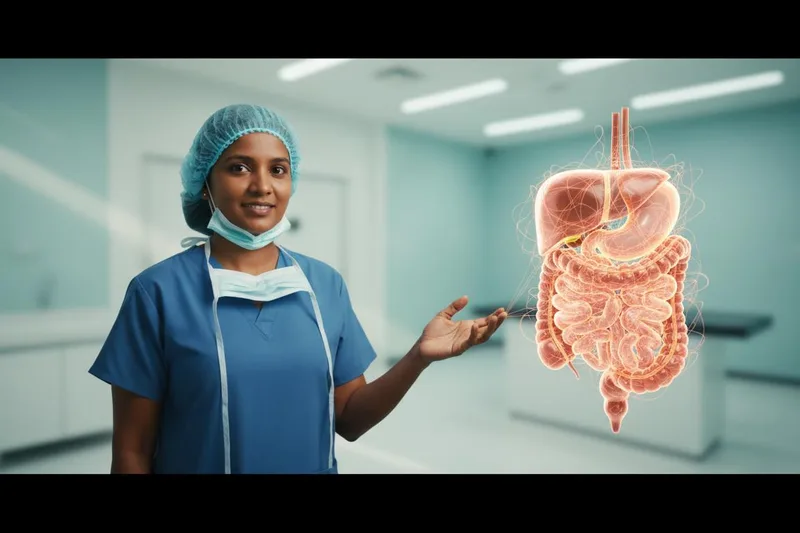
Have you ever had to undergo abdominal surgery? Or has someone you know had to? It's normal to experience some abdominal pain and discomfort after such surgery. But have you ever thought that these surgeries can cause organs to stick together inside our abdomen? Today we're going to talk about these 'abdominal adhesions', which many people don't know about, but which are very common after surgery.
Simply put, what are these abdominal adhesions?
Imagine if you injured your knee and the skin peeled off, and as the wound healed, a scar formed over it, right? The same thing happens inside our bodies, especially between the organs in our abdomen. Abdominal adhesions are bands of scar tissue that form between the organs inside our abdomen or between the organs and the abdominal wall. To be precise, they are like gum that sticks organs together.
Normally, the organs inside a healthy person's abdomen (such as the intestines, liver, and uterus) have a slightly slippery surface, allowing them to move freely. But when these adhesions form, that freedom is lost. The organs can stick together and become stuck.
The main organs inside our abdominal cavity are:
- Digestive system (stomach, small intestine, large intestine)
- Female reproductive system organs (uterus, ovaries)
- Kidneys
- Liver
- Pancreas
- Spleen
These adhesions most often form between parts of the small intestine, but they can occur between any two of these organs.
Why do these adhesions occur? What is the main reason?
The main reason for this is abdominal surgery . In fact, more than 90 out of 100 people who have abdominal surgery develop these adhesions. Just think, during surgery, doctors have to touch and move our organs. This manipulation of the organs causes a small amount of damage and injury. During our body's natural healing process, scar tissue forms as these injured areas heal. That scar tissue is what remains as these adhesions.
Simply put, abdominal adhesions are internal scars that form inside the body. They are part of the body's natural healing process.
Although surgery is the main cause, these adhesions can also be caused by any infection or inflammation that occurs inside the abdomen. For example:
- Pelvic infections
- Appendicitis and its rupture
- Intestinal diseases such as Crohn's disease
- Endometriosis condition
- Pelvic inflammatory disease (PID)
- Radiation therapy to the abdomen for cancer
What symptoms can these adhesions cause?
The good news is that most of the time, these adhesions don't cause any symptoms . Even if you have adhesions inside your stomach, you can live a normal life without feeling anything about them.
But sometimes, these adhesions can cause problems. Just like a water pipe can become kinked and stop the water from flowing, these adhesions can cause the intestines to become kinked, twisted, or blocked. We call this 'Small Bowel Obstruction' . This can happen shortly after surgery, or it can happen years later.
A bowel obstruction is a serious condition that requires emergency medical treatment . It prevents food, fluid, air, and waste from moving through the intestines. If this happens, you may experience these symptoms.
| Symptom | Description |
|---|---|
| Severe stomach pain | A sharp, throbbing pain that comes one after another. |
| Bloating and swelling | Feeling like your stomach is tight and bloated like a rock. |
| Nausea and vomiting | Not only eating and drinking, but sometimes vomiting green or brown bile. |
| Lack of flatulence and stool | This is a very important feature. When the intestines are blocked, neither air nor stool can be passed out. |
Most importantly: If you have any of these symptoms of intestinal obstruction, go to a hospital's Emergency Department (ETU) immediately. This is not a condition that can be treated at home. It can be life-threatening if left untreated.
What other complications can occur due to adhesions?
Intestinal obstruction is the main and most dangerous complication. Apart from that, several other problems can arise.
- Chronic Pain: Some people may experience long-term pain in the abdomen or pelvic area. This is because adhesions prevent organs from moving freely. This can cause pressure and compression on the organs.
- Infertility: Adhesions, especially in women, can make it difficult to have children. These adhesions can prevent an egg and sperm from meeting, or prevent a fertilized egg from implanting in the uterus. This condition, which occurs inside the uterus, is also called Asherman's syndrome .
How does a doctor detect these adhesions?
This is a bit of a complicated issue, because these scar tissues called adhesions cannot be directly seen with a normal scan, that is, an X-ray or a CT scan .
However, a doctor may suspect this by asking about your symptoms (such as stomach pain, vomiting) and your medical history (whether you have had previous abdominal surgery).
Even if the scans don't show adhesions, they can clearly show any blockage in the intestines caused by those adhesions. A CT scan can also determine how severe the blockage is.
The only way to be 100% sure whether someone actually has abdominal adhesions is to perform surgery to look inside the abdomen. This is usually confirmed through a procedure called a laparoscopy.
What are the treatments for this? Is surgery necessary?
Here's the important thing. Surgery is the main cause of abdominal adhesions. Also, the only treatment to remove these adhesions is another surgery.
Do you understand the problem with this? When you have surgery to remove adhesions, there is a very high chance that new adhesions will form as a result of that surgery.
For this reason, doctors do not usually recommend surgery to treat adhesions unless they are causing a serious problem.
- If you have no symptoms: If you have no problems, you may not need treatment even if you have adhesions.
- Intestinal obstruction: This is an emergency and requires surgery to free the blocked intestine.
- If infertility is a cause: If you are unable to conceive a child due to adhesions, surgery can be performed to remove the adhesions.
Therefore, the best decision is made by your doctor after carefully examining your condition and weighing the benefits of surgery against the potential risks (such as new adhesions).
Can't these adhesions be prevented?
Unfortunately, neither you nor your surgeon can completely prevent these adhesions from forming, as they are a natural healing process of the body.
But there are several ways to reduce the risk:
- Laparoscopic Surgery: Compared to open surgery/laparotomy, keyhole surgery, where a camera is inserted through several small incisions, causes less damage to the organs. Therefore, the risk of adhesions is also slightly lower.
- Special Barriers: In some surgeries, surgeons place a special gel or membrane between the organs that dissolves. This prevents the organs from sticking together during healing.
However, even these methods cannot prevent adhesions 100%.
Take-Home Message
- Abdominal adhesions are a very common condition that occurs after abdominal surgery. These are scar tissue that forms inside the body.
- Many people have these adhesions but do not experience any symptoms or problems.
- Sudden severe abdominal pain, vomiting, bloating, and inability to pass gas or stool are symptoms of intestinal obstruction. If these occur, go to a hospital's emergency department (ETU) immediately.
- Although surgery is the only way to remove adhesions, the surgery itself can cause new adhesions to form. Therefore, doctors do not recommend surgery unless absolutely necessary.
- If you have stomach pain or any doubts about this, talk openly with your doctor about it.


💬 Comments (0)
No comments yet. Be the first to share your thoughts here.
Add Your Comment