
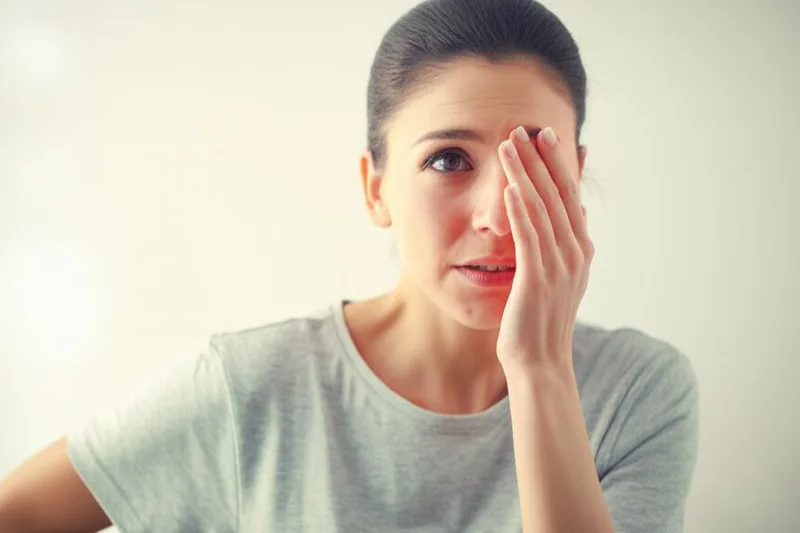
Do you also wake up in the morning with a stiff back, feeling like a log? Even though it gets better as the day goes on, is this back pain and stiffness bothering you? This could be more than just a simple backache. We call it Ankylosing Spondylitis. Simply put, it is a type of arthritis that affects the spine. But did you know that this disease is not limited to the spine? Yes, it can also affect your eyes in a more serious way than you think. That's what we're talking about today.
What is Uveitis ?
The main complication of ankylosing spondylitis (AS) that can affect the eyes is uveitis . This is an inflammation that occurs inside the eye, which means it becomes swollen and red. Our eye is like a ball. It has several layers. This inflammation mostly affects the middle layer of the eye. We call it the ``Uvea''. But it can occur anywhere inside the eye. Doctors classify it according to where the inflammation occurs.
| Type of uveitis | Affected location and description |
|---|---|
| Anterior Uveitis (Iritis) (Anterior uveitis ) | This is the most common type of AS. It affects the front part of the eye, especially the colored part of the eye (the iris). If not treated properly, it can lead to conditions like cataracts and glaucoma . |
| Intermediate Uveitis (Intermediate uveitis ) | It affects the vitreous, the jelly-like substance inside the eye, and the area surrounding the retina. |
| Posterior Uveitis (posterior uveitis ) | This affects the back of the eye. It can damage the retina, which is essential for our vision, and the optic nerve, which carries messages to the brain. |
| Panuveitis (Total uveitis ) | This is the most severe type. This inflammation spreads to all parts of the eye. If not treated quickly, it can even lead to blindness . |
Why do people with AS develop this condition?
Consider this: About one in two people with AS will develop uveitis at some point in their lives. It's that common. Sometimes, your eye doctor may be the first to diagnose AS as the cause of your back pain.
Simply put, the same inflammatory process in your body that causes your back pain also causes this inflammation in your eyes.
Although the exact cause of this is not known, there are a few things that experts believe. One theory is that it starts somewhere we don't even think about: in our gut .
There are trillions of tiny microorganisms in our gut. They are very important to our health. One of their main functions is to regulate our immune system . When these microorganisms are out of balance, our immune system becomes dysfunctional. Then some cells in the immune system (e.g. T-cells) start to attack our eyes by mistake. This is how uveitis can start.
Also, many people with both AS and uveitis have a gene called HLA-B27 . People with this gene are at a much higher risk of developing inflammatory eye conditions.
What are the symptoms? How do you recognize it?
If you have AS, be very aware of these symptoms. They can occur in one eye or both eyes at once.
- Redness of the eyes: The eyes turn blood red.
- Severe pain: A sharp pain or aching coming from inside the eye.
- Blurred vision: The surroundings appear hazy, without being clearly visible.
- Sensitivity to bright light: inability to see outside in sunlight or bright lights, feeling as if the eyes are turning blue.
Some people may have it only once and get better. Others may have it recurring every few years. And for some, it may become a long-term condition and require ongoing treatment.
If you have any of these symptoms, don't delay. See a doctor, especially an ophthalmologist, as soon as possible.
What are the treatments for this?
The main goal of uveitis treatment is to quickly control the inflammation inside the eye, because the more inflammation there is, the more damage it can cause to the eye.
Eye Drops
Often, especially for anterior uveitis , your doctor will give you two types of eye drops:
1. Steroid eye drops: These reduce inflammation.
2. Eye drops that enlarge the black eye: These reduce pain and prevent the parts of the eye from sticking together due to inflammation.
Other treatments
Depending on the severity of the condition, steroid pills may be taken or shots may be given around the eye. Sometimes, a small capsule that releases steroids may be implanted inside the eye.
However, long-term use of steroids can cause side effects such as glaucoma and cataracts, so they are generally not used for more than 3 months.
Let's think about intestinal health?
As we discussed earlier, there is some evidence that changes in the gut microbiome may play a role in this. So some experts recommend trying these things:
- Probiotics: These are bacteria that are beneficial to our bodies. They are found in fermented foods like yogurt and yogurt. They can also be taken as a supplement.
- Prebiotics: These are the food for the good bacteria. They help the good bacteria grow. They are found in foods like bananas, onions, and garlic.
Most importantly: Before making any of these treatments or dietary changes, be sure to talk to your doctor and seek his advice. He will be the one who will determine the treatment that is best for you.
Take-Home Message
- Ankylosing spondylitis (AS) is not just a disease that affects your spine. It can also seriously affect your eyes.
- If you experience symptoms such as eye redness, pain, blurred vision, or sensitivity to light, it could be uveitis . Seek medical attention immediately.
- There are very effective treatments for uveitis . The sooner treatment is started, the less damage to the eye can be minimized.
- Never go for any treatment you feel like. Always talk to your doctor and seek treatment under his guidance.


💬 Comments (0)
No comments yet. Be the first to share your thoughts here.
Add Your Comment