

When you think of cancer treatment, chemotherapy immediately comes to mind, right? We know it as a treatment that goes throughout the body, affects cancer cells as well as healthy cells, and has some serious side effects. But imagine that there is a way to find the exact location of the cancer cell, give it a drug, and destroy the cancer without harming the healthy cells nearby. That is what we are going to talk about today. This is called Antibody-Drug Conjugates, or ADCs for short.
Simply put, what is this Antibody-Drug Conjugate (ADC)?
ADC is a new and very promising technology in the world of cancer treatment. In this, we use a combination of two main treatment methods: Targeted Therapy and Chemotherapy.
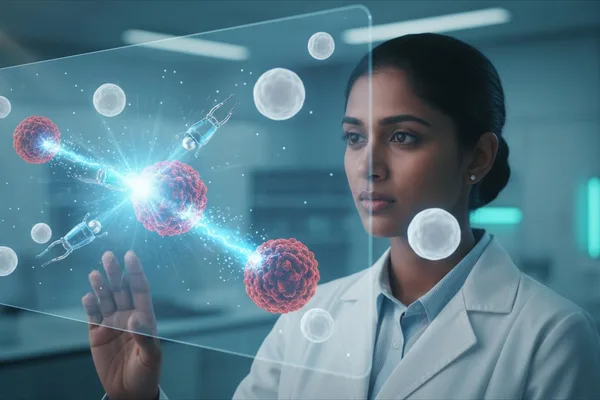
Think of it like a 'guided missile' . A missile can find its target and hit it only. Similarly, ADC therapy selectively finds and destroys cancer cells from among the billions of cells in the body. What happens in this is that a very powerful chemotherapy drug is safely taken to the cancer cell and injected only into it. This means that the effect of the chemotherapy drug on healthy cells is minimal.
Oncologists typically use this ADC treatment to:
- If a cancer recurs .
- If other treatments are not successful (refractory cancer) .
- If the cancer spreads to other parts of the body (metastasizes) .
ADC treatment may not completely cure cancer, but research has shown that patients who receive this treatment have a longer chance of surviving .
Okay, so how does this 'magic bullet' called ADC work?
This may seem a bit complicated to understand, but let's understand it with a simple example. Imagine a parcel ordered online is delivered to your home.
This ADC package has three main parts:
1. Monoclonal Antibody: This is our delivery agent. This is a special protein that is made in the lab. It has the amazing ability to recognize a specific marker on the surface of cancer cells (we call these Tumor Antigens ). Just like a key fits into a lock, this antibody goes to that marker on the cancer cell and sticks to it. It does not stick to any other healthy cells.
2. Special chemotherapy drugs: This is the package that is delivered. These are much more powerful drugs than regular chemotherapy. However, if this drug is sent to the body alone, it can cause great damage to healthy cells. That is why we send it to the delivery agent.
3. "Linker" protein: This is the 'gum'-like part that connects the delivery agent and the parcel together. It has two functions. The first is to hold the parcel (chemotherapy drug) tightly until the delivery agent (antibody) finds the cancer cell. The second and most important thing is to release the parcel and send it inside the cancer cell when it gets to the right place.
So this is how these three work together:
- When the ADC drug is injected into the body, the delivery agent (antibody) travels throughout the body and seeks out cancer cells.
- When a cancer cell is found, it goes to its surface and sticks to it.
- Then, the cancer cell pulls this ADC inside.
- Once inside the cell, that linker breaks and the package (the chemo drug) is released.
- This powerful drug destroys cancer cells inside them.
Simply put, this treatment method is so special because it targets and delivers drugs only to cancer cells, without harming healthy cells.
What types of cancer are treated with ADC?
Currently, ADC therapy is not used for all types of cancer. However, this treatment has been approved for a number of cancer types. This list is likely to grow in the future.
| Cancer category | Examples |
|---|---|
| Blood Cancers |
|
| Cancerous Tumors |
Several ADC drugs currently in use
There are currently more than a dozen ADC drugs approved by the US FDA. Some examples are:
- Brentuximab vedotin (Adcetris®): One of the first ADCs to receive FDA approval. It is used to treat blood cancers such as Hodgkin lymphoma and anaplastic large cell lymphoma.
- Trastuzumab emtansine (Kadcyla®): Used to treat HER2-positive breast cancer that has spread throughout the body.
- Sacituzumab govitecan (Trodelvy®): A treatment for inoperable, advanced triple-negative breast cancer. It is also used for advanced urinary tract cancer.
Researchers are currently investigating whether these drugs can be used for other types of cancer and non-cancer diseases. More than 100 clinical trials are underway around the world.
What are the main advantages of ADC treatment?
The biggest and most important advantage of this treatment is that it can deliver chemotherapy drugs directly to cancer cells without harming healthy cells. This allows doctors to use very powerful chemotherapy drugs without fear of harming healthy cells.
In traditional chemotherapy, the drug is delivered through a blood vessel throughout the body. This is called systemic chemotherapy. When the drug travels throughout the body in this way, it damages not only the rapidly dividing cancer cells, but also healthy cells like our hair cells, the cells that heal wounds in our mouths, and the cells that make blood. This is the main reason for the increased side effects.
But this problem is much less common with ADC treatment. That's why some oncologists even use names like "magic bullet" and "precision treatment" for this treatment.
Like everything else, are there any side effects to this?
Yes. ADC treatment can cause side effects. But these are usually fewer than with traditional chemotherapy. The side effects that occur can vary from patient to patient. This depends on factors such as the type of cancer you have, the stage of the cancer, and your overall health.
If you are receiving ADC treatment, your medical team will monitor you very closely. If any side effects develop, they will work to treat them quickly.
| Common possible side effects |
|---|
|
| When to notify your doctor |
If the side effects are more severe than you expected, for example, if you have uncontrollable nausea and vomiting, inform your doctor immediately. |
How successful is ADC treatment?
In general, research shows that patients who receive ADC treatment live longer than patients who receive traditional chemotherapy for the same type of cancer. However, results can vary from person to person. There are several factors that can affect this:
- Cancer type: ADC treatment is very effective for some types of cancer. It may not be as effective for others.
- Stage of cancer: Treating cancer that has spread throughout the body is always a challenge.
- Your overall health: This treatment can cause serious side effects, so your body needs to be able to tolerate it. Your oncologist will explain this to you thoroughly before giving you this treatment.
The word "hope" is very valuable to someone fighting cancer. ADC therapy is such a new hope. This treatment can help patients who have failed other treatments and whose cancer has recurred live longer and with a better quality of life.
Take-Home Message
- Antibody-Drug Conjugates (ADCs) are an advanced cancer treatment that combines targeted therapy and chemotherapy.
- What happens in this is that only cancer cells are found and a powerful chemo drug is injected into them to destroy them. It's like a 'guided missile'.
- This results in much less damage to healthy cells and side effects than traditional chemotherapy.
- This treatment is currently used for several types of blood cancers and solid cancers such as breast, lung, and cervical.
- Your oncologist will decide whether this treatment is right for you. Discuss all your questions and concerns with him or her.




💬 Comments (0)
No comments yet. Be the first to share your thoughts here.
Add Your Comment