
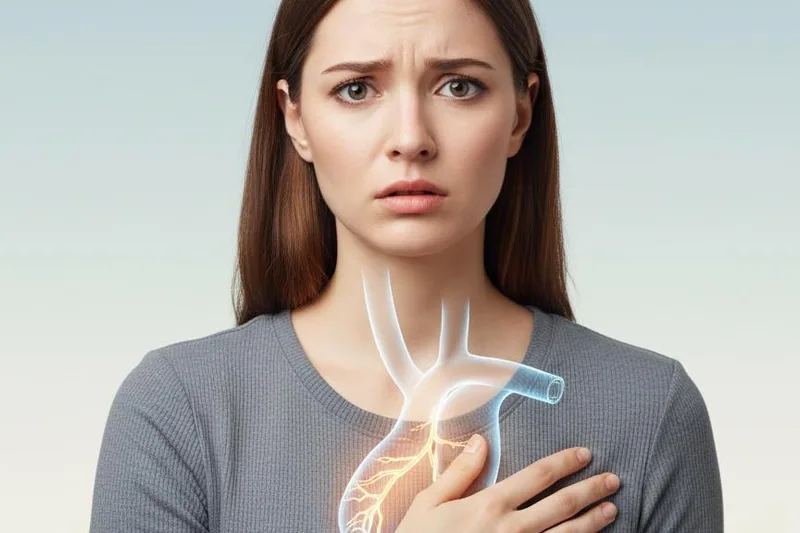
Your heart is the main pumping center for your entire body. So the main, largest blood vessel that comes out of the heart and carries oxygen-rich, clean blood throughout your body is called the aorta. Think of it like the main water pipe that supplies water to your house. Aortic Dissection is when the wall of this main blood vessel tears from the inside. This is a very dangerous, life-threatening emergency that often happens suddenly, without any prior warning.
What is Aortic Dissection? Let's understand it simply
Our aorta is a blood vessel made up of three layers. It's like a three-layered wall. If for some reason, a tear occurs in the innermost layer of this wall, the blood flowing under high pressure enters the tear and starts leaking between the two layers of the wall. As the blood fills in this way, the two layers separate from each other. That's what we call a dissection.
Think of it like a road bursting in two. When this happens, the normal flow of blood to different parts of the body is disrupted. And sometimes, this large artery can completely burst (rupture).
This is a medical emergency. If not diagnosed and treated quickly, it can lead to sudden death. Therefore, it is very important to be aware of this.
What are the main types of aortic dissection?
Doctors divide this condition into two main types, called the Stanford classification, which is based on where the tear occurs.
| Type | Description |
|---|---|
| Stanford Type A | This is the most common and most dangerous type. The tear occurs in the upper part of the aorta, closest to the heart (the ascending aorta). This can be immediately life-threatening, so emergency surgery is often needed. |
| Stanford Type B | The tear occurs in the descending aorta, a little further from the heart. This may not be as immediately dangerous as Type A. If the blood supply to the organs is not cut off, it may be managed with medication , without the need for emergency surgery. |
What are the symptoms of this? How to recognize it?
The main characteristic of aortic dissection is that it occurs suddenly . There are no warning signs. It can happen at any time, such as when you are sleeping, at rest, or doing heavy work.
These are the symptoms that can be seen in general:
- Sudden, unbearable, sharp pain in the chest or upper back. Many people describe it as a "ripping" or "stabbed" feeling. This is the main and most common symptom.
- Severe stomach pain.
- Difficulty breathing (Dyspnea).
- Dizziness or vertigo.
- Sudden drop in blood pressure (low blood pressure).
- A weak, rapid pulse.
- Excessive sweating.
- Confusion.
- Loss of vision.
- Symptoms of a stroke. For example, weakness on one side of the body or difficulty speaking.
If you experience severe chest pain or other symptoms like this, you should go to a hospital's Emergency Department (ETU) immediately, without delay . Do not assume that this is a heart attack. The treatments for these two conditions are different.
Why does this happen? What are the risk factors?
The main cause of an aortic dissection is the gradual weakening of the wall of the aorta over time. This weakening occurs in secret for years, and eventually tears at the weakest point.
The main and most common risk factor for this is uncontrolled high blood pressure (Hypertension) . High blood pressure damages the walls of blood vessels, making them less flexible and weaker.
Other risk factors are:
- Atherosclerosis or high cholesterol.
- Use of tobacco products (smoking).
- Aortic aneurysm.
- Diseases of the aortic valve of the heart.
- Congenital heart defects, for example, bicuspid aortic valve (two valves instead of the usual three).
- Connective tissue diseases, such as Marfan syndrome and Ehlers-Danlos syndrome . These are conditions that can be inherited.
- If someone in the family has previously had an aortic dissection.
- Severe injuries to the chest (e.g., a severe car accident).
- Being between 40 and 70 years old.
- High blood pressure during pregnancy.
- Use of drugs such as cocaine.
How does a doctor diagnose this?
When you go to the hospital, the doctor may suspect this condition based on your symptoms. However, because these symptoms are similar to a heart attack or stroke, several tests need to be done quickly to confirm it for sure.
- CT scan (Computed Tomography): This is the best and fastest way to clearly see the aorta in an emergency.
- Echocardiogram: This is an ultrasound test. A transesophageal echocardiogram (TEE) can show the aorta more clearly than a transthoracic echocardiogram.
- Chest X-ray: Can give a rough idea of whether the aorta is dilated.
- MRI (Magnetic Resonance Imaging): Although this can also produce very clear images, it is less often used in emergencies because it takes longer than a CT scan.
How is it treated?
The treatment method depends on the location of the tear (Type A or Type B) and the patient's condition.
Surgery and other treatments
1. Graft Replacement: This is an open-heart surgery. In this surgery, the surgeon removes the damaged part of the aorta and replaces it with a synthetic graft. This surgery is performed as an emergency treatment for Type A dissection.
2. Endovascular Stent-Graft Repair: This involves making a small incision in a blood vessel in the groin and using wires and catheters to thread a metal mesh tube (stent graft) into the weakened part of the aorta. This strengthens the weakened wall from within. This method is often used for complicated Type B dissection.
3. Hybrid Approach: In some complex cases, both open surgery and stent-graft methods may have to be used together.
Medicines (drugs)
Medications are mainly used before surgery, after surgery, and in Type B cases where surgery is not required.
- Medications such as beta-blockers can be given to lower heart rate and blood pressure. This reduces the pressure on the aorta and prevents the tear from spreading further.
- You have to take medication for the rest of your life to control your blood pressure.
Can this be prevented?
We cannot change some risk factors (e.g. hereditary diseases). However, there are some things we can control.
- Keep your blood pressure under control. If you have high blood pressure, take your medication exactly as your doctor prescribes, and reduce your salt intake.
- If you smoke, stop immediately.
- Maintain a healthy body weight.
- If anyone in your family (parents, siblings) has had this condition, talk to your doctor about it and get the necessary tests done.
- Wearing a seat belt can prevent chest injuries in a car accident.
Take-Home Message
- Aortic dissection is a tear in the main blood vessel leading from the heart. This is a very serious, life-threatening condition.
- If you experience sudden, unbearable, "ripping" pain in your chest or back , this could be the case. Go to a hospital's Emergency Department (ETU) without delay.
- The main risk factor for this is uncontrolled high blood pressure. So check your blood pressure regularly and keep it under control.
- Even after treatment, you need to remain under the supervision of a doctor for the rest of your life. Get regular tests (CT or MRI) and take the prescribed medication exactly as prescribed.
- Avoid strenuous exercise such as weight lifting. However, moderate exercise such as walking and cycling is fine. Ask your doctor for advice on this.




💬 Comments (0)
No comments yet. Be the first to share your thoughts here.
Add Your Comment