
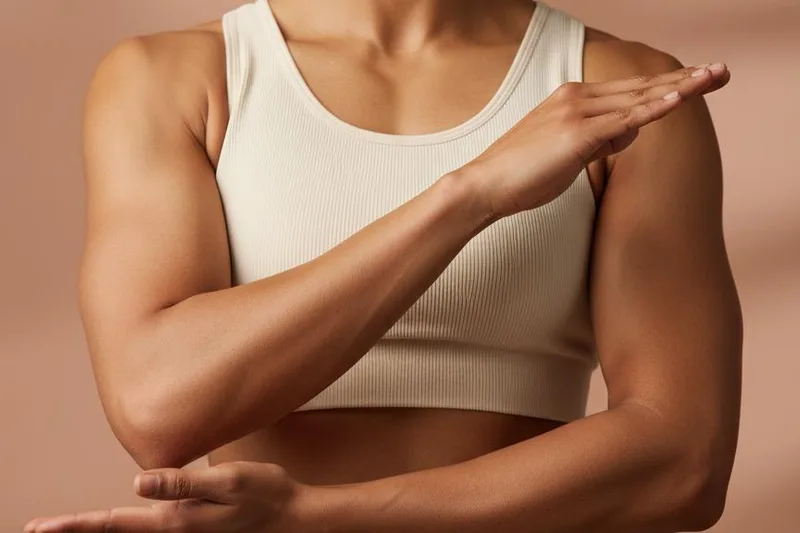
Have you ever thought about how many things we use our hands for in a day? From getting up in the morning and brushing our teeth, to writing, lifting weights, driving a car, eating, and holding a small baby, we cannot do without these two hands. All these movements, from the smallest task like pressing a button to the largest task like lifting a gas cylinder, are helped by the muscular system in our hands. So today, let's talk about these muscles.
What actually happens to the muscles in the hand?
Simply put, the muscles in the hand are what help us move our arms, hands, and fingers. These can be divided into two main parts.
1. Fine Motor Movements: Imagine threading a needle, buttoning a shirt, or writing neatly. These are very fine, controlled tasks that require the small muscles in your hands to help you.
2. Gross Motor Movements: The large, strong muscles in your hands help with large, forceful tasks like throwing a ball, lifting a weight, doing push-ups, and raising your arms up when you play cricket.
These muscles are attached to the bones of the hand by strong tissues called tendons . When you flex a muscle, these tendons stretch and move the bone.
How are the muscles in the hand located?
Our arms, from the shoulder to the wrist, have more than twenty muscles. These are located in two main parts: the Upper Arm , which is the part between the shoulder and the elbow, and the Forearm , which is the part between the elbow and the wrist.
Major muscles of the upper arm
There are four main muscles in your upper arm. The biceps and triceps that we all know are located here.
| Muscle | Location and function |
|---|---|
| Biceps brachii | This is the main muscle on the upper arm, close to the skin. When you bend your arm (for example, when you bring your arm to your ear), this muscle contracts. It also helps you turn your arm upward. |
| Brachialis | This is located deep under the biceps muscle. This is the main muscle that helps you bend your arm at the elbow. |
| Coracobrachialis | This is also a muscle located underneath the biceps. It is attached to the shoulder bone and helps bring the arm closer to the side of the body. |
| Triceps brachii | This is located on the back of the arm, above the elbow. This muscle does the opposite of what the biceps does, which is to help straighten the arm at the elbow. |
Muscles in the forearm
There are many muscles in the area from the elbow to the wrist. These are what control the fine movements of the wrist, hand, and fingers. They are located in two layers: superficial and deep.
Superficial Forearm Muscles
We can sometimes see these because they are almost under the skin.
- Underside: The muscles on this side (such as `Flexor carpi ulnaris`, `Palmaris longus`, `Flexor carpi radialis`) mainly flex the wrist and fingers .
- Back (Top): The muscles on this side (such as `Extensor carpi radialis`, `Extensor digitorum communis`) mainly extend the wrist and fingers .
Deep Forearm Muscles
These are located beneath the superficial muscles.
- Underside: The muscles on this side (such as `Flexor digitorum profundus`, `Flexor pollicis longus`) specifically help to bend the fingertips and thumb.
- Back (Top): The muscles on this side (such as the `Supinator` and `Extensor pollicis longus`) perform specific functions, such as turning the hand up and down, and extending the big toe.
What are the common problems with the muscles of the hand?
Because we use them so often, there is a high risk of injury to the muscles of the hands.
Muscle Strain: This is what we commonly call a "muscle strain." This is when the muscle fibers are pulled or torn too much. This condition can occur if you lift too much weight at once, exercise incorrectly, or overuse the same movement.
Rhabdomyolysis: This is a serious, but very rare, condition. Excessive exercise or exertion causes muscle fibers to break down and release harmful substances into the bloodstream. This can be life-threatening.
What are the symptoms of this type of problem?
If you have a problem with a muscle in your hand, you may experience symptoms like these:
- Muscle pain, stiffness, and stiffness: The pain can be a sudden, sharp pain, or it can be a dull ache that gradually increases.
- Muscle weakness: You may feel like your arm is losing strength. You may not be able to move your arm properly.
- Spasms or Cramps.
- A bruise or tenderness at the site of the injury.
A doctor can usually diagnose a muscle sprain by examining you. Sometimes, they may recommend an ultrasound or MRI scan to see the severity of the injury.
What are the treatments for muscle injuries in the hand?
Treatment depends on the nature and severity of the injury. Your doctor may recommend one or more of these.
| Treatment method | Description |
|---|---|
| RICE method | This is very effective for minor injuries. R - Rest, I - Ice, C - Compression, E - Elevation. |
| Medications | Your doctor may prescribe painkillers, especially nonsteroidal anti-inflammatory drugs (NSAIDs), to reduce pain and swelling. |
| Physical Therapy (PT) | Physical therapy exercises are very important to strengthen muscles and restore movement in the hand after an accident. |
| Stretching | Gentle stretches can be done to reduce pain and stiffness, but these should only be started under the guidance of a doctor. |
| Surgery | In severe cases, such as when the muscle is completely torn, surgery may be necessary. |
How do we keep our arm muscles healthy?
"Precaution is better than cure," they say. So prevention is the best way to prevent an accident before it happens.
- Warm-up before exercise: Before any exercise or heavy work, be sure to warm-up for about 5-10 minutes. Warm muscles are less susceptible to injury.
- Increase intensity gradually: Don't lift heavy weights all at once or exercise for too long. Increase intensity gradually.
- Listen to your body: If you feel pain, stop doing it. The saying "No pain, no gain" is not always true. Pain is your body's warning.
- Lift weights correctly: When lifting weights, use the strength of your legs and back, not just your arm muscles.
When to see a doctor
It's a good idea to see a doctor if a common muscle ache doesn't subside in two or three days. However , if you have the following symptoms, you should definitely seek medical advice immediately.
- If you experience numbness or loss of sensation in your hand.
- If you feel severe weakness in your hand (for example, if you can't even lift a cup).
- If there is swelling in the hand.
- If your urine has turned dark (dark brown or red) (this may be a sign of rhabdomyolysis).
At a time like this, it is best to go to the Emergency Treatment Unit (ETU) of the nearest hospital.
Take-Home Message
- The muscles in our hands are what help us with everything from delicate tasks to heavy lifting.
- Warming up before exercising or doing heavy lifting is very important to protect your arm muscles from injury.
- The RICE method (rest, ice, compression, elevation) can be helpful for minor muscle strains. But if the pain doesn't subside in a few days, see a doctor.
- If you have severe pain in your arm, swelling, numbness, severe weakness, or a change in the color of your urine, it could be a serious condition. So see a doctor immediately.


💬 Comments (0)
No comments yet. Be the first to share your thoughts here.
Add Your Comment